We’ve been thinking a lot about optimistic, cozy or otherwise nice SFF recently, so we’d love to hear your thoughts about this category of genre fiction (whether written, visual, or in any other medium); give us your favorite examples of happy SFF, spoopy horror, even gritty utopian thinking, or tell us about why you think these kinds of fiction work or are needed (or otherwise). To start us off, a few editors, authors and other friends of TFF give us their examples.
M.L. Clark
 Some stories carry great wisdom in their simplicity, and it can take a lifetime to realize the strength of their gentleness. I've returned to My Neighbor Totoro at many phases of life, each time with a deeper sense of comfort and astonishment. It's not just that the story illustrates that one need not have antagonists to develop emotional weight: that realization comes with early viewings. Later, though, one watches the film and notices everything not included in this postwar Japan snapshot of a childhood impacted by a sick mother and soothed by animist wonder. One considers what the director lived through, and the antagonism he saw shape and shatter lives, before choosing to lean into the inner life of deeply feeling human beings. One remembers, too, the Cold War world into which this film was released in 1988, and the fact that Studio Ghibli launched another film the very same day, about a boy and his little sister dying in war-torn Japan. The world is often a difficult place in which to retain a sense of wonder, and hope. But still, even in difficult times, we manage to create oases of uplift in our art. My Neighbor Totoro reminds us that we contain multitudes--and that the gentle and kind in them are very much worth protecting.
Cécile Matthey
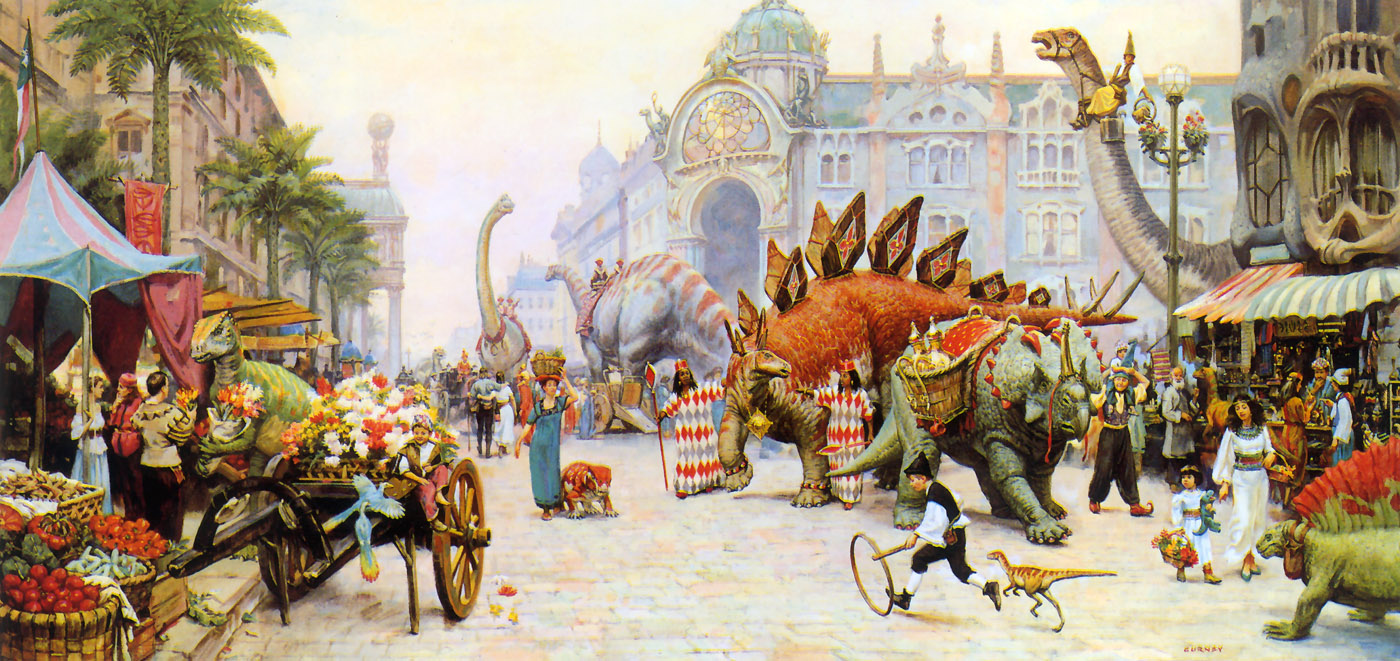 |
| Image © James Gurney via Dinotopia wiki |
In 1860, biologist Arthur Denison and his young son Will set out on a Darwinian voyage of exploration in search of unknown lands. But during the voyage, their ship is caught in a storm and sinks. With the help of dolphins, they are transported to the lost island of Dinotopia: a land where humans and dinosaurs live together in perfect harmony.
James Gurney’s 1992 novel recounts, in the form of a richly illustrated travelogue, Professor Denison's discoveries as he explores this incredible and exciting new world. As a trained professional, he records his experiences in meticulous details: the flora and fauna, the often spectacular architecture of the cities, the daily life (celebrations, sports, art, food…), the history of the island, the peculiar alphabet… With him, we meet dinosaurs tending human children, working as translators, craftsmen or timekeepers, and we even fly on a Quetzalcoatlus’s back.
To me it’s a great feelgood piece: it is full of wonder, freshness and humour, reminding me of the stories by Jules Verne (and of my childhood love for dinosaurs!). What's more, James Gurney’s realistic and detailed illustrations are a real treat for the eyes. It is an optimistic and hopeful piece too, because it shows a peaceful, culturally advanced and well-organised world, where two radically different species manage not only to live together peacefully, but to work together while learning from each other. In short, « Dinotopia » is a must !
 Toby MacNutt
When I want to be wrapped up in a cozy read I reach for Erin Morgenstern's The Starless Sea. Its layers of symbols, books, and myths weave around the romance and adventure (can a cozy book have a sword, a gun, some poison, a bit of light arson? sure!) like the most exquisite blanket. Its improbable spaces are softly lit, time-worn, rich with color and texture and scent. Everything is warm, dreamy, golden—and every complex thread ties up just right in the end. The lost are found, the key meets the door, the left-behind are reunited. Also—of course—there's queers!
Djibril al-Ayad
 I’ve long felt that a utopian setting need not be perfect in every way, lacking in conflict and adventure—any more than a dystopia is a completely unlivable hellscape with no redeeming features—it only need show by example one or a few ways in which our own world could be better with a bit less cruelty, greed, bigotry or self-destruction. Just so is Vonda N. McIntyre’s Starfarers tetralogy: famously invented as a hoax response to a boring panel about SF TV shows, then written by popular demand, this glorious space opera show features not a military starship but a literal university campus in space (faculty and staff rather than crew, a principal rather than a captain, decisions made by senate rather than a command structure); multiple queer, polyamorous, accepting relationships; multi-generational or inter-species friendships; posthumanism and eco-engineering; a space artist making fake archaeology; wonderfully alien aliens; and a science fiction writer as alien first-contact specialist. And while the world isn’t perfect (the principal is even more of a politicking bureaucrat than any vice chancellor I’ve worked under), conflict and peril abound, not all of the positive characters—even protagonists—are entirely likeable, they’re wonderful books, full of comforting adventures, and I could happily read a dozen more volumes. And really: why has no one made the TV show yet!
Please share your examples of hopeful or cozy SFF, whether utopian, optimistic or just comfort reading, in the comments below. Or feel free to ping us on Mastodon or Bluesky to join the conversation there instead.


![[ Issue 2024.69; Cover art © 2024 L.E. Badillo ]](http://futurefire.net/images/f69cover.jpg "[ Issue 2024.69; Cover art © 2024 L.E. Badillo ]") Issue 2024.69
Issue 2024.69