Showing posts with label vampires. Show all posts

Saturday, 31 July 2021

Interview with Alexandra Seidel / Alexa Piper

We’re very happy to welcome to the TFF Press blog author Alexandra Seidel, whose “The City, My Love” we published in TFF#57 earlier this year, and who also writes steamy, speculative romance as Alexa Piper. She joins us to answer a few questions about her work, and also share some snippets from her recent publications.


Alexa Piper writes steamy romance that ranges from light to dark, from straight to queer. She’s also a coffee addict. She loves writing series, and her Fairview Chronicles follow a ragtag gang of supernaturals who try to make their city safer. Mostly. Her second series, Dusk & Dawn, explores banter and the trappings of a world in which Vampires, Werewolves, and the Fae live alongside humans. Elvenswood Tales is a new series that expands the Fairview universe.

The Future Fire: Your story “The City, My Love” is both a love story from a city and a love letter to historical urbanism all in one. Is there a city in your life that you immediately felt a special connection to?

Alexandra Seidel: Oh, there are a lot of cities I adore! I’m lucky enough to live in a place where it’s easy to travel to some of the bigger ones in Europe, although the list of cities I still want to see is long. The city I may have visited the most is Prague, and it’s a strong inspiration for New Elvenswood, where one of the series I write as Alexa Piper is set. But perhaps the city that really charmed me with its difficult to love character is Beijing. To me, as a Westerner, it’s a place of contradiction, a reflection of the people and politics around it. Maybe because of that, its character is so strong and memorable. And yes, it made it into one of my books as well.

TFF: Cities can sometimes make people feel swallowed and invisible. Is there a piece of urban cultural heritage that you like, and that reminds inhabitants how they are part of the place’s history?

AS: Personally, I love architecture. Don’t get me wrong, I don’t know much about it, but buildings that have been there for a few hundred years and show it just have something about them that always draws my eye. It’s no wonder that the city in “The City, My Love” feels like it does about its buildings. In terms of connecting the people with their city, there is a so-called Schuttberg or rubble mountain in Munich, which is where the rubble, left behind by the bombs of WWII, was collected. It’s now part of a park, it’s green and from the looks of it, you wouldn’t know how many individual tragedies are connected to it. It certainly is a way to maintain a connection with the past for the inhabitants.

TFF: In The Hunting Mates you explore an unlikely genre crossing, between romance and noir. How did you manage to harmonise the feeling of bleakness that fills noir stories with the cozy promise of a HEA?

AS: That’s an interesting thought. See, it never occurred to me that you need to harmonize anything here. A HEA (happily ever after, for all those who are less familiar with the romance lingo) offers the promise of a happy relationship after the book is done. I feel like a strong, healthy relationship can thrive even if the outside circumstances are dire, even if characters have a dark past or demons that haunt them (which I don’t mean literally, but sure, I can see myself write someone literally being haunted by a demon. Let me know if you think that would be a good idea!) The one is the outside world, the other is the relationship between characters. Maybe it’s because I don’t think the former can ruin the latter that the romance works out as it does, even gets stronger as two characters go through life together.

TFF: Speculative erotica is a tricky genre, since to meet its potential the sexuality needs to be science-fictional, fantastic, or surreal, not just the background. How would you balance inventive erotic pairings or scenarios with relatable romantic or sexy scenes?

AS: Let me quickly clear up that erotica and romance are not the same thing, and what I write as Alexa Piper is steamy romance.

I’m not exactly sure how to answer this question! I mean, as far as logistics are concerned, we have the basic male and the basic female configuration to work with. Yes, Loved by a Kraken offers additional appendages, but that’s why it’s fun. And yes, I sometimes have multiple pairings (two sexy guys and one sexy gal in Bonfire Bright, the latest in the Elvenswood Tales series,) and the line editor mentioned she was tempted to break out dolls to follow the blocking, but for the most part, I’m not reinventing the wheel there. One thing I use to strengthen a character’s viewpoint is how they see the world; my snake demons are sensitive to temperature, my siren understands the world around him by sound as much as sight, and the kraken demon mentioned earlier gets a lot of sensory input from his suckers.

TFF: Your Fairview Chronicles series combines fantasy, crime and comedy. There is a famous saying: “It’s easy to make people cry, it’s making them laugh that is difficult.” Would you agree?

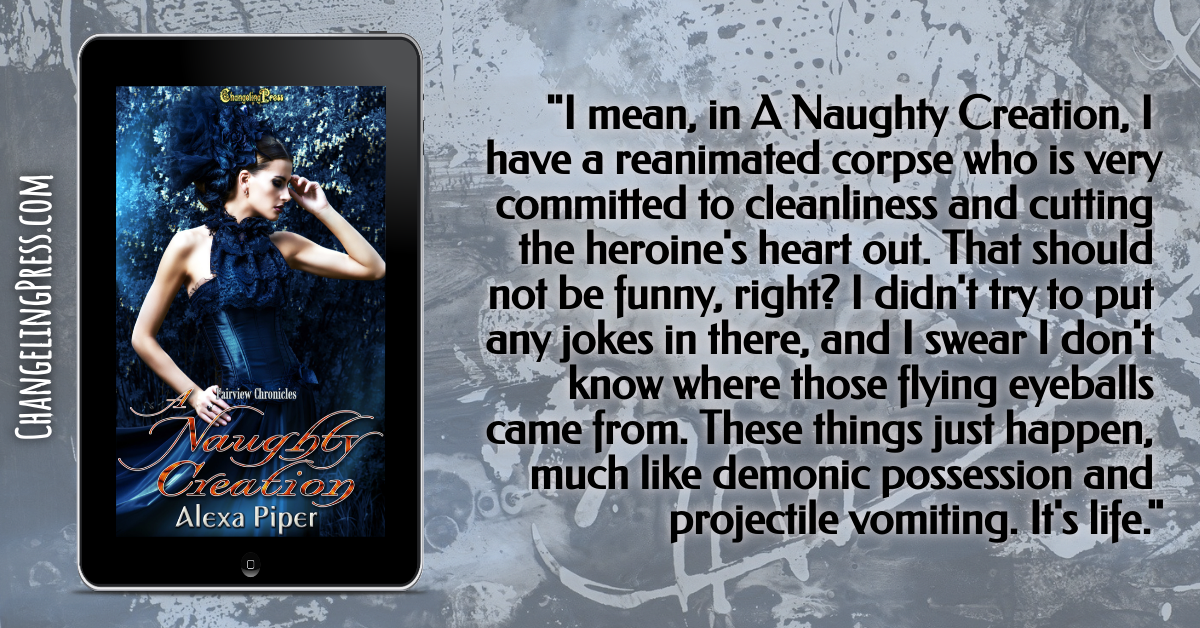
AS: I’m going to say yes. And I’m going to tell you a secret. I don’t really try to make anyone laugh. I mean, have you been keeping track of the body count in my books? I’m worse than Shakespeare trying to write a teenage love story when it comes to the body count, I assure you. It’s the voice of the characters and the kind of narrative that makes the humor happen (I once wrote a joke into a book and I didn’t even notice I did that until a proofer pointed it out.) I mean, in A Naughty Creation, I have a reanimated corpse who is very committed to cleanliness and cutting the heroine’s heart out. That should not be funny, right? I didn’t try to put any jokes in there, and I swear I don’t know where those flying eyeballs came from. These things just happen, much like demonic possession and projectile vomiting. It’s life.
TFF: Speculative fiction is often seen as a convenient medium for discussion of social justice issues, because it purports not to be about the real world (while of course it is). Is this something that works for you? Are there other stories about the real world that SF allows you to tell?

AS: I think fiction is an outlet that allows any kind of story to be told. That being said, I’d like to point out that writers don’t always try to do that. I don’t set out with an agenda in my head, and I don’t aim to write manifestos. Yet, our personal experiences will inform the way we think about any given situation, real or imagined. In my case, that is not always conscious or intentional, but I can certainly see it in my own work once I’m done writing.

TFF: How do you go about attributing personalities to inanimate objects or places? Are you led by their material qualities and physical details, or by the overall narrative?

AS: This question really wants to be answered with an easy to follow, step-by-step process. Except I don’t have that. For “City,” it just happened. I sat down, and the story wanted to be told like this, in that particular voice. I have a scene in Arrow Struck that is told by flowers in a garden (it’s a fight scene,) and that just happened without me planning it like that. Stories, like cities, are things that grow, and not always like you expect them to.


Thanks for joining us, Alexa! And good luck with the latest novels.

Friday, 12 August 2016

Artist Feature: Christina Cartwright

TFF wouldn’t have been able to run for the last eleven years without the input of our heroic, generous and talented team of artists, who illustrate every story we publish with work that is every bit as creative and important as the stories and poems themselves. One of the artists who has worked with us for the longest is Christina Cartwright, book cover illustrator at Digitell Design, who first joined us in 2006 with an illustration for “Deadline,” and followed up with the Dali-esque surreal cover art for issue #11. If you’ve been following TFF for any length of time at all, you’ve certainly come across some of her detailed, dramatic, digital illustrations. We asked Christina to tell us a bit about her illustrating and artistic work elsewhere, and she has prepared the following showcase for us—if you like what you see, she can also be commissioned for custom cover design in many different styles, including children’s illustration. Over to you, Chris!

Christina Cartwright has a degree in visual communications and has been creating book covers, story illustrations and posters since 2003. She has also created images for games and various other projects. Chris lives in south west Indiana with her husband Tom and 3 cats Buffy, Piper and Gypsy.

Anyone who knows me knows I adore vampires. It is my favorite genre of the horror industry. And in the fantasy genre, dragons is my subject of choice. There was a time several years back, I dreamed of a story of a woman who was part vampire and part dragon. I started to write this story, but I am no writer. So, I looked up a fellow I created a few covers for and asked him if he would be interested in writing about my dragon/vampire lady and he agreed. I created the cover for it and it was titled Dragon Blood. (Zoom for larger image.)


As a small child, I can barely remember the imaginary friend I had. I guess a lot of kids have imaginary friends. I wish I could remember more about mine, but I do remember her name was Kathy. This story, The Adventures of Adam and the Incredibly Mysterious Zorkins, by Ronnie Glazer, is about a boy who discovers some very small beings who are not imaginary. It is a really cute story and I had a lot of fun illustrating it!


I created a series of three covers for a man and wife team of writers. J.K. Barber (Jay and Katie) is what they call themselves. I created their logo for them too. I worked directly with Katie. She was tough one to please, but we had a great time working together and she pushed me to do the best I could do. I learned a lot working for her! This is the cover for the second volume in their trilogy, Icebound.


I work on children’s books the most. I really enjoy the stories that people come up with, I have a lot of fun with them. With kid’s stories, anything goes! Sometimes work gets slow, so at one point I wanted to learn how to format the interior of a book. I decided to write a small children’s book and of course illustrate it too. As I said before, I am no writer, but I gave it my best shot. I wanted the experience. So I created Gina Gets Glasses. It didn’t turn out too bad and I may do another story about Gina.


Another genre I enjoy is Sci Fi. Another great way to let the imagination run wild! This cover below is for the story Libertas and Thunderbolt. It is a story about a male and female who are the creators of humans and the Earth. It is a really cool story!


And that leads us to The Future Fire. One of the very first magazines to be kind enough to allow me to illustrate some of their stories. And I even created a couple of covers for them! I will always be thankful to Djibril and his magazine crew! Here you can see one of the covers and illustrations I created for TFF, based on the story Soul Catcher by Christel Bodenbender.


For myself, I enjoy all types of stories and art, anywhere from horror to children’s books and inbetween. I create either cartoon-like or the realistic style images… anything you can dream up! If you are looking for a cover artist or a story illustrator or both, look me up!

You can find my website/portfolio at: digitelldesign.com and you can email me at: chris@digitelldesign.com.

Thank you for reading!

Monday, 2 May 2016

Interview with Vladimira Becić #FaeVisions

Fae Visions of the Mediterranean is a new anthology featuring twenty-four stories and poems of horror and wonder of the sea. Among these stories is Vladimira Becić’s “Kod Kose i Sata”—translated as “The Scythe and the Hourglass” and published in both Croatian and English versions—an oneiric, mythical allegory of writing challenges and haunted houses. We asked Vladimira a few questions about her work.

After a career as a military psychologist, Vladimira Becić started writing on a bet (which she lost). Her published works include a YA vampire novel Orsia and a number of short stories, mostly in the fantasy genre. This is her first English publication.

TFF: “Kod Kose i Sata” reads like a Borgesian take on a dark folktale—postmodern allegory meets atavistic beliefs. What did the story mean for you?
Vladimira Becić: I thought it would be interesting to put together a real place surrounded by stories of being haunted with a non-existing, actually haunted place as is the case with “The Scythe and the Hourglass”.

What sort of a connection do you feel with the Mediterranean Sea itself?
As someone who grew up on the seaside, I am firmly in the camp of those who say, sea is beautiful, land is reliable.

If you could meet the Talason of your house, what would you ask her/him?
I would ask what the moment of transition from a human soul to a house-protecting soul looks like.

Would you dare be a guest at "The Scythe and the Hourglass"?
On good days, when writing is easy, I wouldn't hesitate for a second. Otherwise, I'd have to think twice.

Are the vampires in your novel Orsia dusty castle-dwelling predators, super cool red-eyed assassins, or sparkly-skinned, sulky teens?
Orsian vampires live in a subterranean, not in the least dusty city under Zagreb, and they are more entrepreneurs and businessmen than assassins. Their teenagers are insufferable, though, like all teenagers are—especially when they come up with plans that turn the whole of Orsia upside-down.

What is your favourite (real or literary) sea creature and why?
Octopus. Because they are smart and they look totally cool and unreal, like fairy-tale characters.

What is under your bed?
Ghouls that are yet to get their place in the attic.

Where else can fans of your work find stories of yours to read? Anything in the pipeline?
Most of my previously published stories and articles can be found at vladimira-becic.com. I am currently working on several projects, most of which connect my current main interests: psychology, writing, languages and music.

Thank you, Vladimira!

Vladimira Becić’s “The Scythe and the Hourglass” can be found in Fae Visions of the Mediterranean.

Thursday, 22 September 2011

V is for Vampires

Vampires: possibly one of the most well-known and well-rehearsed narrative metaphors. Constantly reboot-able, vampires are high-profile candidates as tools of speculative fiction. Speculative writing, as the creator of this alphabetical series tells us, “can cast light on our own world […] it should show us how we need to improve [it].” Originally vampires were the monster in the dark; ‘Them’. They stood for everything nasty and undesirable, infectious and unspeakable and not ‘Us.’ Modern re-readings of older narratives have attributed this more specifically to colonialism, fear of the exotic, bigotry and sexism. As a palliative to the monster, there would be a thread of obvious or implied morality: the pure and sinless characters or repudiation of temptation.

Modern vampires are concerned with modern preoccupations of deviancy. Having been allowed right into the human circle, forming relationships with the human world, they stand for the ‘monster within.’ The part of human psyche most especially represented has been the ‘monster’ of fleshy delights and darkness, proving that they remain a figure for moral diatribes. But now the message is that we cannot blame an external, demonic force for evil, but must look to ourselves and what we are capable of.

The mainstreaming of vampires into romances and adventures has seen them become somewhat domesticated into objects of human sexuality; symbolic of desirability precisely because they are not ‘Us’. Instead of being abhorred, we are invited to identify and desire these creatures, to be titillated by their ‘wickedness’. Modern ‘dark romances,’ repeating the same formula over and over are effectively whoring out that ‘allowed’ naughtiness; stretching the Mr Rochester I shouldn’t-but-he’s-gorgeous myth to breaking point. At the same time, though, this rubbishes the isolating power of the Other the vampire once had. This being the one motivating power for the vampire metaphor, enabling discussion through the presentation of the vampire’s among us/ not us figure.

Are vampires still ‘speculative’? Perhaps it is worth asking, were they ever speculative? If truly speculative writing is all about holding a slightly differential mirror up to the now, to facilitate discussion of current social issues, then can vampires fulfil this function?

Vampires are an interesting sideline. They are a part of the wider monstrous genre, becoming extremely popular in their own right to the point of becoming a high-profile genre of their own. The monster stands for whatever we want it to against whom heroes rise and fight. Speculatively, this is not so much a debate or dialectic on what the monster may stand for but it is a dramatically presented purgative action where evil can be ritually expunged.

For example, the fleshier, nastier bodily horror of zombies and werewolves are seeing a new rise in popularity. Social theorists could attribute this to the current political gestalt being one based on bodily horror: the horror of perceived threat against the body politic and the body public by explosive, poisonous, it-is-among-us terrorism.

The suavity and humanity of the vampire’s presentation means he has become a monster very much of ‘Us’, rather than the repugnance of ‘Them’. This is where the vampire could become more powerfully speculative. Modern society has turned inward, seeking answers for horrific actions from the ‘monster within;’ precisely where the vampire metaphor now resides. The desire to rationalise means that the vampire is now in a position to be wide open to use as discursive tool: a seeming-human monster upon whom such narratives could be layered. There are some vampire stories out there that achieve this, keeping the validity of narrative vampirism alive. It will struggle, however, as these are a relatively few narratives fighting against the disproportionately oversized stream of current fashion in vampirism. This is the mainstream and the mass expropriation of vampire figures as objects of spectacle, comprising shows of sexuality and wham-bam-thank-you-ma’am action. This is the vampire as its own genre; no longer open to standing back and commenting on the action, the vampire, in becoming the action, has had their rhetorical fangs drawn.

Vampires stand on a balance of the intellectual and the fleshy; the innovative and the hormonal. Both have their merits for entertainment and enlightenment, and between them the vampire metaphor still just about dances the metaphorical jig that shakes off a definitive description. He remains something of a speculative free-lancer, available for consultation but not restricted to one employ.