Saturday, 7 May 2016

Sicily: Culture and Conquest #FaeVisions

Guest post by Kelda Crich

Sicily: Culture and Conquest: Multiculturalism a Thousand Years Ago
An exhibition review.

I love looking at old stuff; if it's beautiful and priceless old stuff, so much the better. Manufactured objects; the mundane and the extraordinary are slivers of culture, of history. They contain stories: real and imagined. Museum objects often inspire my writing.1 My poem in Fae Visions of the Mediterranean took inspiration from the Assyrian sculpture in the British Museum. So it seemed a happy coincidence when Fae's launch coincided with a new exhibition at the British Museum: Sicily: Culture and Conquest,2 3 examining Sicily, the Mediterranean's largest island.

With its fertile soil enriched by volcanic ash, and a strategic position in the heart of the Med, Sicily has been subject to centuries of colonisation, wave after wave of invaders. The exhibition ranges from prehistory to the medieval period, but focuses on two golden ages, the rule of the Greek Tyrants (7th Century onwards) and the rule of the Normans (12th Century onwards). Dirk Booms, the co-curator points out that both these ages occurred when the invading Kings lived on the island.4 Sicily fared less well ruled at a distance.

In the mid-11 century, at a time when the sons of Vikings were invading England, they were also turning an envious eye to Muslim ruled Sicily. A thirty years campaign finally ushered in a golden age of enlightenment where philosophers, artists and scientists from many races were invited to court. It's interesting to see the Normans portrayed as progressive rulers, rather than the vilified conquerors of popular British history. This exhibition invites the visitor to rethink Britain’s own history and heritage.

San Cataldo, Palermo, Exterior view from the side
The exhibition presents Norman Sicily as a society of multicultural harmony. It celebrates the blending of Muslim, Byzantine and Christian cultures and religious tolerance.


A remarkable Arab/Norman-style architecture emerged.
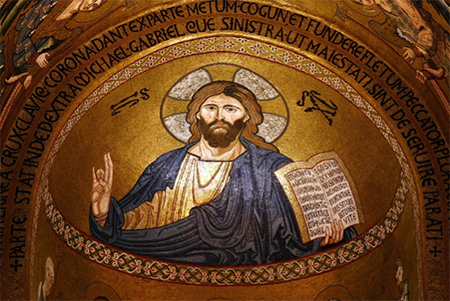


Christ Pantokrator in the apse of the Cathedral of Cefalù, Sicily.
Mosaic in Byzantine style.
Churches such as The Capella Palatina at Palermo were built with Norman Doors, Sarcenic arches. The Byzantine domes were decorated with Arabic script and Byzantine-style mosaics.


Roger II of Sicily depicted on the
muqarnas ceiling in an Arabic style.
The sons of Vikings presented themselves in the style of Muslim rulers.

The blending of cultures is quite remarkable and is testimony to the catholic Normans' embrace (or should I say appropriation?) of other cultures. One reviewer even suggests that as the Mediterranean is once again a crossing point of peoples, lessons could be learnt from the integration apparently shown in Norman Sicily.5

Yet, museum exhibitions are stories which invite a visitor to enter only one narrative dream of the past. While the very nature and limitation of space, an exhibit narrative demands simplicity, an appeal to aesthetic sensibilities rather than the presentation of the complex, myriad storied past. I can't help thinking that multicultural, harmonious Sicily is too good to be true. I would have liked the exhibit to present objects examining the culture clash that must have existed.

Still, it was thrilling to look at the beautiful stuff. The exhibition also presents well-chosen items examining the other cultures who have invaded Sicily over the centuries. There were over two hundred objects on display, many for the first time in the first time in the UK.

The exhibition is supplemented (as is common in British Museum temporary exhibits) by evocative photographic landscape and architectural vistas, and interesting written quotes displayed on the walls. I was less keen on the photographs of objects and the replicas on display. When I visit a museum, I like to see the real deal.

It's an interesting exhibition, with much finely chosen and exquisite stuff, but no one piece caught my attention particularly. There was, perhaps, an over-reliance on photographs of objects, which is not to my taste. Still, it made me reconsider the history of a conquest I had been taught as a girl. I left wanting to know more about the sons of Vikings and the people they crossed the Mediterranean to conquer nearly a thousand years ago.


1 Confessions of a Museum Bunny. Deborah Walker. SFWA Blog. 2012
2 Sicily: Culture and Conquest At the British Museum, London, 21 April to 14 August 2016.
3 Sicily: Culture and Conquest. Dirk Booms and Peter Higgs. The British Museum Press. 2016
4 Sicily the Superpower: British Museum Revisits Island's Golden Ages. The Guardian Blog 2016
5 Sicily: Culture and Conquest Review – Gods, Monsters and Multiculturalism The Guardian Blog 2016


Kelda Crich's poem “Regretful in the City of Promises” can be found in Fae Visions of the Mediterranean.

Thursday, 5 May 2016

Light and Passion #FaeVisions

Guest post by Maria Grech Ganado

Għanja Bla Flus / A Free Song

Towards the Light, © Ġoxwa Borg, reproduced with permission
The migration issue was a distressful problem for the Mediterranean long before it became a world-wide one. Ġoxwa Borg, a Maltese artist living in Paris, captures in this painting, Towards The Light, a familiar scene which has provoked emotions in Malta beyond those of compassion for the suffering and the drowned. Controversies caused by the inability of such a small island to cope with the incessant boatloads arriving from Africa has provoked extreme xenophobia in many, and a sense of impotence in the sensitive caring. My poem seeks to address the latter with an imaginary picture of what could have been, in the long run, preferable to an escape from drowning—worse is the horror of finishing up in Malta’s Safi detention centre for immigrants. Here, overcrowded, unhygienic conditions are far from ideal, and violence can break out to further pollute these conditions’ not only between the guards and frustrated, exhausted, disillusioned, disorientated, unhappy, desperate survivors, but also among themselves. ‘Towards the Light’ indeed!

Il-Passjoni Ta’ San Ġorġ / The Passion of St George

Mattia Preti, St. George Victorious (1678)
What I call ‘the passion of St George’ is, of course, ironically meant to deride the chauvinistic attitude of the knight in the legend. His intention in saving the helpless damsel is to prove his courage and strength, and she is cast in an image of the chaste, modest, grateful woman Religion would have her be. In Catholic Malta, where every location celebrates its patron saint with boisterous pomp and gusto, St George presides over two big towns, one on the main island and another in Gozo. Mattia Preti’s commissioned paintings of the saint are more concerned with his valour vis-a-vis the dragon, and not at all with the poor damsel (another macho trait). It is the martyrdom of St. George the feasts are meant to commemorate. I have set things to rights in the poem by having the fiery woman preferring the advances of the passionate dragon.

Maria Grech Ganado’s poems “A Free Song” and “The Passion of St George” can both be found in Fae Visions of the Mediterranean.

Wednesday, 4 May 2016

Interview with Claude Lalumière #FaeVisions

This month sees the release of Fae Visions of the Mediterranean, the latest Futurefire.net Publishing anthology, featuring 24 stories and poems of horrors and wonders of the sea. Two of these stories are by Claude Lalumière, one a modern and playful mythography, the other dark, alien, inhuman love story. We asked Claude a few questions about his work.

Claude Lalumière (claudepages.info) is the author of Objects of Worship, The Door to Lost Pages, Nocturnes and Other Nocturnes, and (forthcoming in 2017) Venera Dreams. He has edited fifteen anthologies in various genres, including Super Stories of Heroes & Villains. Originally from Montreal, he's currently headquartered in British Columbia.

TFF: ”The Dance of the Hippacotora”/“El baile de la Hipacotora” is an irreverent and absurdist retelling of ancient myth in an Iberian setting. What does the story mean to you?
Claude Lalumière: For a time, I was writing an online serial of fake mythology called Lost Myths. A few of those texts wound up in my collection Nocturnes and Other Nocturnes, but the bulk of them, including "The Dance of the Hippacotora," is destined for what I hope will be my fifth book, whose current working title is Cryptomythologies.

The two main elements that fed into the creation of this particular Lost Myth are my lifelong passion for Greek legend and my love of Barcelona, whose vibrant La Rambla and its delightfully strange and playful living statues found their way into the story.

"The Dance of the Hippacotora" is not a retelling of myth but rather an exploration of a different type of narrative than contemporary fiction. It's an attempt at writing myth rather than fiction, which flexes different writing muscles entirely.

“Xandra's Brine” is a very different story, full of quiet menace and unsettling sensuality, tracking the shores of the Mediterranean before plunging triumphantly into the icy depths. Where did this story come from?
Venice (photograph © Claude Lalumière)
The details of the Nice sequences are culled from a brief stay there back in 2006. The setting of Venera is largely inspired by Venice (with hints of Rome and Barcelona)—I first conceived of Venera while on the vaporetto in Venice. Over the past decade, I gradually aggregated Venera stories until I had a full book of them: Venera Dreams, which is coming out in 2017.

Do you feel a connection with the Mediterranean Sea?
Ever since my first childhood encounter with the Atlantic Ocean—by far, my fondest childhood memory—I have been obsessed with the sights, sounds, and smells of saltwater. When I finally made it to Europe in 2006, there was no question that I would prioritize the Mediterranean. It never occurred to me not to. So my trip was mostly taken up by the Mediterranean Sea: Bari, crossing the Adriatic by boat (twice—from Italy to Greece and back again), Athens, Venice, Nice, and Barcelona. On that trip, I composed one story with my feet in seawater, on the shore at Bari ("The Sea, at Bari") and another at sunset staring at the sea from the Riviera in Nice ("She Watches Him Swim"). I return to the Mediterranean as often as I can, both in real life and in my imagination. It's the body of water that I am the most drawn to.

What sort of chimera would you choose to be, or to create?
I've created so many! The hippacotora is one of my favourites. Another favourite is the alien/werewolf hybrid in "Roman Predator's Chimeric Odyssey."

What would it take to make you leave everything and run, empty-handed, to the other end of the world?
The loss of my spouse, Alexandra Camille Renwick.

Would you rather be on a ship that is about to leave or that is bringing you home?
One that is about to leave. I'm always ready for a new adventure.

What attracted you to speculative fiction in the first place?
The potentiality of unlimited imagination. The fact that it is, at its best, the ideal genre for subversion and for challenging notions of consensus reality, dominant worldview, hegemonic culture, social conformity, identity… for not assuming or presuming that the norm is necessarily normal, good, or desirable.

Do you have any other stories immediately forthcoming?
New stories: "The Quantocorticoid Effect" in Albedo One #46 and "The Patchwork Procedure" at Beneath Ceaseless Skies. Also, "What to Do with the Dead" (which is, like "The Dance of the Hippacotora," a Lost Myth) will soon be republished at Tabulit.

Thank you, Claude!

Claude Lalumière’s “Dance of the Hippacotora” and “Xandra’s Brine” can both be found in Fae Visions of the Mediterranean.

Monday, 2 May 2016

Interview with Vladimira Becić #FaeVisions

Fae Visions of the Mediterranean is a new anthology featuring twenty-four stories and poems of horror and wonder of the sea. Among these stories is Vladimira Becić’s “Kod Kose i Sata”—translated as “The Scythe and the Hourglass” and published in both Croatian and English versions—an oneiric, mythical allegory of writing challenges and haunted houses. We asked Vladimira a few questions about her work.

After a career as a military psychologist, Vladimira Becić started writing on a bet (which she lost). Her published works include a YA vampire novel Orsia and a number of short stories, mostly in the fantasy genre. This is her first English publication.

TFF: “Kod Kose i Sata” reads like a Borgesian take on a dark folktale—postmodern allegory meets atavistic beliefs. What did the story mean for you?
Vladimira Becić: I thought it would be interesting to put together a real place surrounded by stories of being haunted with a non-existing, actually haunted place as is the case with “The Scythe and the Hourglass”.

What sort of a connection do you feel with the Mediterranean Sea itself?
As someone who grew up on the seaside, I am firmly in the camp of those who say, sea is beautiful, land is reliable.

If you could meet the Talason of your house, what would you ask her/him?
I would ask what the moment of transition from a human soul to a house-protecting soul looks like.

Would you dare be a guest at "The Scythe and the Hourglass"?
On good days, when writing is easy, I wouldn't hesitate for a second. Otherwise, I'd have to think twice.

Are the vampires in your novel Orsia dusty castle-dwelling predators, super cool red-eyed assassins, or sparkly-skinned, sulky teens?
Orsian vampires live in a subterranean, not in the least dusty city under Zagreb, and they are more entrepreneurs and businessmen than assassins. Their teenagers are insufferable, though, like all teenagers are—especially when they come up with plans that turn the whole of Orsia upside-down.

What is your favourite (real or literary) sea creature and why?
Octopus. Because they are smart and they look totally cool and unreal, like fairy-tale characters.

What is under your bed?
Ghouls that are yet to get their place in the attic.

Where else can fans of your work find stories of yours to read? Anything in the pipeline?
Most of my previously published stories and articles can be found at vladimira-becic.com. I am currently working on several projects, most of which connect my current main interests: psychology, writing, languages and music.

Thank you, Vladimira!

Vladimira Becić’s “The Scythe and the Hourglass” can be found in Fae Visions of the Mediterranean.

Sunday, 1 May 2016

Fae Visions release and blog carnivale

Tomorrow sees the launch of Fae Visions of the Mediterranean: An Anthology of Horrors and Wonders of the Sea, edited by Valeria Vitale and Djibril al-Ayad and released by Futurefire.net Publishing. This anthology of 24 pieces of fiction or poetry, translations and multilingual pieces, which Publishers Weekly calls an “unusual, lyrical collection,” features authors such as Rhys Hughes and Claude Lalumière, and poets including Maria Grech Ganado and Mari Ness (see full table of contents).


Over the next few weeks we will be posting interviews and other blog posts from the authors and editors of this volume, both here and elsewhere. If you'd like to take part in this blog carnival, please give me a shout and we'll be happy to set up an interview or guest blog post on the theme of Mediterranean culture, diverse or multilingual horror and dark folktale, seamonsters, or other topics relevant to the anthology. We'd also love for you to review the book, even if just a rating and short comment on Amazon or Goodreads; a limited number of review copies are available on request. And if not, please signal boost our interviews, blog posts, teaser images, and other posts that come out here during the month of May. Many thanks!

Sunday, 24 April 2016

New issue 2016.36

“But when I woke up this morning, could’ve sworn it was judgment day.”
 [ symbol ]

[ Issue 2016.36; Cover art © 2016 Pear Nuallak ]

Issue 2016.36


E-book versions coming soon

Review this issue on Goodreads

Thursday, 10 March 2016

Fae Visions of the Mediterranean TOC

The Mediterranean horror and weird themed anthology edited by our own Valeria Vitale, Fae Visions of the Mediterranean will be on bookshelves from May this year. You can see the publisher’s details and thumbnail of Tostoini’s marvellous cover art over at the press page, but herebelow is the first preview of the full table of contents:
  • Madonna Mermaid Christine Lucas
  • Regretful in the City of Promises (poem) Kelda Crich
  • The Miracle Town Mattia Ravasi
  • The Dance of the Hippacotora Claude Lalumière (trans. Arrate Hidalgo)
  • Salt in Our Veins Dawn Vogel
  • On Encountering Unicorns (extract) Marco Polo
  • The Wisps of Tabarka Hella Grichi
  • Għanja Bla Flus / A Free Song (poem) Maria Grech Ganado
  • The Minotaur in Pamplona Rhys Hughes
  • The City of Brass (extract) Anonymous
  • The Heart of the Flame (poem) Mari Ness
  • Ya duerme el mutado Álvaro Mielgo Gallego
  • Bilaadi S. Chakraborty
  • Mimikrija / Mimicry Urša Vidic
  • Michaelis and the Dew Shades Louise Herring-Jones
  • Изгубеното злато / The Lost Gold Kalina Aïch
  • Liquid Pleasure (poem) Jenny Blackford
  • The Return of Melusine Angela Rega
  • Kod Kose i Sata / The Scythe and the Hourglass Vladimira Becić (trans. Dunja Ševerdija)
  • The Strangest Sort of Siren Lyndsay E. Gilbert
  • Il-Passjoni Ta’ San Ġorġ / The Passion of St George (poem) Maria Grech Ganado
  • Mare Nostrum Simon Kearns
  • Buzzing Affy (Sappho’s Hymn to Aphrodite) Adam Lowe
  • Xandra’s Brine Claude Lalumière
We can’t wait for you to have this beauty in your hands! Some great authors and wonderful atmosphere between the covers of this anthology. I think you’ll like it.

Sunday, 7 February 2016

Octavia Flora Fabian (1920–2015)

I recently learned of the sad passing of a former collaborator of ours. Octavia Flora Fabian was known as “Tavie” to her friends (although there’s little agreement on the spelling, since it was mainly a spoken diminutive), but always “Mrs. Fabian” in correspondence, and of course, now famous as “Flora Fabiana” in print publication. This variance in nomenclature was both evidence of her concern for privacy (her family asked that no photos of her be posted) and separation between different roles and circles, and symbolic of the facets of her personality that sometimes seem at odds with one another.

Tavie married Edgar Fabian in 1946, and they remained childless until his death from heart disease in 1980. It was apparently at about this time that Tavie stopped volunteering at the local church, which seems to have been her main activity for all of her married life, since she never took a job. She lived on Edgar’s modest pension for the next few years, but by 1994 her physical health had deteriorated and she chose to take up residence in a care home for the elderly, which she paid for from an investment account she created from the sale of their small house. This account comfortably supported her for the 21 remaining years of her life.

Fearing boredom and mental decline, Tavie asked her niece Jasmine to buy her a typewriter so she could write “articles and stories.” Worried that a typewriter would be too noisy in the close confines of the care home, Jasmine instead prevailed on her son Tony to give his great-aunt an old Compaq laptop PC instead. It was Tony Michael who taught Tavie to use the computer, some years later set her up with an internet account, and periodically updated her laptop with a new hand-me-down model every few years.

Tavie seems to have written prolifically, although she also erased most of her early work when it ceased to be of interest to her, and seldom kept files that she was not intending to publish. Still in the 1990s she began to study at the Open University for a BA in English Language and Literature, and although she never completed the degree, she began to write many short works of criticism and literary biography at this time. She had a talent for digging out little-known but important writers to profile critically and professionally, especially women who wrote on topics or in genres that were more common for men.

Due to her scholarly interest in gothic, fairytale, suspense, and early pulp writers, Tavie’s work naturally found a home in the genre press, especially fanzines and online publications. It was in this capacity that I first corresponded with her, as she was researching women whose names appeared in golden age pulp zines but for whom biographies or later careers were unknown. She wrote a few short reviews for TFF back in the ’oughties, before we were archiving the site, and she had an obvious zest for both library, archive and internet research into the genealogy and bibliography of her subjects.

The first hint of media recognition for Tavie came when she wrote her groundbreaking profile of Emily Goldhill Kenzie, whose short SF mystery “The Airlock” (1950) in Super Science Stories was all anyone else had previously been able to find of her (along with the tenacious but unsubstantiated—and unexplained—rumour that she once publicly slapped Ejler Jakobsson in the face). Tavie had discovered more details about Kenzie than most of us could find about our own great-grandmother in family history research—although she was of course restrained and respectful in how much she included in her profile. Albeit among a small group of critics and editors to begin with, Tavie’s reputation as a serious researcher in the history of speculative fiction was cemented.

After a series of low-profile but impressive critical biographies of obscure writers, Tavie’s real breakthrough came when she apparently tracked down not only the ToC but the entire fiction contents of the inaugural issue of Whatifn’t magazine (1.1 – 1968), whose first dozen issues were assumed completely lost. She wrote detailed reviews of several of the stories, including a rare late SF story by John Moore that she characterized as “proto-eco-SF,” and a reprint of “one of the weaker” Cordwainer Smith stories. No one else has seen the issue Tavie worked from, and she never clarified whether she found a physical copy or a scan; either way she presumably didn’t keep it.

Three TitansA turning point in this low-key but increasingly exciting career came when Tavie reviewed for a US-based speculative fiction review, an obscure, independently published chapbook titled Three Titans. This slim volume of less than fifty pages, which her review gives no indication of being satirical or otherwise doubtful, purports to publish, for the first time and all together, the final stories by each of John Jacob Astor IV, Jacques Futrelle and W. T. Stead, three SF writers who died in the wreck of the Titanic in 1912. The review is masterful: the stories are all typical of the authors’ respective oeuvres and styles, their flaws are dissected critically but with consideration of their age, and they are all put into the context of their literary surroundings, as well as each other (Astor and Futrelle at least were friends). The only problem was, no one else has ever been able to identify either this modern chapbook or any of the stories in it. Once people started to try, it soon became clear that either the chapbook was itself a pastiche or, more likely, that Tavie had invented it herself for the express purpose of this fabricated review.

We must not forget that at the same time as these increasingly suspicious works of criticism were starting to receive attention, Tavie was still putting out an impressive stream of indubitably genuine reviews, profiles and literary studies (she was after all retired, and writing about genre fiction was her main hobby). She never confirmed or denied that some of her reviews and other articles were fraudulent, even when a couple of crusading fans for a while made it their mission in life to expose and discredit her. With no social media presence or publicly available email address, she was pretty much immune to any harassment that might have ensued, and the zealous “investigators” quickly lost interest. Tavie continued to review, and no doubt to invent, genre authors and works, until only a few months before her death.

Among the more surprising titles Tavie wrote about was an early issue of the psychological, gore and dark crime magazine Shadowed Dreams in 2007, which she analyzed at some depth without ever saying whether the darker stories were to her taste or not. She wrote a short retrospective of the work of eclectic author and editor Tadala Linn, in which she recasts what most reviewers have seen as an eccentric taste in unpredictable supernatural themes as a virtue, as injecting a dose of surrealism into dark fantasy. She wrote a detailed account of C.L. Moore’s unpublished diaries and juvenilia, and how it prefigures many of the themes of her published work.

Through it all, Tavie retained her kindness and generosity, her playfulness and willingness to explore new genres, her obsession with the obscure and the underrepresented. She was a valuable and insightful reviewer, and she deserves to be remembered as one of the most creative authors in the last two decades of the speculative small press, even though she never published a single work labelled as fiction.

Tuesday, 29 December 2015

New Issue 2015.35

“The waves of the Aegean are not just washing up dead refugees, dead children, but the very civilisation of Europe.”

—Alexis Tsipras

 [ Issue 2015.35; Cover art © 2015 Laura-Anca Adascalitei ]

Issue 2015.35

Download e-book version: PDF | EPUB | Mobi

Review this issue on Goodreads.

    Saturday, 14 November 2015

    TFF-X table of contents

    We’re very happy to share the TOC of the anthology celebrating ten years of The Future Fire magazine, which will be out next month in print and e-books from all the usual places. We think you will love TFF-X, as we do, with its mix of stories you may have seen before (if you’ve been reading TFF loyally for the last decade), and many new pieces of irreverent, experimental and unexpected content… We couldn’t have done this without these amazing authors, and especially you beautiful readers. This one’s for you.

    Nasmina’s Black Box • Jennifer Marie Brissett
    The Taste of Their Dreams • Margo-Lea Hurwicz
    Shadow Boy and the Little Match Girl • C.A. Hawksmoor
    Flight of a Sparrow • Jocelyn Koehler
    What Hath God Wrought? • Neil Carstairs
    Fae Visions of the Mediterranean • Valeria Vitale
    Reflection • Jessica E. Birch
    The Need To Stay the Same • Jo Walton
    Bottom Drawer • Brett Savory
    Liquid Loyalty, ten years on (poem) • Redfern Jon Barrett
    Always Look on the Bright Side • Alison Littlewood
    Mermaid Teeth, Witch-Honed • Benjanun Sriduangkaew
    Sweet Like Fate • Sara Puls
    An Unrecognized Masterwork • Bruce Boston
    Je me souviens • Su J. Sokol
    Lessons of the Sun (poem) • Joyce Chng
    Sophie and Zoe at the End of the World • Rebecca Buchanan
    Accessing the Future • Kathryn Allan
    Art Attack! • Mark Harding
    Slice of Life • Julie Novakova
    Half Light House • James Bennett
    Lifting the Veil on the Illustrators • compiled by Cécile Matthey, Serge Keller
    Drown or Die • Therese Arkenberg
    Easy Sweeps of Sky • Melissa Moorer
    Always Left Behind • Jack Hollis Marr
    Outlaw Bodies (seven prologues and an epilogue) • Lori Selke
    Thick on the Wet Cement • Rebecca J. Schwab
    Innervation (poem) • Toby MacNutt
    Ephemeral Love • Melanie Rees

    If you haven’t already seen it, don’t forget to check out the fabulous cover art by Cécile Matthey on our Press Page.

    Saturday, 31 October 2015

    Hallowe’en favourites from the editors of TFF

    Staying in the Hallowe’en mood, we asked all of the TFF editors and guest editors for their recommendations of horror-themed short stories (both worldwide and in TFF’s back catalogue), for names of women and POC horror writers, for films, children’s books, artwork and videogames in this genre. Not everyone answered in every category, and the list below is just the first thing or two that each person thought of, in no particular order, and is certainly not meant to be a definitive list. Please add your own favorites or recommendations in the comments. Happy Hallowe’en!

    1) Horror Stories:
    2) TFF horror stories:
    3) Women horror writers:
    • Mary Shelley
    • Susan Hill
    • Nicola Griffith
    • Octavia Butler
    • Cecilia Tan
    • Cherie Priest
    • Tanith Lee
    • Wendy Wagner
    4) Horror writers of colour:
    • Tananarive Due
    • Rani Manicka (her book The Rice Mother about the horrors of the Japanese occupation of Malaysia was so disturbing)
    • Ben Okri's books are terrifying
    • Benjanun Sriduangkaew
    • Daniel José Older
    • Koji Suzuki
    • Khakan Sajid
    5) Horror films/TV shows:
    • A Woman Walks Home Alone at Night
    • Ginger Snaps
    • Alien
    • The Thing
    • Babadook
    • Pan’s Labyrinth
    • The Hunger
    • The Ring
    • The Nightmare Before Christmas
    • Afterlife (TV)
    • Pushing Daisies (TV)
    • Les Revenants (TV)
    6) Horror/monster-themed children’s books:
    • Les trois brigands, by Toni Ungerer (I don't know if this counts as horror, but it is a scary story that turns out to be cute in the end)
    • Jan Pienkowski's Haunted House
    7) Horror artwork:
    8) Horror videogames:
    • Eternal darkness: Sanity's Requiem
    • American McGee’s Alice