Showing posts with label profile. Show all posts

Wednesday, 16 February 2022

Cécile Matthey: Pop, Pastiche and Play

Cécile Matthey (portfolio) is the artist who has been with The Future Fire for the longest; her first illustration for us was in issue #6 (2006), and she has been featured as cover artist ten times. She is now also an assistant editor of the magazine, and was co-editor of the anthology TFF-X: Ten years of The Future Fire. So let's find out more about her work, her influences, and the woman behind those sometimes fiendish, sometimes playful, always delightful illustrations!


Cécile, can you show us and talk us through a few of your illustrations for TFF of the last few years?

All three illustrations I have chosen show the protagonists of the stories: a mermaid, Gennesee, and Shuuran/Kuroba Ren. They look very different, but in the end, all of them are strong, unusual, gifted or cursed, and often lonely. The first two are closely inspired by artworks of the 19th /early 20th century.
The Mermaid
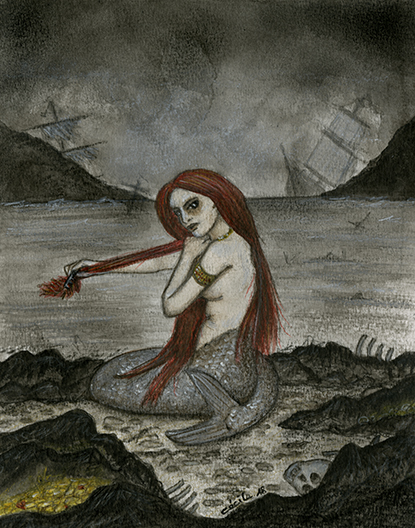
The mermaid (Illustration for « Mermaid’s Comb » by Colleen Anderson TFF 2018.45)

This siren combing her hair is based on a famous painting by John William Waterhouse (1900). It is the archetype of the siren to me, so it was quite natural to take it as a reference here. To match the dark and evocative atmosphere of Colleen’s poem, I represented her as a sinister, vampire-like creature, surrounded by the bones of the sailors she lured. The whole atmosphere is grey and stormy, and we can see wrecked ships in the distance. The only colours are the glittering gold she has gathered and her bright red hair. Waterhouse, whom I discovered during a summer English course in Oxford, is one of my favourite artists, especially for his works depicting legends and classical myths. Funny enough, his painting was also inspired by a poem: “The Mermaid” by A.L. Tennyson.

Gennesee (Illustration for « A Subtle Fire Beneath the Skin » by Hayley Stone, TFF 2021.57)

The portrait of Gennesee comes from another archetype: the red-haired poetess illustrated by Eugène Grasset on an advertising for the ink brand Marquet (1894). It was fun reinterpreting this classic Art Nouveau figure as a black woman with piercings and long flowing braids, keeping the antique dress, the quill, and the ink bottle. Something in this lovely story by Hayley Stone reminded me of Edgar Poe, so I copied a few verses from The Raven on Gennesee’s arms, to show the deathly poetry literally flowing under her skin. But you must look very closely at the illustration to see it!

Shuuran/Kuroba Ren (illustration for « The Boy from the War » by Perrin Lu, TFF 2019.48)

“The Boy from the War” by Perrin Lu is an eventful, almost cinematic, story. Actually, it was difficult for me to decide which moment to illustrate. So, I chose to show something happening “between the lines”: Shuuran/Kuroba Ren in a moment of calm, meditating before her fight against Gohei. In the background, we can see the demon mask she will use to (once again) hide her identity. Preparing the illustration, I looked for visual references on the web and was surprised to find 19th century photos of real Japanese samurai women. They didn’t inspire me directly, but they probably influenced what I imagined the protagonist could look like.
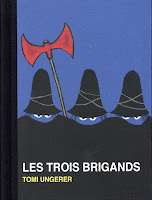
Les trois brigands

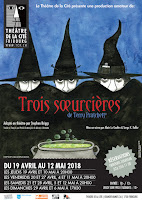
Trois sœurcièresLet's talk about you for a bit, then. What is your favourite illustration from the last ten years?

I have a soft spot for the witches on the poster of the play Trois soeurcières (“Wyrd sisters”) by Terry Pratchett (Théâtre de la Cité, Fribourg/Switzerland, 2018). My inspiration came from a children’s book called Les trois brigands, illustrated by Tomi Ungerer. I loved it then but dreaded it too, because the cover was very impressive to me. I enjoyed reinterpreting it here, about 40 years later.

How has your work matured or evolved in the eight years since you last visited us here at the Press Blog?

It’s always difficult to analyze one’s own work. On the whole, I’d say the illustrations are a bit more elaborate. The colours are richer and stronger, I tend to use more mixed media, the themes and points of view are more varied. I always enjoy exploring my personal references (books, paintings, films…) and twisting them to produce something original. The woman illustrating the poem « Daughter » by Eva Papasoulioti (TFF 2019.51), for instance, is inspired by a 19th century brooch; the dark siren of “The mermaid’s comb” (discussed above) is a parody of the painting by J.W. Waterhouse, etc.
Is there a painting or illustration in which you have always dreamed to enter? What would it be like in there?

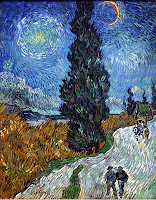
When I was a child, I used to spend the summer holidays in a chalet in the Swiss Alps. Above my bed there was a reproduction of “La route aux cyprès” by Van Gogh. I was fascinated by it, wondering if it was a kind of dream: there seemed to be a moon and a sun together, and the whole picture seemed to undulate and palpitate. I would have liked to go to the cypress to have a better look. Surely I would have felt dizzy in there, like after watching too much static on a TV screen… or drunk too much wine.

Could you imagine challenging yourself by illustrating something in a completely different medium from usual?

I like etching and its various techniques, that can create stunning visual effects. But it demands a lot of practice to achieve something good. Collage, combined (or not) with drawing or painting, could be another option. I discovered this technique last summer and loved it. It’s more spontaneous than “classic” illustration, and the graphic possibilities are numerous. I think I’ll give it a try in a future TFF assignment.
Who is the artist who has surprised you the most? (By using an unexpected technique or medium, for example, or by creating work outside of the style you associate with them.)

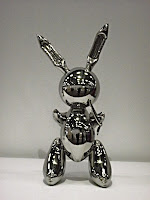
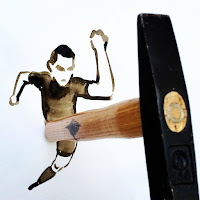
At secondary school, I gave a presentation about Pop Art. It was a small revolution to me: art was not just academic and “boring” but could be colourful, inventive and fun. I have vivid memories of an exhibition I saw in Geneva at the time, showing works by Andy Warhol, Roy Liechtenstein and Jeff Koons. His “inflatable” metal rabbit is still a favourite of mine today. And more recently, I discovered Christoph Niemann, who makes everyday objects (an ink bottle, a sock, a hammer…) part of his illustrations. It’s very inventive and fun too!

Is there a story you would always have liked to illustrate?

Illustrating Treasure island by R.L. Stevenson has always been a dream of mine. It’s a big and challenging task… I’ll get down to it when I’m retired, maybe ! In the meantime, I’d love to explore classical mythology, for instance, or illustrate a “Victorian” story, like The picture of Dorian Gray or a book by Jules Verne. It could also be interesting to work on something darker : a vampire story, for example.
Is there a painting or illustration (by another artist) that you think really represents you, or some aspects of your personality?

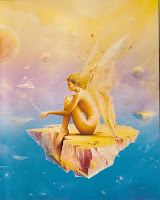
I like this illustration by W. Siudmak, showing a paper-winged angel seated on the edge of a rock floating in space, holding a small revolving planet. It could represent my constant search for balance and beauty in this unstable world, with a feeling of fragility, a kind of innocence, and a fertile, creative imagination, of course.


Finally, can you give us a taste of a few of your artworks that won’t be found in the pages of TFF? What sort of thing have you been illustrating elsewhere?
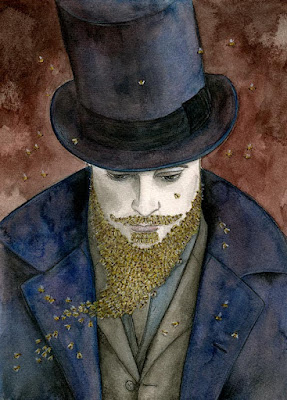
Lord of the bees

I made this portrait for Belinda Draper (author of “The Bright Hunters” – TFF 2015.33), who bought a custom illustration from me in the TFF-X fundraiser in 2015. She asked me to illustrate her story “The honey tree,” a lovely reinterpretation of the fairy tale “Bluebeard”. I was given “carte blanche,” so I chose to represent the protagonist Beebeard as a styled dandy, with a top hat. Drawing each bee individually demanded some patience! I was planning to take the illustration to Belinda in person in Australia, but this project had to be postponed because of the burns and then the Covid pandemic.
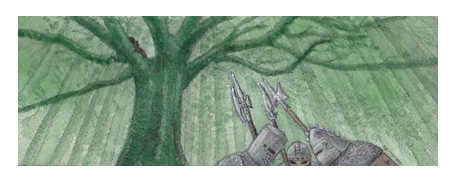
Hiding in the tree

This illustration was made for a friend of long standing, Gaëlle Vadi, who wrote a great fantasy epic called Le retour d’Achal Kaalum (“The return of Achal Kaalum”) in the early 2000s. I have been illustrating it since 2004, very irregularly. It’s a real long-term task! But we hope to publish it one day, somehow… Here, we can see Anders, one of the protagonists, hiding in a tree from dire assassins. Their arms are a mix of Viking, medieval and fantasy elements. This illustration is the frontispiece of the chapter, which explains its unusual oblong format.
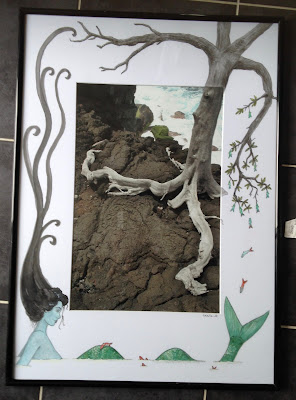
The fish tree

Another collaboration, and… another mermaid! The photo was taken by my friend Rachel Rumo, a nature-lover and long-distance tripper. She asked me to let my imagination wander around it on the passe-partout. In 2007, we held a whole exhibition together with such “hybrid” works in Romont (Switzerland), which was an unexpected success. This one, a siren watching a naked tree growing fish, was made in 2018 to celebrate the 30th anniversary of the exhibition hall, located in a medieval tower called “la Tour du Sauvage.”


Thank you so much for stopping by, Cécile. See you again soon in the pages of the magazine!

Sunday, 7 February 2016

Octavia Flora Fabian (1920–2015)

I recently learned of the sad passing of a former collaborator of ours. Octavia Flora Fabian was known as “Tavie” to her friends (although there’s little agreement on the spelling, since it was mainly a spoken diminutive), but always “Mrs. Fabian” in correspondence, and of course, now famous as “Flora Fabiana” in print publication. This variance in nomenclature was both evidence of her concern for privacy (her family asked that no photos of her be posted) and separation between different roles and circles, and symbolic of the facets of her personality that sometimes seem at odds with one another.

Tavie married Edgar Fabian in 1946, and they remained childless until his death from heart disease in 1980. It was apparently at about this time that Tavie stopped volunteering at the local church, which seems to have been her main activity for all of her married life, since she never took a job. She lived on Edgar’s modest pension for the next few years, but by 1994 her physical health had deteriorated and she chose to take up residence in a care home for the elderly, which she paid for from an investment account she created from the sale of their small house. This account comfortably supported her for the 21 remaining years of her life.

Fearing boredom and mental decline, Tavie asked her niece Jasmine to buy her a typewriter so she could write “articles and stories.” Worried that a typewriter would be too noisy in the close confines of the care home, Jasmine instead prevailed on her son Tony to give his great-aunt an old Compaq laptop PC instead. It was Tony Michael who taught Tavie to use the computer, some years later set her up with an internet account, and periodically updated her laptop with a new hand-me-down model every few years.

Tavie seems to have written prolifically, although she also erased most of her early work when it ceased to be of interest to her, and seldom kept files that she was not intending to publish. Still in the 1990s she began to study at the Open University for a BA in English Language and Literature, and although she never completed the degree, she began to write many short works of criticism and literary biography at this time. She had a talent for digging out little-known but important writers to profile critically and professionally, especially women who wrote on topics or in genres that were more common for men.

Due to her scholarly interest in gothic, fairytale, suspense, and early pulp writers, Tavie’s work naturally found a home in the genre press, especially fanzines and online publications. It was in this capacity that I first corresponded with her, as she was researching women whose names appeared in golden age pulp zines but for whom biographies or later careers were unknown. She wrote a few short reviews for TFF back in the ’oughties, before we were archiving the site, and she had an obvious zest for both library, archive and internet research into the genealogy and bibliography of her subjects.

The first hint of media recognition for Tavie came when she wrote her groundbreaking profile of Emily Goldhill Kenzie, whose short SF mystery “The Airlock” (1950) in Super Science Stories was all anyone else had previously been able to find of her (along with the tenacious but unsubstantiated—and unexplained—rumour that she once publicly slapped Ejler Jakobsson in the face). Tavie had discovered more details about Kenzie than most of us could find about our own great-grandmother in family history research—although she was of course restrained and respectful in how much she included in her profile. Albeit among a small group of critics and editors to begin with, Tavie’s reputation as a serious researcher in the history of speculative fiction was cemented.

After a series of low-profile but impressive critical biographies of obscure writers, Tavie’s real breakthrough came when she apparently tracked down not only the ToC but the entire fiction contents of the inaugural issue of Whatifn’t magazine (1.1 – 1968), whose first dozen issues were assumed completely lost. She wrote detailed reviews of several of the stories, including a rare late SF story by John Moore that she characterized as “proto-eco-SF,” and a reprint of “one of the weaker” Cordwainer Smith stories. No one else has seen the issue Tavie worked from, and she never clarified whether she found a physical copy or a scan; either way she presumably didn’t keep it.

Three TitansA turning point in this low-key but increasingly exciting career came when Tavie reviewed for a US-based speculative fiction review, an obscure, independently published chapbook titled Three Titans. This slim volume of less than fifty pages, which her review gives no indication of being satirical or otherwise doubtful, purports to publish, for the first time and all together, the final stories by each of John Jacob Astor IV, Jacques Futrelle and W. T. Stead, three SF writers who died in the wreck of the Titanic in 1912. The review is masterful: the stories are all typical of the authors’ respective oeuvres and styles, their flaws are dissected critically but with consideration of their age, and they are all put into the context of their literary surroundings, as well as each other (Astor and Futrelle at least were friends). The only problem was, no one else has ever been able to identify either this modern chapbook or any of the stories in it. Once people started to try, it soon became clear that either the chapbook was itself a pastiche or, more likely, that Tavie had invented it herself for the express purpose of this fabricated review.

We must not forget that at the same time as these increasingly suspicious works of criticism were starting to receive attention, Tavie was still putting out an impressive stream of indubitably genuine reviews, profiles and literary studies (she was after all retired, and writing about genre fiction was her main hobby). She never confirmed or denied that some of her reviews and other articles were fraudulent, even when a couple of crusading fans for a while made it their mission in life to expose and discredit her. With no social media presence or publicly available email address, she was pretty much immune to any harassment that might have ensued, and the zealous “investigators” quickly lost interest. Tavie continued to review, and no doubt to invent, genre authors and works, until only a few months before her death.

Among the more surprising titles Tavie wrote about was an early issue of the psychological, gore and dark crime magazine Shadowed Dreams in 2007, which she analyzed at some depth without ever saying whether the darker stories were to her taste or not. She wrote a short retrospective of the work of eclectic author and editor Tadala Linn, in which she recasts what most reviewers have seen as an eccentric taste in unpredictable supernatural themes as a virtue, as injecting a dose of surrealism into dark fantasy. She wrote a detailed account of C.L. Moore’s unpublished diaries and juvenilia, and how it prefigures many of the themes of her published work.

Through it all, Tavie retained her kindness and generosity, her playfulness and willingness to explore new genres, her obsession with the obscure and the underrepresented. She was a valuable and insightful reviewer, and she deserves to be remembered as one of the most creative authors in the last two decades of the speculative small press, even though she never published a single work labelled as fiction.