Thursday, 9 July 2015

How I Learned to Stop Worrying and Access the Future

Guest post by Nicolette Barischoff

As a writer living with Cerebral Palsy, I’ve always been wary… no, squeamish, when it comes to writing about disability. Why? Who exactly knows. There’s the old standby paranoia of not wanting to be told what I “ought” to be writing, not wanting to be used as some able-bodied person’s Teaching Moment or inspiration blow-up doll. There’s my stubbornly held belief that a writer who can only write with honesty and empathy about their own experiences (or characters whose experiences are similar to their own) is not a particularly good or useful writer.

But I suspect that most of my aversion to disability-themed fiction stems from the fact that a good portion of it is just not very much fun.

So many bad stories that feature disability (sometimes written by the well-meaning able-bodied, but just as often perpetrated by writers with disabilities intent on fictionalizing a particular kind of experience they think might be dramatically interesting) treat disability as a source of social isolation, misunderstanding, and physical limitation. Very often, their goal as stories is to show that the disabled person’s reality comes with a particular set of hardships—usually brought upon them by an ignorant, inaccessible, or prejudicial society—that is separate from the set of hardships experienced by most human beings. As one narrative about disability, this has value. As the only narrative about disability, it is tedious, divisive, unrealistic, and unhelpful.

What so appealed to me about Accessing the Future was not only how much fun it promised to be (The Future, as we know, is chock full of giant robot battles, generation ships, designer creatures, fancy holographic limbs, and hot sex in zero gravity) but how naturally and effortlessly its premise promotes an alternative narrative about disability.

By merely depicting futures that include people with disabilities, futures in which disabilities have not “gone away” or “got better,” Accessing the Future takes disability out of its Otherized position as a special group with special problems for able-bodied people to feel things about, and puts it back where it belongs, squarely within the spectrum of Humanity.

As long as there have been humans, there have been humans of varying ability, aptitude, and strength. And guess what? They have all found uniquely human ways of surviving and thriving.

The relative concept of “disability,” just like the relative concept of “poverty,” has always existed, of course, and always will exist, even as, especially as, the human landscape of ability is radically altered.

But by suggesting to us what that disability might look like in the future (what technologies might be at its disposal, what spaces it might share) ATF reminds us that Disabled People are not an anomaly, engaged in their own separate, alien struggle, but simply another example of humans doing what humans have always done when they have found their environment to be inhospitable: Adapting.

Humans at all levels of ability have always adapted, facing down incredible physical inequity with a combination of clever tools, innovative solutions, and sheer bullheadedness. Once we understand that, humans with disabilities become simply humans, neither special objects of inspiration nor of pity, but participators in the collective human struggle: bucking the system, searching for meaning, spitting in Natural Selection’s eye, and just generally being an irrepressible pain in the ass.

In writing “Pirate Songs,” I wanted to speak to our adaptability as a species, and our ability to adjust when our own particular worldview has been shattered. Thus, I divested my protagonist Margo of her wheelchair before I put her aboard a shipful of outlaws who would have no idea what to do with her. I trusted she would grit her teeth and hold her own. And she did.

In Margo, I sought to create a protagonist that behaved like a protagonist. Another important thing this anthology has done for the de-Otherization of disability is allowed people with disabilities to be at the center of their own stories. In generating such a dynamic space for characters with disabilities to play, ATF practically demands protagonists that are a fully-realized and active driver of the story they’re in.

Disability in fiction is so often objectified, there to be reacted to, or to be acted upon. Even when a disabled character is purportedly the Main Character of a story that is about her, it is often other people in the story who do the majority of the growing and the changing and the driving that defines a protagonist. She remains emotionally (and oftentimes physically) static, while those around her become inspired, learn to be more inclusive, have their expectations challenged, change the rules of their favorite sport, etc, etc.

In part, people with disabilities are kept from occupying the role of true Protagonist because there are so many bad stories designating them as a special group with special problems. The perceived otherness of what are assumed to be their concerns makes it difficult for a less-than-imaginative writer to imagine those concerns growing or changing or being shattered as the story progresses.

But the ability to imagine someone growing, changing, learning, is nothing more or less than the ability to imagine them as a fully complete and complex human being. The ability to envision another person as the full-fledged hero of their own story, with their own hard lessons to learn, their own disappointments and victories and tragic flaws, is nothing more or less than empathy. One reason it becomes so important to give disabled children a protagonist they might see themselves in, is quite simply that Protagonist is the opposite of Other.
Nicolette Barischoff is the author of “Pirate Songs,” one of fifteen short stories in Accessing the Future: A Disability-Themed Anthology of Speculative Fiction, available in print and e-book this month from all online booksellers. More details, including links to bookstores, can be found at the Accessing the Future press page.

Saturday, 20 June 2015

New Issue 2015.33

“Much like fairy tales, there are two facets of horror. One is pro-institution, which is the most reprehensible type of fairy tale: Don’t wander into the woods, and always obey your parents. The other type of fairy tale is completely anarchic and antiestablishment.”

—Guillermo del Toro

 [ Issue 2015.33; Cover art © 2015 Robin E. Kaplan ] Issue 2015.33
Download e-book version: PDF | EPUB | Mobi

Rate and review TFF #33 on Goodreads

Wednesday, 10 June 2015

Interview with Małgorzata Mika

Djibril al-Ayad (for TFF): Hello, Małgorzata. You’ll be known to TFF readers as one of our reviewers, and perhaps also as the editor of the Speculative Treasury (more on that later). What other activities do you get up to in speculative fiction?

Małgorzata Mika: Hello Djibril! When it comes to my work for The Future Fire, I have only just begun my journey. I am grateful that this opportunity has landed in my lap, allowing me to finally word texts in English. It has been my dream to contribute to the field of the fantastic in a language that is used worldwide. Yet, my previous writings included essays, articles and reviews for the Polish academic journal, Creatio Fantastica. Since 2013, I have been attending sci-fi/fantasy conventions in Poland, such as Grojkon in Bielsko-Biala, Krakon in Cracow and Dni Fantastyki (Fantasy Days) in Wroclaw. At times, apart from being an active listener, I was an active lecturer, giving a talk on some of the topics in the field of the fantastic. Sharing my knowledge is an experience I deem powerfully enriching for me, and I hope that a piece of it will stay with my audience.

DA: How did you first get into science fiction or fantasy? What are some of your favorite works today?

MM: The circumstances surrounding my first encounter with science fiction are pretty incongruent, and, looking back at them from the perspective of time, I feel a mixture of nostalgia and embarrassment. It happened when I was around five years old and I was hardly a literary type at that time. One evening I was watching a remake of Flash Gordon from 1980, and I was absolutely amazed by its fast-paced action and visual beauty. However tacky and pulpy this movie appears to me now, to me as a child, it was an immensely intense experience for me at that time. It needs to be noted here that I was more captivated by the variegated scenery and special effects than by the story itself.

Saturday, 11 April 2015

Call for submissions: Fae Visions of the Mediterranean

Fae Visions of the Mediterranean
Edited by Valeria Vitale and Djibril al-Ayad

Call open until November 13, 2015 for:
(a) Microfiction in Mediterranean languages;
(b) all stories by North African or Near Eastern authors


Call for stories:

Quivering mirages, ghost ships, glossy scales slipping away beneath the waves; we are seeking progressive and inclusive short stories about wonders, terrors, omens, sea-monsters, apparitions and other folk creatures and horrors from throughout the Mediterranean region. You might find inspiration in medieval bestiaries and the margins of maps and manuscripts; stories whispered by pirates in the long nights at sail; horrible and marvellous visions shaken travellers barely dare to recall; names of creatures known by everyone in the streets around the harbour; particularly troubled nightmares you had or someone shared with you.

The rules:
  1. The editors are looking for uncanny stories up to 5 000 words, illustrations/comics up to 12 pages, or poems up to 40 lines.
  2. The anthology will also include micro-stories of approximately 500 words written in all languages of the Mediterranean. Authors may send stories in any language. Authors should additionally include a cover letter in English, Italian, French, Arabic or Spanish (these are the languages we can read).
  3. Stories may be horror/fantasy, magical realist, surreal, absurdist, pirate stories, ghost stories, folk tales or fairy tales. All stories should be set on or around the Mediterranean Sea. The editors would like to see the cultures and legends of the Mediterranean reflected in the stories.
  4. Stories will be free-standing and individual. The anthology is not a shared-world or otherwise constrained to a joint narrative or structure.
  5. The editors welcome fiction by authors from the Mediterranean region, particularly North Africa and the Near East. The editors also welcome fiction written by other under-represented groups (such as women, queer/trans/nonbinary, non-anglophones, people of color, people with disabilities, etc.).
  6. Story submissions should be sent as a .doc, .docx or .rtf attachment to faevisions.med@gmail.com by Friday, November 14, 2015; the call is closed to general submissions, but two categories of story are still welcome: (a) Microfiction (up to 1000 words) in any Mediterranean languages; (b) stories in English (up to 5000 words) by North African or Near Eastern authors.
  7. Reprints and multiple submissions are welcome, but please do not submit stories that are simultaneously under consideration elsewhere. The editors will reply to all submissions as quickly as possible. The editors are NOT interested in fan-fiction.
  8. This anthology will pay €30 plus royalties for first world print (or reprint) and e-book publication rights for 1000-5000 word stories, comics and poems. Flash and micro-stories will be paid €15 plus royalties.*
  9. The anthology will be edited by Valeria Vitale and Djibril al-Ayad, and published in print and e-book by Futurefire.net Publishing in early 2016.
* Please note that you should decide whether you want to sell first print rights for this relatively low rate; you will only be able to sell a story again as a reprint after it has appeared in this anthology.

Keywords:
  • absurdism; Albania; Algeria; bilingual; Borgesian; Bosnia-Herzegovina; Ceuta; comics; Corsica; Croatia; Cyprus; Djerba; djinn; dreams; Egypt; Elba; fantasy; fata morgana; folklore; France; ghosts; ghûl; Gibraltar; Greece; horror; illustration; Israel; Italy; Jebel Tariq; journeys; Lampedusa; Lebanon; Libya; Majorca; Malta; manuscripts; maps; Marmara; microfiction; mirage; Monaco; Morocco; mythology; naznaz; nightmares; Palestine; Pillars of Hercules; pirates; poetry; postmodern; Sardegna; seamonsters; sea stories; shaitan; shipwreck; Sicily; sirens; Slovenia; Spain; surreal; Syria; travelogue; Tunisia; Turkey; uncanny; weird; world literature.

Thursday, 19 March 2015

New issue 2015.32

“It was not in my nature to be an assertive person. I was used to looking to others for guidance, for influence, sometimes for the most basic cues of life. And yet writing stories is one of the most assertive things a person can do. Fiction is an act of willfulness, a deliberate effort to reconceive, to rearrange, to reconstitute nothing short of reality itself. Even among the most reluctant and doubtful of writers, this willfulness must emerge. Being a writer means taking the leap from listening to saying, ‘Listen to me.’”

—Jhumpa Lahiri
 [ Issue 2015.32; Cover art © 2015 Cécile Matthey ]
Download e-book version: PDF | EPUB | Mobi

Rate and review TFF #32 at Goodreads

Sunday, 15 March 2015

Interview: Margrét Helgadóttir

Valeria Vitale (for The Future Fire): Let's start with your debut book, The Stars Seem So Far Away, a collection of interlinked tales published by Fox Spirit. What is this book about and what do the five main characters have in common?

Margrét Helgadóttir: My intention was to give the readers glimpses, like pieces of a larger puzzle, or short film clips. The Stars Seem So Far Away is not a collection of stories, but it’s not a novel either. It’s a hybrid, a fusion of linked tales that together tell a larger story, set in a distant apocalyptic future, where plagues, famine and wars rage across the dying Earth. The last shuttles to the space colonies are long gone. Fleeing the deadly sun, humans migrate farther and farther north.

I strongly believe in telling broader, more universal stories through the eyes of people who struggle with their own nightmares and personal stories, so this story is told through the tales of five people: One girl who sails the Northern Sea, robbing other ships to survive; one girl who guards something on a distant island; one guerrilla soldier; and finally, two refugee siblings who become separated when the plague hits Svalbard. They all try to survive on their own in a cold world where everything seems hopeless. It is a pessimistic world, filled with death and despair, but I wanted to tell a story where there’s also hope, love, laughter and friendship. I hope I have succeeded in this and that people will like the stories and the characters.

VV: You have also co-edited with Jo Thomas the first volume of a series about monsters: you recently published European Monsters, and are also planning the follow-up, African Monsters. Is there something that particularly struck you in how the imagery of monsters changes across different countries and cultures?

MH: We see some similar kinds of monsters across countries and cultures; sea or lake monsters, animal monsters, were animals and shapeshifters, demons and evil spirits. But there are differences when you look closer at the individual monsters. Some monsters like the vampire and the werewolf are considered universal. However this is mostly because it’s the western myths that dominate popular culture. A vampire in West Africa is something quite different than the vampire stalking the streets in Europe. They both are blood-thirsty, but where one seeks darkness, the other has an affinity
towards light.

Typically, monsters are used to embody nature and the wilderness or natural powers, to explain the existence of things that were made, such as rock formations; or to blame for when things go wrong. So, the individual monsters might not be universal, but the idea of what a monster is and their origin is. It’s a very exciting book series to work with and I am excited to see the stories we now receive to the Africa volume.

VV: A call for submissions for another Fox Spirit anthology titled Winter Tales has just opened. Do you think there is something that makes winter in the northern countries particularly fascinating and/or terrifying?

MH: I have lived in a few African countries, and despite what people think, you do have winter seasons in Africa as well. The temperature drops, the ocean becomes cold and in some parts, like Addis Ababa or South Africa, it can even snow.

That said, I adore the winters in the northern world, but that’s probably because I have lived here huge chunks of my life, so I have learned to look beyond the snow and the freezing cold. When it feels like the ice pierces through everything, including yourself, and you want to escape it, but you can’t, the northern winters might seem harsh and extreme. Personally I struggle mostly with the winter darkness. We have sun and daylight only for a short while during the winter season. All you want to do is sleep, and we joke about going into hibernation like animals do.

But I think there is beauty and magic. The pure white snow covers everything, chasing away the dark. The northern light dances green in the sky. And everything is so, so quiet. Candles are lit to chase away the darkness and people huddle up together in front of fires to share warmth, food, music and stories. It’s an important part of the culture and history of the northern and arctic countries and the different people who live here. Many of our stories and folklore have been created and shared in settings just like this. Just as I’m sure stories have been told in front of the fires in the cold seasons in other parts of the world for hundreds of years. And this, to me, is part of the magic of the winter seasons.

E. Dulac's illustration for H. C. Andersen's Snow Queen.
London: Hodder & Stoughton 1911
VV: In your experience as an editor, what makes a story stand out? What kind of stories would you like authors to submit to the winter anthology?

MH: In my view, the stories that stand out usually have a strong writing voice and a natural narrative flow. They don’t have to be long. I’ve read flash stories that impressed me more than novellas. Language is to me part of the reader experience, and I will enjoy a story even more if the language is polished and the story is proofread. Other than this, it’s difficult to say what makes me read a story twice. It can be a feeling in the story, a convincing character development, or an original setting.

The Winter Tales anthology will be a speculative fiction anthology, so I want fiction stories with full plot and strong characters within these genres. Stories about creatures, monsters, animals and shapeshifters are welcome. I seek and encourage diversity in literature, so I hope to receive many stories written by and/or about characters from all over the world, all genders and orientations. But I ask that the stories must be written in English, take place on Earth and have the winter as frame.

Poetry is also welcome. For more details, read our submission call.

Thursday, 5 February 2015

Accessing the Future TOC

At last, we can share with you the authors and titles of stories that will appear in the Accessing the Future anthology, exploring disability through speculative fiction, edited by Kathryn Allan and Djibril al-Ayad (with guest commentary from JoSelle Vanderhooft and Derek Newman-Stille). Also, go over to the Accessing the Future press page and check out the  g o r g e o u s  cover art by Robin E. Kaplan, aka the Gorgonist!
  • Nicolette Barischoff “Pirate Songs”
  • Sarah Pinsker “Pay Attention”
  • Margaret Killjoy “Invisible People”
  • Joyce Chng “The Lessons of the Moon”
  • Samantha Rich “Screens”
  • Sara Patterson “A Sense All its Own”
  • Kate O'Connor “Better to Have Loved”
  • Toby MacNutt “Morphic Resonance”
  • Louise Hughes “Losing Touch”
  • Jack Hollis Marr “into the waters i rode down”
  • Petra Kuppers “Playa Song”
  • A.C. Buchanan “Puppetry”
  • A.F. Sanchez “Lyric”
  • Rachael K. Jones “Courting the Silent Sun”
  • David Jón Fuller “In Open Air”
In addition to these stories, we will include eight pieces of freestanding artwork, illustrations that tell stories of their own on the theme of the anthology. Our wonderful artists are:
  • Fabian Alvarado
  • L.E. Badillo
  • Jane Baker
  • Comebab
  • Pandalion Death
  • Rachel Keslensky
  • Vincent Konrad
  • Tostoini

Friday, 26 December 2014

#EuropeanMonsters #WritingPrompt competition

Hello, everyone!

This could be your prize!
You may have noticed that Djibril of The Future Fire has been running some fantastically #EuropeanMonsters specific #WritingPrompts on Twitter that are now starting to overflow on to Facebook and the British Fantasy Society's forums. He's even been kind enough to keep an eye on the resulting work and keep a Storify of them.

Well, we - the editorial team and Fox Spirit Books - were persuaded to get in on the action. So, here's what we're going to do. We are offering one shiny paperback copy of European Monsters to the most appreciated response to Djibril's European Monsters writing prompts. To see what you could win, have a look at the book page on the Fox Spirit website.

And here's what you need to do:
  1. Write a response to one of the daily #WritingPrompts starting with the "Am here to give my testimony of how I became a ..." Djibril supplies.
  2. Submit it on Twitter (use the tags so he can find them), Facebook (in reply to the posts on The Future Fire account) or the BFS forum (use the forum thread linked above).
  3. Get peope to vote for you on the survey, which will be opened once the writing prompts have closed (this post will be updated with a link when the form becomes available) is now open.
The writing prompts will continue until Sunday (28th), so all responses need to be submitted by midnight / end of Sunday (GMT).

Voting for the favourite entry closes by midnight / end of Wednesday 31st - better known as New Year's Eve - so don't forget to get your votes in.

Once we've had a chance to crawl out from under our hangovers (assuming alcohol is involved at New Year's), we'll compile the results and announce the winner on Twitter, Facebook and the BFS forum thread by the end of Thursday (1st).

Good luck and write well!

Jo Thomas

Sunday, 2 November 2014

Call for Illustrations: Accessing the Future

THIS CALL IS NOW CLOSED.

WE HAVE MORE ILLUSTRATION PITCHES THAN WE KNOW WHAT TO DO WITH!

Accessing the Future will be an anthology of short stories and art on the theme of disability and science fiction. (See the original call for stories.) The editors are looking for single-page, black and white illustrations to include in the anthology. The illustrations will be free-standing (i.e. not depicting scenes from the stories). The editors want to include illustrations from as many and diverse people as possible. The editors especially encourage submissions from people with disabilities or chronic illness, and people who are neuroatypical.

Illustrations that the editors want:

The editors want illustrations that depict disability and people with disabilities in the future. The editors also want the illustrations to reflect diversity (in terms of race, nationality, gender, sexuality and class). Illustrations can be abstract or realistic and use any technique appropriate to creating high contrast, black and white images.

Here are some questions the editors want artists to think about when drafting their illustration:
  • How will people with disabilities change the future world?
  • What kinds of new spaces (on Earth and in outer space) will there be to explore and live in? Who will have access to these spaces? In what ways will people use these new spaces?
  • What kinds of technology will people use in the future to make their lives easier?
  • What does an accessible future look like?

If including technology in your illustration, the focus should be on the human user(s) and not on the technology. Please avoid proposing illustrations of cyborgs or any image that dehumanizes the user(s) of technology.

Submission Guidelines

In the first instance, please pitch the idea for an illustration to the editors. The editors will select the ideas that work best, and will work with artists to make sure the final images are a good fit for the anthology.
  • Send the editors an email with a description of the planned illustration and an explanation of how it fits the theme. This may include a rough sketch. The pitch should also include a link to an online portfolio or previous examples of artwork.
  • Email the editors at accessingfutureatgmailcom with your pitch as soon as possible. The call for illustrations will remain open until the editors have as many images as they need. Final versions of images will be needed by January 31, 2015.
  • Final images will be approximately 11cm x 19cm (4.5" x 7.5") in portrait orientation. Images will be printed in black and white, on off-white book paper.
  • The editors do not ask artists to identify themselves as a person with a disability. The editors respect anyone’s desire to self-identify.

Payment and Rights

The publisher will pay $75 (USD) for global English first publication rights in print and digital format. The artists retain ownership and copyright.

About the Editors and Publisher

Kathryn Allan is an independent scholar of feminist SF, cyberpunk, and disability studies. She is the first Le Guin Feminist Science Fiction Fellow (2013-14). She is editor of Disability in Science Fiction: Representations of Technology as Cure (2013, Palgrave MacMillan). Kathryn is an Associate Editor and Reader of The Future Fire. She tweets and blogs as Bleeding Chrome.

Djibril al-Ayad is a historian and futurist. He is the owner of Futurefire.net Publishing. He co-edited both Outlaw Bodies (2012, co-edited by Lori Selke) and We See a Different Frontier (2013, co-edited by Fabio Fernandes). He has edited The Future Fire magazine since 2005.

Thursday, 30 October 2014

New Issue 2014.31

“And you think they’ll let you,” said Machine. It was a flat, sad statement.
“No,” she said, “but nobody ever let me do anything in my life before and I never let that stop me.”

—Joanna Russ

 [ Issue 2014.31; cover art © 2014 Martin Hanford ] Issue 2014.31
Editorial introduction by Regina de Búrca.

Download e-book version: PDF | EPUB | Mobi

Sunday, 19 October 2014

Accessing the Future: plain language call for stories

(by Kathryn Allan)

Note new closing date: December 31, 2014.

Accessing the Future will be an anthology of speculative fiction short stories. The theme of the book is disability. Kathryn Allan and Djibril al-Ayad are the editors of Accessing the Future. The editors want to receive stories from as many people as possible. The editors encourage submissions from:
  • people with disabilities (this includes physical and mental disabilities)
  • people with chronic illness
  • people with mental illness
  • people who are neuroatypical
  • people who understand disability politics
  • the QUILTBAG community
  • people of colour
  • non-North American writers
  • people who are sensitive to intersectional politics
Stories the editors want:

The editors want to read stories that depict disability and people with disabilities in the future. The editors also want the stories to be mindful of race, nationality, gender, sexuality, and class. Stories can take place in virtual spaces (like the internet). Stories can also be set in outer space or anywhere on earth. Stories can deal with prosthetic technology (like brain implants or artificial limbs). Stories can also be about medical technology (like gene therapy).

Here are some questions the editors want writers to think about:
  • How will people change the future world?
  • What kinds of new spaces will there be to explore and live in? Who will have access to these spaces? In what ways will people use these new spaces?
  • What kinds of technology will people use to make their lives easier in the future?
  • How will new technology change existing differences in ability, class, gender, sexuality, nationality, and race?
  • What does an accessible future look like?
Stories the editors will reject:
  • Stories where people with disabilities are “cured,” or receive medical treatment without consent.
  • Stories of people with disabilities as “extra special,” “magical,” or “inspirational” because of their disability.
  • Any story that is racist, sexist, or homophobic.
  • Any story that is insulting or harmful to any person or group of people.
Payment and Rights:

The editors will pay $0.06/word (six cents a word) for global English first publication rights in print and digital format. The authors retain copyright.

Submission Guidelines:
  • Send stories to accessingfutureatgmailcom by midnight on December 31st, 2014.
  • Story length is between 2500-7500 words.
  • No reprints or simultaneous submissions.
  • Attach the story as a .doc, .docx, or .rtf file, with the author’s name, the story title, and the wordcount on the first page.
  • The editors do not ask authors to identify themselves as a person with a disability. The editors respect anyone’s desire to self-identify.
About the Editors and Publisher:

Futurefire.net Publishing is the publisher of The Future Fire magazine. Futurefire.net Publishing also published Outlaw Bodies (2012, co-edited by Lori Selke) and We See a Different Frontier (2013, co-edited by Fabio Fernandes). Djibril al-Ayad is a historian and futurist. He co-edited both Outlaw Bodies and We See a Different Frontier. He has edited TFF since 2005.

Kathryn Allan is an independent scholar of feminist SF, cyberpunk, and disability studies. She is the first Le Guin Feminist Science Fiction Fellow (2013-14). She is editor of Disability in Science Fiction: Representations of Technology as Cure (2013, Palgrave MacMillan). Kathryn is an Associate Editor and Reader of The Future Fire. She tweets and blogs as Bleeding Chrome.

Monday, 22 September 2014

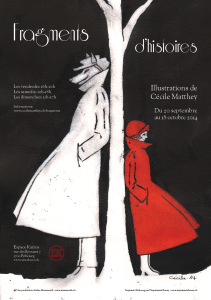
«Fragments d’histoires», Espace Kairos, Fribourg

Cécile Matthey, exhibition « Fragments d’histoires » at the gallery Espace Kairos, Fribourg (Switzerland), 20 September–18 October 2014.


Q: Your work is of course well-known to readers of TFF. Could you tell us a bit about how you put your exhibition together, what the themes and focus are?

Cécile: My first idea was to show illustrations of fairy tales and legends. But along the way, I felt I wanted to work on other subjects too, from mythology, fables or novels. Besides, I thought this exhibition was a good opportunity to show some of the works I produced in the last few years, including TFF illustrations, and posters advertising theatre plays. The initial theme was thus broadened to illustrations in general, and the exhibition called « Fragments d’histoires » (« Fragments of stories »), because it shows images that open like windows in the big world of stories: Little Red Riding Hood, Moby Dick, Treasure Island, the Raven and the Fox, The Hobbit, Alice in Wonderland, Icarus, Richard III, …

Q: Espace Kairos is an independent gallery featuring the work of local talent. Tell us more about this gallery: how does it work? Which other local artists will be featured in coming months?

Cécile: Espace Kairos is a small gallery located in an old house close to the cathedral of Fribourg (Switzerland). It is run as a non-profit activity by Vincent, a man who wishes to promote local artists in a simple and convivial way. The exhibitions, usually lasting one month, are very varied: paintings, drawings, sculptures, puppets and so on, and can include cultural happenings such as concerts or readings. The gallery has been successful for a few years now. But Vincent has new plans for the future and unfortunately, Espace Kairos will close in December. After “Fragments d’histoires”, two more artists will show their works: André Stauffer, who makes drawings in “ligne claire” style, and the painter Pierrick Matthey (perhaps a distant cousin of mine?).

Now show us some of the art!

Little Red Riding Hood
This interpretation of the well-known fairy tale is inspired by an old-fashioned advertisement, originally showing an elegant pair leaning on either side of a street lamp. The technique used, involving Indian ink and gouache, makes it look like an etching. It requires a little courage, because the drawing must be completely soaked in water, and the result is not entirely predictable.

Treasure Island
Illustrating this classic novel is a long-range project of mine, and this exhibition was a good opportunity to get started on it. I tried to compose the illustration like an old-fashioned book cover. It shows Jim and Long John Silver on the Hispaniola, seen from the back, arriving in sight of the island. The parrot turns to the spectator screeching, as if knowing what will happen next…

Richard III

This piece was made as a poster advertising the theatre play by Shakespeare. It was all about showing the archetype of the villain in a simple but scary way. A shadow is a good way to achieve this, as I remembered from the old film “Nosferatu” by Murnau. To create the silhouette, I posed in the sun wearing a long thick winter coat, and added a menacing spiked crown inspired by John Howe’s version of Sauron and… the top of the cathedral of Fribourg!

Shadow Boy (for “Shadow Boy and the Little Match Girl” by C. Allegra Hawksmoor, 2013)
To give a sense of the melancholy and solitude of the protagonist, I drew him seen from the back, walking among the graves at dusk. The long white hair brings some strangeness and ambiguity to the character, and adds contrast. The cemetery is inspired by old English and American cemeteries, which always impress me with their gravestones all askew—you wouldn’t see that in Switzerland.

Josh and Paris (for “The Man Who Watched the Stars” by Carol Holland March, 2014)

This illustration is inspired by the souvenir photos made by the NASA before each mission, showing the astronauts posing in their suits, smiling. It seemed a simple and elegant way to evoke the first flight out of the solar system, on which the story is based, and the main protagonists. Josh is inspired by Claude Nicollier, a Swiss astronaut. As for Paris, I found it hard to draw an attractive alien with huge eyes, avoiding the Roswell cliché. In the end I used a tarsier's face as a reference, because it is strange but cute!

More information about the gallery:
http://www.espacekairos.ch

More information about the exhibition “Fragments d’histoires”:
http://www.cecilematthey.ch/fragments