Way back in 2013 we published a story that could have been a paradigm for the speculative, progressive Noir crossgenre, in the form of Zoë Blade’s “Terminal City.” Fittingly, as we prepare for the Spec-Noir themed issue of TFF at the end of the year, we have invited Zoë over to talk about Cyberpunk and Noir aesthetic, social justice and speculative fiction, and transhumanism, among other things.
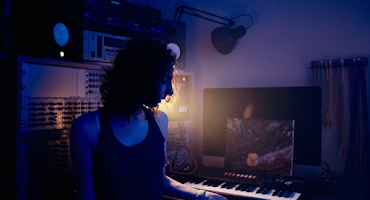 When she's not writing cyberpunk fiction, Zoë Blade can be found in her studio, making music for the leftwing side of YouTube.
The Future Fire: Would you like to talk a little bit about “Terminal City” to start out? We enjoyed this story not only because of the social-justice and dystopian themes, the alternative-history cyberpunk setting and classic Noir aesthetic, but also because of its unapologetically geeky and subculture references. It's also a powerful story in its own right, and it lets a little more hope creep in at the end than some Noir allows itself, but it by no means overturns the dystopian setting or guarantees a happy ending or improved circumstances for the protagonists. To what degree did you think about genre and aesthetic writing this story, as opposed to letting the plot and characters dictate elements like settings and environmental details?
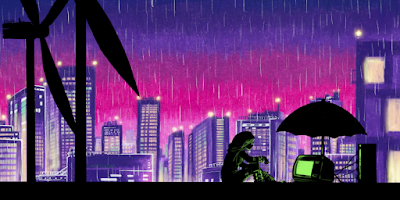
Zoë Blade: Thank you! I think I started with an image in my head of someone using a public terminal in the rain. I'd read about the Esper machines in Blade Runner, how they were networked and performed all these other tasks besides zooming into photos. You can see a few in the film, but they're never mentioned. This was as interesting to me as anything in the film.
Companies, universities, and libraries used to have these big mainframes, that people would access remotely with dumb terminals instead of having their own computers. As a teenager, I was amazed when I first installed a Unix clone covermounted on a magazine. I got to play around with a tiny mainframe all of my own! It felt very empowering, the same way it felt getting my first home computer.
Another big part of the hacker community is phone phreaking, another large network you can only access in small glimpses. I'd also become fascinated by Kowloon Walled City, perhaps the most cyberpunk-looking place on Earth, a maze of rooms where everyone would steal everyone else's electricity and sublet wherever someone might conceivably fit, even in the middle of a diner or factory. So I kind of connected all these threads together.
At its heart, I think “Terminal City” is about a corporation trying to control a piece of technology, computing power, versus a flourishing community of street-level hackers trying to turn it into something everyone can use independently. It made sense to me to set it in an alternate history, where a phone company leased out accounts on their mainframe, that you could access via public terminals strewn throughout the city, and no-one had their very own computer, only leased terminals they could plug into their network and log onto their paid account. I think the main difference is that in real life, no corporation ever tried to suppress microchips, thankfully.
Perhaps it was mostly written out of frustration at what I saw as people ripping off the least interesting aspects of The Matrix. Behind the Bullet-Time effect and the violence was a tale of diverse hackers standing up against authoritarian white men in suits telling them who they couldn't be and what they couldn't do. In a BDSM club, naturally. Who doesn't want to visit that world?
TFF: What did cyberpunk mean to you? Is the character of the hacker an essential prototype, like the P.I. in Noir?
ZB: As a Brit who grew up in the eighties and nineties, it’s somewhat inevitable that I’d be immersed in the dominant popular culture of the time, hailing from the exotic lands of Japan and America. As a loner who enjoyed programming home computers like my trusty Commodore 64, my taste naturally skewed towards the usual suspects favoured by hackers: Blade Runner, Neuromancer, Ghost in the Shell, Snow Crash, Pi, and The Matrix. They feature hackers as heroes, an escapist fantasy for technically-minded shut-ins. And as a transgender woman, I naturally gravitated towards stories of people who modified or outright abandoned their own bodies, and questioned who they really were in spite of how others treated them.
It was only years later, as an adult, that I learned Brits and Americans had feared Japanese businessmen taking over their corporations, something they projected onto everything from Brazil to Die Hard. As a child, that fear completely went over my head. Of course the future was Asian. Watching Dominion: Tank Police, with its female protagonist, I’d associated more with that imagined world than any of the American ones.
As for the hacker: I try to avoid using the generic archetype characters I've seen mentioned in writing guides (“hackers are tricksters like the mythological Loki”) in favour of what I know: hackers tend to be technically knowledgeable yet socially naïve people who wield a lot of power with reckless abandon, for better or worse. I think that covers everyone from Aaron Swartz to Zuckerberg.
TFF: We’d like to ask you more about the relationship between body and identity, which is a popular trope in Cyberpunk, from machines that gain consciousness (or become more human than humans), to people trying to replicate or download their memories and feelings. How do you feel this concept resonates with those who have made the decision to modify or otherwise redefine their bodies?
 ZB: I suspect I'm far from the only transgender woman who felt Major Motoko Kusanagi from Ghost in the Shell resonated with her. Though in a way it's reversed, as she wasn't convinced she had a human brain, and felt that how other people treated her was what granted her humanity; whereas transgender people generally spend a lot of time and anguish working out exactly what and who their brain is, in spite of other people's disbelief.
What always seems absurd to me is how many cisgender people consider themselves to be transhumanists, imagining themselves to have escaped the rigid bonds of being overly attached to an unmodded body... and then proceed to be transphobic without missing a beat. If you're against people overriding their own endocrinological system, then what exactly do you want to allow people to do? I think for most transgender people who overly think things through, it's a natural extension to be very much in favour of everyone's bodily autonomy. A lot of us have firsthand experience of its necessity for happiness or even any kind of normal life.
It's also obviously a nice fantasy that you could transplant your brain into a body that hasn't been damaged from being on the wrong hormones, but allowing young people to block the wrong ones before they can take effect has presumably diminished the need for such escapist wishful thinking.
TFF: Cyberpunk literature and popular culture have probably made us imagine artificial intelligences as an expression of rigid objectivity. But now that we can actually see AIs at work, we see that they simply replicate the same biases that appear in the data that were fed to them. Do you think that this changes the way we look at AIs in cyberpunk, not as superior ethical and objective beings, but bearing the baggage of all our worst prejudices, power imbalances, and other ugliness?
ZB: I think there are two quite different concepts of AI here, leading many people to talk at cross-purposes. Cyberpunk imagines a general-purpose AI that's roughly analogous to a human brain: simple parts, replicated billions of times, interconnected. Like a human child, this new kind of lifeform would need to be carefully nurtured and loved in order to grow into a responsible adult. The main issue there being that only corporations and perhaps governments could afford such technology, at least at first, and they are far from loving parents. Raising a human child in such an environment would be unconscionable, and the scenario isn't improved with that child having thought processes that are utterly unfamiliar to us, and eventually far smarter than us.
What we instead currently have in real life are small, specific bits of computer code that were rapidly evolved in an automatic training process. You tell a computer “here's somebody doing a thing. Please write some random code and tinker with it until it does more or less the same thing as them.” All we've managed to do there is automate the biases of the person whose work is being replicated. All this technology, and we've simply automated racism. It's bias laundering, so managers can say “see? This machine's doing the same thing, and it can't be prejudiced, it's a machine.”
A third option I'm hopeful for is some kind of artificial intelligence that can look at the big picture and point out our biases. That can sift through all the data out there and work out various things we've misinterpreted, or that are statistically suspicious. Something too smart to say “Bob's giving more jobs to people named Greg than Lakisha, so I'll do that too, as presumably Gregs must be better at the jobs.” Instead, it might say “Bob's giving more jobs to people named Greg than Lakisha, so let's work out why this correlation exists,” then it would go off and look at all the worldly data it can find, and finally show how racism and sexism have tarnished all our knowledge and actions. But then, we don't need a machine to tell us that the system's rigged. We need to listen to all the minorities who have already been telling us for a very long time.
TFF: Is cyberpunk basically “tech noir” then?
ZB: Cyberpunk’s aesthetic is solid Noir. Hidden beneath the glamorous façade portrayed elsewhere, the seedy underbelly is populated by far more relatable characters, denied a place in mainstream society. Forced into black markets just to survive, their lyrical street slang obfuscates the illicit work demanded from them, at once publicly punished and privately required by polite society, from the sex work that exploits their perceived exoticism through to the corporate espionage that requires their unique skills.
The aesthetic is an easy sell, a cluttered mess of smoke, rain, neon, cables, litter, and the violence that inevitably engulfs black markets. The harder pill to swallow is that these seemingly superficial trappings are inexorably intertwined with the all too real poverty and discrimination endured by people denied legitimate jobs. It’s a genre of underdogs, relatable realism for some, poverty tourism for others. Because even your suffering is a commodity to be packaged and sold.
At the heart of the genre are clones, robotic replicas, and wholly new AI, all trying to break free of their bonds, placed on them by the all-too-human heads of megacorps and zaibatsu, who fully expect them to be as oppressive as themselves. While the fear of being literally inhuman is a modern one, being treated as such is all too real for many people.
Blade Runner is the epitome of this future noir, showing someone mercilessly hunting freed synthetic slaves only to have his own humanity in turn questioned. The aesthetics, themes, and plots are inseparable. Cyberpunk expresses our fight to have our humanity recognised, and our freedom granted.
TFF: Is there something else you’ve worked on recently that you’d like to tell us about?
 ZB: Let’s go with Inhuman, a comic about a Japanese hitwoman who wakes up to discover she’s a synthetic replica of her former self, who her client is trying to kill. Which corporation would you want to have full autonomy of your body?
When an assassin regrets killing her latest target, she discovers how hard it is to quit her job and go freelance.
At its core, Inhuman is a story about a woman who has a phobia of electronic recreations of people, only to wake up one day to discover she's been made into such a recreation herself. She has to team up with her original human self in order to work out why the corporation she was working for robbed her of her body, and expose their secrets.
I originally wrote it as a screenplay, but as it's an original property and would need the kind of ridiculously high budget reserved for established franchises, I'm currently working with my regular artist Monosílabo to turn it into an online comic book. We’ll hopefully be sharing it soon on our online media, including https://twitter.com/zoeblade and https://twitter.com/monosilabo_art.
TFF: Thank you for joining us, Zoë!
If you fancy your hand at some speculative or progressive Noir short fiction or poetry, please consider sending something in for the TFF-Noir themed issue this year.

