Showing posts with label colonialism. Show all posts

Thursday, 23 November 2023

Micro-interview with Priya Chand

We invited Priya Chand, author of “Woman, Soldier, Girl” in The Future Fire #67, over for a brief chat.


Art # 2023 Katharine A. Viola

The Future Fire: What does “Woman, Soldier, Girl” mean to you?

Priya Chand: I read Madhusree Mukherjee's Churchill's Secret War and basically… processing learning about the Bengal famine, plus my love of the steampunk aesthetic contrasted against the way that, at the time, a lot of it went hand-in-hand with effectively glorifying the imposition of Victorian aesthetics and empire. I'd also read this bit about how it's flattening to exclusively cast the colonized as victims, and the colonizers as all-powerful, because local allies made a lot of difference in how successful colonization ultimately was (there were examples, the only one I remember is La Malinche). So I also wanted to capture some of that nuance, and show some complicity as well.

TFF: What is your favorite progressive SFF movie or TV show?

PC: Does Everything Everywhere, All At Once count?? I feel like it should. That movie was way too damn relatable though, haha. I avoided watching it with my mom because I didn't want to be glared at every time Evelyn was disrespected by her daughter.

TFF: Tell us about one of your favourite underrated artists or authors?

PC: Fargo Tbakhi. I've loved everything of his I've read so far. His written work is both lyrical and sharp.


Extract

Decades later, there will be a memorial, and tourists who mostly walk past the memorial—there’s plenty of shopping, the latest fashions and a myriad of clever trinkets in the artisans’ district, where people are still discovering techniques and ideas lost during the war and subsequent occupation. It’s astounding, some say, that their ancestors didn’t do more to preserve these things. The occupation didn’t last that long, after all, and such an illustrious heritage cannot be so easily erased.

Reminder: You can comment on any of the writing or art in this issue at http://press.futurefire.net/2023/10/new-issue-202367.html.

Friday, 8 December 2017

Interview with Benjanun Sriduangkaew

We are joined by Benjanun Sriduangkaew, Campbell- and BSFA-nominated author of many postcolonial cyberpunk and South-East Asian fantasy short stories (among which “Courtship in the Country of Machine-Gods,” “Vector,” “We Are All Wasteland on the Inside” and “Mermaid Teeth, Witch-Honed” in TFF publications), who is celebrating the release of her new novella, Winterglass from Apex Publications.

Benjanun Sriduangkaew writes love letters to strange cities, beautiful bugs, and the future. Her work has appeared on Tor.com, in Beneath Ceaseless Skies, Clarkesworld, and year's best collections. She has been shortlisted for the Campbell Award for Best New Writer, and her debut novella Scale-Bright has been nominated for the British SF Association Award.

She agreed to answer a few of our questions (after the Winterglass blurb below):

The city-state Sirapirat once knew only warmth and monsoon. When the Winter Queen conquered it, she remade the land in her image, turning Sirapirat into a country of snow and unending frost. But an empire is not her only goal. In secret, she seeks the fragments of a mirror whose power will grant her deepest desire.

At her right hand is General Lussadh, who bears a mirror shard in her heart, as loyal to winter as she is plagued by her past as a traitor to her country. Tasked with locating other glass-bearers, she finds one in Nuawa, an insurgent who’s forged herself into a weapon that will strike down the queen.

To earn her place in the queen’s army, Nuawa must enter a deadly tournament where the losers’ souls are given in service to winter. To free Sirapirat, she is prepared to make sacrifices: those she loves, herself, and the complicated bond slowly forming between her and Lussadh.

If the splinter of glass in Nuawa's heart doesn't destroy her first.


“A fairy tale, beautiful like an ice crystal, and razor sharp.”
SILVIA MORENO-GARCIA, WORLD FANTASY AWARD-WINNING CO-EDITOR OF SHE WALKS IN SHADOWS

“Winterglass is rich with diamondine prose, a scintillant retelling of the Ice Queen that challenges Occidental aesthetics, colonial mentality, and personal identity.”
CASSANDRA KHAW, AUTHOR OF HAMMERS ON BONE, BFA & LOCUS AWARD NOMINEE

The Future Fire: Winterglass isn’t the first subverted fairy tale retelling that you have written. What is it about this genre that appeals to you?

Lusadh, illustrated by Mumi
Benjanun Sriduangkaew: The obvious one for me is to queer it all up: most fairytales and mythological stories are depressingly heteronormative, even ones that purport to center a woman rescuing a boy are stuck in this quagmire (since when are boys worth risking your life for? Exactly). My hope is that by retelling and reconfiguring these stories there's something we can reclaim for ourselves and for our places in the world. Stories are a powerful thing, the human subconscious looks for narrative patterns. I like to think that by engaging with stories with origins in our cultural bedrock we can reconfigure our minds a little, shift our default assumptions of what love stories are supposed to be like, of who gets to have power and who gets to speak.

TFF: Do you have any plans to collect your fairy tale stories into a single project of some kind?

BS: At first I thought I hadn't written that many, but as it turns out—aside from full-length novellas like Scale-Bright and Winterglass (which are too thematically different)—I have actually written a fair number of stories that fit the bill. 'Paya-Nak' is a lesbian take on a Thai folktake, 'Mermaid Teeth, Witch-Honed' [in TFF-X, ed.] is a Lovecraftian lesbian retelling of The Little Mermaid, 'The Beast at the End of Time' is a post-singularity lesbian Beauty and the Beast, and so on. At the moment there is probably not quite enough volume, but it's very much a possibility to put them together into a mini-collection (plus a new story or two), and I expect there would be interest. It will have to wait a while, as I'll have a collaboration out next year, Methods Devour Themselves (Zero Books), that's partly a mini-collection.

TFF: Why did you choose a tale from the European tradition to talk, among other things, about colonialism and cultural assimilation?

BS: Andersen lived in a culturally homogeneous region, and his entire body of work is culturally/racially homogeneous. His fairytales, like many western fairytales and European narratives, are part and parcel with cultural imperialism. It seems as apt as any to regard his fairytales as a symbol of that hegemony. ‘The Snow Queen’ in particular struck me as a useful allegory—not because the original put in any such work or even pauses to think about it (Andersen was no doubt about as familiar with post-colonialism as he was with having a fulfilled romantic life, which is to say not at all), but because the idea of imposing an unfamiliar climate is essentially what colonization is. It changes ways of life, makes the colonizer's technology seem suddenly 'necessary', and demands total submission into the new order. Having said that, the colonizer in Winterglass—the Winter Queen—is neither white nor European.

TFF: Is there a particular pleasure in remodelling stories that have been told and retold for centuries and yet being able to use them to say something completely new?

BS: Yes! Structurally Winterglass has very little in common with the Andersen story, and eschews the bildungsroman entirely (Gerda and Kay are children; Nuawa and Lussadh are respectively in their thirties and forties). What I was interested in doing wasn't a literal retelling so much as referential, so I treated ‘The Snow Queen’ as material to mine rather than a framework to replicate.

While I don't think I'm saying something entirely new I do find that most retellings—being by white authors—more interested in the gender politics of fairytales (usually the agency and role and activity of female characters; somewhat more rarely, in queering up the stories) or in grimdarking it all up (by emphasizing or adding, sometimes to excess, the violence and sexual assault). The questions of empire and culture come up somewhat less. Either way I like to think that I'm bringing something to the table that, say, Disney very much hasn't.

TFF: As a reader/viewer, do you enjoy retellings of classic stories? Is there one that taught you something you found useful in your own writing of Winterglass?

BS: Joan D. Vinge's The Snow Queen was very interesting for its time, even if on reread now it doesn't hold up, partly because it depicts an improbable white-guilt fantasy: here's a planet inhabited entirely by white pagans, here's a bunch of brown people who colonized and exploited them. Unfortunate implications, as they say. I don't think it necessarily taught me a concrete lesson, but it does show that you can really put a fairytale in unexpected settings, clones and supercomputers and all.

TFF: Why do you think mirrors make such good symbols of our deepest desires?

BS: Reflection is potent, and reflection that can distort—such as in concave or convex glass—unnerves. There's a reason doppelgangers are creepy, because it can be either a very harsh teller of truth or a version of you that's not quite right, and sometimes it can be both. Mirrors can represent so much dream logic, the subconscious, suggesting that what it brings out can be something about ourselves we don't even know (or want to know). And physically glass is an attractive material, it does interesting, intriguing things with light. There's a lot of room for metaphor there.

Thank you so much for talking to us about Winterglass, Benjanun. I look forward to reading it!

Tuesday, 31 December 2013

SF twitfic contest for young writers

To celebrate the recent successes achieved by the We See a Different Frontier: postcolonial speculative fiction anthology, we're going to run another "twitfic" microfiction writing contest over the first couple weeks of the new year. If you are under 20 years old, this is your chance to win a handful of lovely prizes by writing a short story that fits within a single tweet (with space for hashtags) on the topic of colonialism-themed speculative fiction.

The rules:
  • To be elligible to enter, you must not yet have reached your twentieth birthday on the day you post the tweet
  • Your entire story should be under 125 characters long. Post your story in a tweet along with both the hashtags #wsadf #YAscifi
  • Your story can be in any of the subgenres of science fiction, fantasy, horror or even surreal or magical realist, whatever works for you, so long as you include the theme of colonisation from the perspective of the colonized
  • For an idea of what sort of stories themes might work, see the original call for submissions for the colonial SF/F anthology
  • The closing date for entries is midnight UTC on Wednesday January 15th, 2014
  • Prize-winning stories may be used in promotional contexts and other materials for the We See a Different Frontier anthology. All other rights, including full copyright, remain with the authors.
    The prizes:
    • One winner will receive a hardcopy of We See a Different Frontier; a one-year e-book subscription to Crossed Genres magazine; a signed copy of Sofia Samatar's A Stranger in Olondria; a reading slot in the outro of an instalment of one of the Escape Artists fiction podcasts; a copy of Ilike Merey's graphic novel a+e 4ever from Lethe Press.
    • At the judges' discretion, one or more runners-up may in addition be offered e-book copies of the WSaDF anthology.
      The judges:
      The winning story and runners-up will be selected by the panel of judges, made up of:
      • Malinda Lo (author of Ash and Huntress)
      • Catherine Krahe (Alpha Workshop and Strange Horizons)
      • Regina de Búrca (TFF co-editor and YA author)

        Tuesday, 22 October 2013

        Postcolonial SF/F Twit-fiction writing contest

        If you haven't yet read the postcolonial speculative fiction anthology edited by Fabio Fernandes and Djibril al-Ayad, We See a Different Frontier, here is a chance to win a copy, and a great bunch of other goodies, simply by writing a <140-character microstory.

        The rules of the contest are simple:
        1. Write your colonialism-themed SFF microstory from the perspective of the colonized (full story guidelines as per the original CFS) in 124 characters or less.
        2. Tweet your microstory with the hashtags #twitfic #WSaDF by midnight UTC, November 6th, 2013.
        3. Multiple entries per author are allowed.
        4. Stories will be judged by Amal El-Mohtar, Fabio Fernandes and Nisi Shawl.
        5. One winning microstory will receive a paperback copy of the We See a Different Frontier anthology sent in the mail (an alternative prize of a pb of Outlaw Bodies may be offered if you already own a copy), plus a signed copy of Ernest Hogan's Smoking Mirror Blues, the new Crossed Genres superhero anthology Oomph, and the steampunk anthology Journeys in the Winterlands.
        6. Runners-up prizes will include e-books of WSaDF or Outlaw Bodies, and Oomph.
        7. The winning microstories may be reproduced by Futurefire.net Publishing in promotion for the anthology, but beyond that they belong to the authors.

        Sunday, 9 September 2012

        We See a Different Frontier CFS: extended deadline

        As announced three months ago, we are seeking submissions for a colonialism-themed anthology of new stories told from the perspective of those with experience of colonization or postcolonial cultures, titled We See a Different Frontier, to be guest edited by Fabio Fernandes and published by The Future Fire. (See the original Call for Submissions for all rules and pay scale.)

        The call for submissions was due to close one week from today. We have received many excellent submissions in this time, but we would like to give more authors who have not yet had a chance to write a story on this theme, particularly authors with underrepresented perspectives (including those whose first language may not be English) the opportunity to do so. Rather than offer this extension of the submissions deadline only to a few authors who have already asked for it, we are keeping the reading period for this anthology open for a few weeks longer, until October 31st 2012.

        All stories that are currently held for further consideration will remain in our shortlist until this new closing date, at which point we will make our final decision about the contents of the anthology.

        Monday, 16 July 2012

        SCIFIISTA RUMBLINGS IN DE-COLONIALIZING AZTLÁN


        by Ernest Hogan

        So it's not just me. Things are happening here in Azltán, the Aztec homeland, the part of the United States of America that was once Mexico. The future has arrived, and it's firing imaginations.

        It started with a post by Rudy Ch. Garcia, Spic vs spec – 1. Chicanos/latinos & sci-fi lit, in La Bloga about his story “Last Call for Ice Cream” in the webzine Flurb. A critic said, “It has so much slang that it become tiresome very quickly.” After a few brain clicks, Rudy asked, “Do Chicanos/latinos read sci-fi?” and “How many are writing sci-fi? Should more latinos be writing it?

        This got responses from science fiction writing Latinos that triggered Spic vs spec – 2. providing some background, and answering questions from the readers.

        So I had to devote my next Chicanonautica column (every first and second Thurday in La Bloga), to Sci-Fi Evolution and Revolution in the Global Barrio in which I gave examples of science fictional art and even polticial discussion, gave some advice to aspiring scifiistas, and even plugged The Future Fire and We See a Different Frontier.


        In Spic vs spec – 3. Rudy went on to ask about where science fiction readers are (both Anglo and Latino), the need for entry-level books in the genre, and that “future jobs will be filled by someone who will likely have an interest in sci-fi lit.”

        The series ended with Spic vs spec – 4. Rudy got a response from a publisher that was interested in, and had published multicultural science fiction and fantasy for, the young adult audience and gave a nod to David Macinnis Gill's Black Hole Sun, a YA about a Latino mercenary on Mars.

        I went on with another Chicanonautica, Chewing Scifiista Holes in the Tortilla Curtain with links to blogs dealing with science fiction, fantasy, and horror in Spanish, plus a few others to help rescue sci-fi from the monocultural ghetto.

        And not to be outdone, Rudy announced the approaching publication of his novel, The Closet of Discarded Dreams, a post-cyberpunk tour-de-force that boldly demonstrates how Chicano is a science fiction state of being.

        Things have being stirred up. I hope some writers who hadn't considered science fiction as a possibility are creating visions of the future the likes of which no one has ever seen.

        And I encourage those of you who haven't checked out La Bloga to do so. Some very interesting things are happening there.


        Ernest Hogan is the author of the pioneering Chicano science fiction novel Cortez on Jupiter. His infamous short story “The Frankenstein Penis” has recently become available in the anthology Love That Never Dies. His blog is Mondo Ernesto.

        Tuesday, 12 June 2012

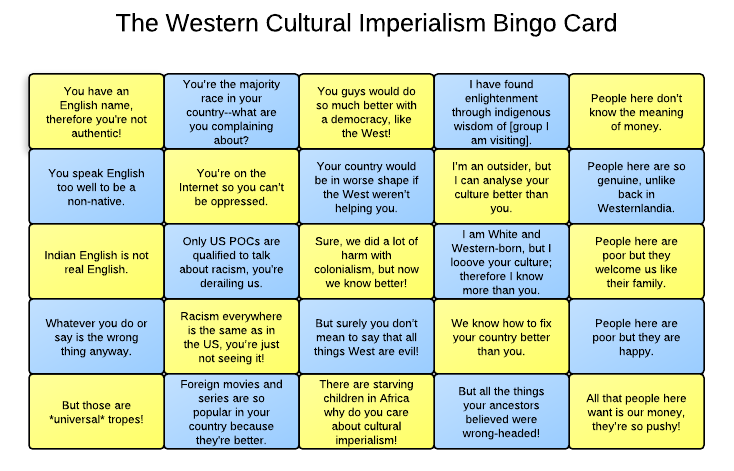
        Signal Boost: Presenting the Cultural Imperialism Bingo Card

        If you think colonialism is dead... think again. Globalisation has indeed made the world smaller--furthering the dominance of the West over the developing world, shrinking and devaluing local cultures, and uniformising everything to Western values and Western ways of life. This is a pernicious, omnipresent state of things that leads to the same unfounded things being said, over and over, to people from developing countries and/or on developing countries.

        It's time for this to stop. Time for the hoary, horrid misrepresentation clichés to be pointed out and examined; and for genuine, non-dismissive conversations to start.

        Accordingly, here's a handy bingo card for Western Cultural Imperialism--and we wish we could say we've made it all up, but unfortunately every single comment on this card was seen on the Internet.

        Card designed by Aliette de Bodard, Joyce Chng, Kate Elliott, Rochita Loenen-Ruiz, @requireshate, Charles Tan, @automathic and @mizHalle. Launch orchestrated with the help of Zen Cho and Ekaterina Sedia in addition to above authors (and an army of volunteer signal boosters whom we wish to thank very much!)

        Any signal boosting on this much appreciated!

        Monday, 11 June 2012

        Guest post: I Hear a Different Frontier by Nisi Shawl

        Fellow geniuses, I have things to tell you that you probably already know. But you may know them in different ways than I do.

        For instance, my friend Jaymee Goh knows about postcolonial science fiction and fantasy the way a woman much younger than me would, and in the way someone who was born and has lived most of her life outside the US would, and in the way of someone who has traveled much further into the figurative world of academia than I. So when she was interviewed in early June on the topic of writing postcolonial SF, and a questioner asked, “Do you think belonging to a Non-Western (sic) culture is essential to write a really good, convincing story about it? Being an outsider to the culture you want to write about is an enriching or empoverishing (sic) experience (or it doesn’t matter in the end)?” her reply was much longer and more considered than mine, and also more revealing. I would have said something like, “I refuse to answer your stupid.” Or, in a more cooperative mood I would have talked about my own experience writing about a culture from its outside, which requires work, which I guess might be equated with “empoverishment.”

        Not Jaymee, though. She bestowed on the questioner several paragraphs of weighty thoughtfulness while flipping the power dynamic inherent in interview and interrogation right around. She noted that describing non-Western cultures from the perspective of their conquerors, or the perspective of their conquerors’ heirs, is quite a longstanding tradition. My favorite line from her response: "I really have to question why any one writer would ask such a question, and am hard-pressed to come up with any other answer besides 'seeking validation.'" Which validation she then proceeded to deny them.

        A couple of weeks before that interchange, I appeared on the “Cultural Not-Appropriation” panel at WisCon 36 with Diantha Sprouse, Sofia Samatar, and Daniel José Older, our moderator. Diantha I’d known for several years, but Sofia and Daniel were new to me.

        Daniel is a something of coreligionist—his practice of Lucumi and mine of Ifa are closely related—so that’s a perspective on empire we share, along with US birth and residency. But Daniel’s also younger than me, plus he’s male, and he speaks Spanish. We both differ from colonizers’ cultural paradigms, but in different ways. Our experiences of postcolonialism, and postcolonial speculative fiction, are different. Like yours and mine.

        Which is where I would have come from if I’d been seriously answering the question Jaymee got asked. Where I did come from when talking on the WisCon panel about How to Do It Right: from the place of being simultaneously innocent and implicated, and paying attention to what that means.

        What we all know, from our many perspectives, is that colonialism bites the flaming donkey weenie. It messes shit up. It messes up most of what could be used to sort shit out and unmess it. It extracts costs from the colonized, costs that are carried across generations. Some of these costs masquerade as benefits. Some are presented as choices.

        I do my best not to contribute to the legacy of colonialism in my fiction, but when it comes to certain entanglements I understand that I must use the utmost caution and concision.

        I made what I’d call a successful foray into explicitly postcolonial science fiction with “Deep End,” which first appeared in the anthology So Long Been Dreaming: Postcolonial Science Fiction and Fantasy (Arsenal Pulp Press, 2004). Taking Australia as a model, I wrote about a prison ship flying to an extrasolar planet with a freight of disembodied activists; these activists were scheduled to be downloaded into clones of their oppressors. “Deep End” was reprinted in my Tiptree Award-winning collection Filter House in 2008. This summer I’m working on a sequel.

        My current novel-in-progress, Everfair, is another deliberate confrontation of colonialism: steampunk set in the Belgian Congo. It arose from my dislike of steampunk’s tendency to privilege imperialism, and especially Britain’s Victorian Empire. It also focuses on the site of one of the worst modern human rights atrocities, an infamous episode intimately connected with the rape of natural resources that lies behind the Industrial Revolution.

        To ensure representation of the multiplicities of non-dominant difference, I’m writing Everfair from many viewpoints: white and mixed-race Europeans, African-Americans, and indigenous Africans. Research is sometimes exhilarating, and sometimes heartbreakingly piecemeal, particularly in the case of the indigenes, whose histories were severely disrupted—to say the least—by their decimation. Often the only voice left to tell a tale is that of the colonizer. When using those versions of events, I do what I can to up-end unwritten assumptions. I learn what I can from the examples of nearby, possibly related, people. I dream and make things up.

        I know I’m treading on the bones of those who went before me. It’s unsteady ground, even if I’m related to the giants beneath my feet. I walk respectfully, carefully, listening with my outer and inner ears. Repeating what I hear, what you already know, but saying it in my way.

        Nisi Shawl was WisCon 35’s Guest of Honor and the editor of WisCon Chronicles 5: Writing and Racial Identity. She is coauthor of Writing the Other: A Practical Approach, a founder the Carl Brandon Society, and a member of Clarion West’s Board of Directors. She edits reviews for the Cascadia Subduction Zone, a literary quarterly. She’s fairly active on Twitter and Facebook, and she promises to update her homepage (www.nisishawl.com) soon.

        Sunday, 10 June 2012

        We See a Different Frontier: Call for submissions

        We are seeking submissions for a colonialism-themed anthology of new stories told from the perspective of the colonized, titled We See a Different Frontier, to be guest edited by Fábio Fernandes and published by The Future Fire.

        THIS CALL IS NOW CLOSED

        It is impossible to consider the history, politics or culture of the modern world without taking into account our colonial past. Most violent conflicts and financial inequalities in some sense result from the social-political-economic matrix imposed by European powers since the seventeenth century—even powerful countries such as the BRICS (Brazil, Russia, India, China, South Africa) have to be viewed through the filter of our history to fully appreciate their current circumstances. The same is true of art and literature, including science fiction; as Rochita Loenen-Ruiz eloquently explained, “it is impossible to discuss non-Western SF without considering the effects of colonialism.” Cultural imperialism erases many native traditions and literatures, exoticizes colonized and other non-European countries and peoples, and drowns native voices in the clamour of Western stories set in their world. Utopian themes like “The Final Frontier”, “Discovering New Worlds” and “Settling the Stars” appeal to a colonial romanticism, especially recalling the American West. But what is romantic and exciting to the privileged, white, anglophone reader is a reminder of exploitation, slavery, rape, genocide and other crimes of colonialism to the rest of the world.

        We See a Different Frontier will publish new speculative fiction stories in which the viewpoint is that of the colonized, not the invader. We want to see stories that remind us that neither readers nor writers are a homogeneous club of white, male, Christian, hetero, cis, monoglot anglophone, able-bodied Westerners. We want the cultures, languages and literatures of colonized peoples and recombocultural individuals to be heard, not to show the White Man learning the error of his ways, or Anglos defending the world from colonizing extraterrestrials. We want stories that neither exoticize nor culturally appropriate the non-western settings and characters in them.

        We See a Different Frontier will pay US$0.05 per word, with a minimum payment of $50, plus the possibility of royalties if sales are good enough. We are looking for stories between 3,000 and 6,000 words in length; we are willing to be flexible about this wordcount, but the further a story falls outside this range, the harder a sell it will be. Please do not submit stories that are also under consideration elsewhere. Query before sending more than one story to us. We are unlikely to be interested in reprints unless they were published only in a market that is not well-known to an anglo-american SF audience, but in any case please query before sending a reprint, explaining when and where the story has appeared before.

        Please send submissions as an attachment (.doc[x], .rtf or .odt) to differentfrontier@gmail.com. The deadline for submissions is midnight UTC, October 31, 2012.

        About the publisher: The Future Fire is an e-published magazine showcasing new writing in Social-Political Speculative Fiction, with a special interest in FeministSF, Queer SF, Eco SF, Postcolonial SF and Cyberpunk. See http://futurefire.net/ for more details.

        About the editor: Fábio Fernandes is a SFF writer and translator living in São Paulo, Brazil. His short fiction in Portuguese has won two Argos Awards in Brazil. In English, he has several stories published in online venues in the US, the UK, New Zealand, Portugal, Romenia, and Brazil. He also contributed to Steampunk Reloaded, Southern Weirdo: Reconstruction, and The Apex Book of World SF Vol. 2. His articles and reviews have appeared in The Fix, Fantasy Book Critic, Tor.com, and SF Signal. He is also the non-fiction editor for International Speculative Fiction.

        Tuesday, 15 May 2012

        Guest Post: I Didn't Know I Was an Alien, or: How I Became a Recombocultural Sci-Fi Guy


        text and art by Ernest Hogan


        It's the 21st century. Modern media interconnects the world. Suddenly, we have a global civilization, and it is diverse.

        Actually, that's an illusion. Civilization has always been diverse. Unless you are part of an isolated tribe that never contacts the outside world, you have to deal with cultures not your own. It's a basic survival skill going way, way, way, way the hell back.

        This illusion is part of the colonial tradition. The conquerors come in and bring “civilization” to the natives, who are expected to cooperate if they don't want to be wiped out. In my part of the world, the Wild West, AKA Aztlán, AKA The Southwest (of the United States of America), it gets interesting – especially since I'm of Mexican descent, with some Irish thrown in, and I accidentally have the same name as the controversial Father of Ragtime.

        I find myself to be a vintage, veteran multicultural (though I prefer the term “recombocultural” for reasons I'll explain later) science fiction writer.

        Some folks would say speculative fiction – and they may be right, but let's get to that later . . .

        I didn't intend to become Mr. Sci-Fi Recombozoid. It was thrust upon me, like my ethnic identity and place in society.

        I was a wee tot way back in 20th century, in the Fifties. I was born in East L.A. – some folks call it the Barrio, my parents called it the Neighborhood. For me it was the flowers in my grandmother's garden that towered over my head. I thought the whole universe was like that.

        Science fiction came in through the television set. Space Patrol and Commando Cody taught me about the larger universe. Later, Forbidden Planet landed at a local drive in. My developing mind learned early about crossing borders, and new frontiers.

        At first the monsters scared me. I was plagued with nightmares, but couldn't stay away. Eventually, I came to love the monsters. They were easier to identify with than the whitebread-kid mold that the media was trying to stuff me into. I found it was easier to tell the kids at school that I was Martian rather than explain myself.

        Those were the days of Godzilla multiculturalism: Japanese monsters, Mexican vampires, Russian space epics, European sleaze, and Filipino horrors were mixed in with the low-rent Hollywood fare. We can't forget that after Bruce Lee, guys in the ghettos and barrios felt they could be heroes, too.

        It was the fabled Sixties. Besides comic books and monster movies, there was the space program, UFOs, ESP, LSD, and a world gone mad on the evening news. After the Chicano Moratorium riots, I found out I was part of a minority group.

        Before that, Chicanos were invisible. Teachers would talk about “Mexicans” – as if we weren't in the room with them. Suddenly, we were problem. It was easier being a Martian.

        So I let my overdeveloped imagination go wild. I wasn't just into science fiction – I was into surrealism, satire, underground, art films, low-budget obscurities, anything weird and out of the ordinary. Cultural mutations became a life-long obsession. Science fiction was a focus, but never a limit to my interests.


        By the Seventies, my reading went to Edgar Rice Burroughs, to Ray Bradbury and Harlan Ellison. Dangerous Visions and the New Wave were a big influence – yes, “speculative fiction.” I also read translations from other countries when I could find them. I was always happy to find a new kind of sf.

        I also reveled in writers like William Burroughs, Ishmael Reed, and Hunter Thompson.

        I boldly started writing and trying to sell my work, I didn't limit myself. I tried to come up with the most daring, outrageous stuff I could, inspired by the diverse world I lived in.

        Yeah, it took me years to get good – but even after I improved, I noticed that the genre and I were going in different directions. After Star Wars, science fiction became popular, but suddenly, everyone thought they knew what it was – traditional melodrama in funny clothes – and it wasn't what I was doing.

        It was also assumed that the audience was white and male – all heterosexual nerds.

        I was told things like “You have blacks and hispanics in there – you have to be careful, they get offended, you know.”

        My name – that I share with a black historical figure – had them thinking I was white.

        By the Eighties, I began to sell stories. These were out in the fringes, but I had my foot in the door. Some readers were confused as to what I was doing in their sci-fi magazine.

        And I wasn't just submitting to sf markets. I sent my stories everywhere – especially if they paid well. It just happened that most of the places that have published me have the words “science fiction” as part of their title. There seems to a tolerance for strangeness in some of these places. It also may be a hold over from when science fiction was a catch-all term for things you didn't understand.

        When I sold Cortez on Jupiter, I didn't mention anything about the Chicano or Aztec stuff. Or the Spanglish. I played up the science fiction elements. I had learned how to get away with things.

        When it came out, I got good reviews (The best [first novel] I've read in science fiction since Neuromancer.Locus), and bad (an avalanche of excessive verbiage and abominable prose styleLocus, a few pages later). But nobody called it dull. And some folks really liked it.

        When my second novel, High Aztech, came out, the publisher did not promote it. The ad in Locus showed the cover, but had no text. No review copies were sent out. People told me that they had to call the publisher and cuss them out to get copies.

        Still, High Aztech gained an audience. People still discover it and put good reviews online. You could say it has a cult following.

        And in the introduction to the glossary for the Españahutl slang is my first use of the word recombocultural. I coined to explain what I do in my work, that was rapidly being label multicultural – a term that was becoming maligned, and associated with political correctness. The recombo is as in recombinant DNA, emphasizes that what I am writing about are the cultural mutations that happen when cultures come together, fuck & fight, damage chromosomes, and generate fascinating new monstrosities.

        But, back in the Nineties, they weren't ready for diversity. The New York-based publishers wanted formula entertainment for their sci-fi consumers that didn't present disturbing concepts. They assumed that the audience was white and middle class. Non-white characters were either pale or only showed the back of their heads on the covers.

        Ideas became scarce. I kept meeting readers who said, “I like science fiction because I always know what's going to happen.” I wondered what I was doing trying to write in this genre.

        Also, word spread about my ethnicity. It seemed like I was being treated differently – like the most talented leper they ever met. Like an alien. And it didn't seem to matter if I was legal.

        I could still sell occasional short stories to far-out fringe markets, but New York wouldn't touch my novels. The rejections followed the same format: They would praise my work as highly original, then tell me that it wasn't what they were looking for. Then they'd inform me about the latest hot, new trend – military sf, sexy vampires, zombies . . .

        After years of rejection, I published my novel Smoking Mirror Blues through a small press. I got a hint of why New York wouldn't touch it when an artist refused to do the cover because of a tantric sex ritual in the beginning. There was also a Chicano mad scientist, lesbian lovers, religion, politics, and the world-as-we-know-it reconstructed to illustrate conflicts that are shaping the future. Yet it has attracted a following.

        As the 21st century lurched along, I gave up on New York. They still saw me as an unpublishable alien. The audience is now seen as being young women who are sexually attracted to the undead. And publishing is going through a crisis, with the economic turmoil and the arrival of the e-book. They say they only want to publish bestsellers, but nothing seems to be selling.

        In the midst of it all, I see young writers coming on the scene, doing the sort of thing that I have been doing for decades. I hope they get treated better than I was. My advice to them is to write the most exciting fiction they can, inspired the world they live in.

        Projects like We See a Different Frontier show promise by doing things in a non-traditional manner. We need these experiments. I expect to see traditional publishing dropping dead very soon.

        Empires are falling. Colonies are rearranging. Cultures are mutating.

        Recomboculture is in the air.

        I have given up on being “commercial.” I am releasing my novels as ebooks, and working on ideas that the dying publishers wouldn't dare touch – like my science fiction bullfighting novel. I have seen the audience, and they are diverse.

        The funny thing is, I am not alien – I am native. I am impure, a Chicano, a mestizo, a mongrel. And that is the future.


        Ernest Hogan's Cortez on Jupiter is available as an ebook from Amazon and Smashwords. Smoking Mirror Blues and High Aztech be available later in 2012. Links to short fiction that can be read for free can be found at his blog, Mondo Ernesto.

        Monday, 14 May 2012

        Guest Post: Decolonizing as an SF Writer

        As I write this, I am thinking of a young writer somewhere in the world who comes from a country just like mine. I write reflecting on the process of decolonization that I am going through as I consider history. This look back may be painful and I may have to face unhappy truths, but still it is important. I need to understand the source of the pain, to accept it, embrace it and find healing so I can reclaim what is mine and become the writer that I want to be.

        #

        Towards the end of the Marcos regime in 1986, Filipinos marched through the streets protesting not only against the dictator, but also against the continued presence on our shores of the American bases and the perpetuation of American influence on Filipino politics and economics.

        While history tells us that we were granted independence in 1912, we know for a fact that the Americans never truly intended to surrender their foothold in our country. Their presence in the Philippines was guaranteed by the acquisition of a lease that granted them permission to establish and maintain Military bases in the Philippines.

        In 1991, this lease expired and as the newly installed Philippine senate refused to grant an extension of this lease, America was forced to vacate the bases. Ostensibly the Americans have left, but they haven’t really left us and what the American occupation has left behind is a great wound on the cultural soul of the Philippines.

        Mark Twain, in his essay, To the Person Sitting in Darkness, speaks out against the Imperialism of the United States and in particular against the actions taken by the Americans in subjugating the Philippines and appropriating the victory of the Filipinos against the Spanish colonizers.

        Mark Twain writes in his essay about the mindset of America in those days: We have got the Archipelago, and we shall never give it up.

        When I read this essay, I can feel the bewilderment of the patriots who had fought and won the war against the Spanish, and I feel utter sorrow in knowing that our supposed allies painted us as being uncivilized and not fit to rule our own country. I also feel indignation on behalf of the soldiers who fought against the Spanish and who realized that they were facing another, more insidious enemy. The thing is, where Spain very clearly presented themselves as conquering overlords, America presented itself as a friend. It was an excellent strategy which confused us completely because what they did to the Filipino was a betrayal of that word “friend”.

        Perhaps this explains why there is a keen edge to the anger we feel when we look at this history. We love and yet we cannot love because on the one hand, there is the face of friendship and the knowledge that the Americans were our allies. On the other hand we see the face of the trusted friend who betrayed us. We realize that we were never considered equals but in the eyes of our white allies, we were savages to be treated as children and to be condescended to as “the little brown brother”.

        I quote history because as an SF writer who comes from a nation steeped in colonialism, this history is relevant as I seek to reclaim indigenous narratives and to break the impositions of colonialism on my culture.

        In his book, “Oral Traditions of the Ifugao”, Manuel Dulawan writes of the colonization of the Ifugao and how the Americans employed public education as a means to neutralize and to Americanize the people. This move was so effective that subsequent governments adapted the principles set down by the American education system without realizing just how much damage this had done and was doing to the existing indigenous culture.

        Dulawan writes: They have been brainwashed in the schools and in the churches and made to believe that their culture is backward and not worth keeping or learning. As a result, their sense of cultural values is disoriented.

        He describes the effects of this cultural brainwashing as being traumatic, sad and painful and writes of how many of those who inherited or adopted the Christian religion assume the conditioned belief that anything of Ifugao cultural origin is either no good or inferior.

        In Ifugao culture, the passing on of traditions and rites are done by native priests who are called Mumbaki. They are assisted in this by the elder tribeswomen who are also trained in the oral tradition. In the past, young girls would spend time with the elder women who taught them the traditions, the chants and the songs. Young boys were sent to spend time with the Mumbaki who passed on to the next generation the oral literature, the rituals of the tribe and the practices which were inherited from the forefathers.

        During the American occupation, the passing on of the oral tradition was suppressed as the native priests and their rituals were demonized not only by the white colonizer but also by the white missionaries who followed in their wake. This meant that the true traditions and the original culture were slowly overlaid with the glaze of white culture and white belief.

        Add all this up and it is no wonder that the psyche and the culture of the Filipino is so scarred and wounded to the point where we see the white and the west as being superior to us in all things.

        Reading the history of conquest and colonization is a traumatic experience for the colonized. The Philippines went through not one, but two colonizers. I wonder how many colonizers other countries had to endure.

        From reading these histories, it becomes clear to me that the erasure and subjugation of existing indigenous narratives were prioritized as these were viewed as being rival to the colonizing power.

        Before the coming of the Americans, the Philippines had already endured four hundred years of colonization under the Spanish regime (1521-1898). It was a colonization that started with the suppresion and the eradication of many of our indigenous culturebearers. Where the American colonizers sought to erase the indigenous culture through the use of education, the Spanish brought with them Spanish friars with the intention of subjugating and exerting influence on the native Filipinos through the use of religion.

        Reading this part of my country’s history, I see how the image of the strong indigenous Filipino woman was slowly and surely erased to be replaced by the idealized and hispanized version of what a Filipina should be. The liberated women of our country were shamed and called lewd and bad and this Christianization inflicted a sense of shame and lesser worth in us.

        In her essay “Silencing the Babaylan”, writer Gemma Araneta Cruz writes of the Babaylan and of the Spanish response to the presence of the Babaylan: Fray Alzina (the Spanish priest) and missionaries like him saw that the babaylan was a formidable obstacle to Christianization who had to be discredited, if not destroyed and forever silenced.

        Who are these Babaylan and what role do these women play in the cultural life of the Philippines?

        When these Spanish friars came to the villages, they noticed the presence of strong women of influence. These strong women were the Babaylan who not only had the power to heal, they were the authority on mythological and cultural heritage, they were the harbingers of ritual and they knew astronomy.

        It was during these encounters that the Friars saw how the Babaylan were a major force and a possible obstacle to their goal of hispanizing and subjugating the archipelago. It was then that the decision was formed to disempower the Babaylan.

        In “Betraying the Babaylan”, Araneta Cruz describes the technique of divide and conquer which the Spanish employed to disempower the Babaylan and effectively erase them. The first thing that the Spanish did was to alienate the effeminate Babaylan from the women priestesses. They also gained the support of the tribal elite in their cause to wipe out the Babaylan through the use of bribery and promises of power. With the male Babaylan and the elite on their side, the Spanish friars went on to accuse the Babaylan of being of the devil and of practicing witchcraft.

        While I narrate events that are specific to the Philippines, I find myself wondering if such events were also mirrored in countries that were colonized by foreign powers. How pervasive is that other culture? How much has it stolen from or killed of the original culture?

        When I look at my country, I see how much these things have harmed our psyche and I also see the resilience of our culturebearers who employed whatever means was at their disposal to preserve our culture. Even so, the wounds have spread deep and there are certain things that demonstrate to us how deeply rooted colonialism is.

        Even to this day, we see young women buying whitening creams because white is perceived as the ideal color. I long to tell my fellow Filipinos, there is nothing more beautiful than kayumanggi (brown).

        At Eastercon, a good friend asked me who I wanted to read my work. It was a question that was unexpected and perhaps because I didn’t expect it, I gave the answer that came quickest to me. I want Filipinos to read my work and in particular, I want the people from Ifugao to read my work. Of course, I amended, I want everyone to read my work, but when I write, I am always thinking of the Philippines.

        When I heard of the We See A Different Frontier project, I was immediately attracted to the premise of an anthology that seeks to bring attention to stories coming from people and places who have endured colonization.

        As a Filipino writer who engages Science Fiction, I see myself in conversation with the SF that comes from the West. A great part of existing SF narrative is that of the colonizer, but my narrative is one wherein I strive to reconcile my decolonization with the truth of my country’s history, the reality of where I am now and my vision of where I want to be.

        I may transgress against the rules of SF because there are many things that I do not know about Science Fiction. I did not grow up surrounded and soaked in its language as Science Fiction fans and writers from the West. But I do know what SF looks like when seen with the eyes of the decolonized. It is a different SF, but it is still Science Fiction. As my Clarion West instructor, John Kessel said: Science Fiction is when I point to it and say that’s science fiction.

        It is easy to be intimidated, and it is a struggle not to be so. And that’s why I think it is important for a writer of color to see other writers and fans of color in the field of Science Fiction.

        In the course of this journey, I have been told that I need to learn English better. That I can’t possibly grasp the nuances of the English language the way a native English speaker does and that I will never be published as an SF writer.

        And then, there are people who say that because I write in English, my narrative is contaminated and no longer true to the culture I come from.

        The people saying those things may believe those things to be true, but I persist because I hear the voices of those who have admonished me from the moment I engaged this genre.

        I hear the voice of my elder sister telling me: Don’t be stupid. Is this your dream or what? Are you going to let yourself be silenced by those words?

        There is my precious grandaunt who told me: there are no limits. If this is what makes you feel passionate, then you must keep on writing it.

        And there are dear friends like Aliette de Bodard who, when I was thinking of giving up, asked me: So, are you going to wait until someone else appropriates your culture? 

        And so I go and commit SF yet again.

        #

        *This essay was inspired by a twitter exchange between Djibril al-Ayad, Kate Elliott, Requires Hate, Aliette de Bodard and I.

        Rochita was the first Filipina writer to be accepted into the Clarion West Writer's Workshop. She attended the workshop in 2009 as the recipient of the Octavia Butler Scholarship. Her short fiction has been published in The Philippines as well as outside of The Philippines. She has a livejournal at http://rcloenen-ruiz.livejournal.com

        This essay is also cross-posted to Kate Elliott's blog where there may be further comments/discussion.

        Thursday, 10 May 2012

        Guest post: International SF - A Modest Proposal


        I’ve been doing a lot of thinking lately regarding difference in SFF – after all, that’s what happen when you start a project called WE SEE A DIFFERENT FRONTIER (if you still don’t know what’s that about, please check here and here). Being part of a global Science Fiction and Fantasy community, you come to expect a great conversation to ensue between people from all over the world – but that doesn't always happen (aside from social networks like Twitter). In fact, although there is SFF of good quality (and quantity) all over the world, most of this material is never read beyond the borders of their home countries, and there seems to be little interest in having them translated to other languages. The Science Fiction & Fantasy Translation Awards crew is doing a great job of raising awareness in the English-speaking world about that, but it’s a big, hard job and their role is not to publish translations.

        In countries like Brazil, we do a lot of translations – mostly from English, but also from French, Spanish, German and Italian. As a result, there is more International SFF in our bookstores’ shelves than Brazilian fiction. Can we say the same thing of an American or French bookstore? Of course not.

        A few days ago, Lavie Tidhar posted on Twitter a comment on his experience regarding Non-Western SF panels in conventions. Quoting him:

        “non-anglophone panel==how can i (english person) get my stuff published in your country.”

        In Brazil’s case, this is easier than you could think – there’s LOTS of publishing houses looking forward to translate American and British SFF, for example (Fantasy is trending HUGELY in Brazil since Harry Potter, Twilight and, now, for an older audience, with Game of Thrones – SF, alas, not so much). But I wonder – would a Latin American writer find the same easy environment in which to get translated out there? The answer, unfortunately, must be no again.

        That’s why I, in a sort of rant, wrote a week ago the manifesto below (or a mini-manifesto, since it’s small and a kind of a draft – I still want to elaborate it further, but the Locus Roundtable and The Cogsmith Roundtable (thanks to Karen Burnham and to Djibril al-Ayad, respectively, for organizing them) prompted me to join in the discussion with a modest proposal, namely:


        How to End International SF in Six Steps – A Mini-Manifesto
        Fabio Fernandes


        1. Accept and embrace diversity. All kinds of. Why? Because it’s there. It was ever there. Here, there, everywhere. It’s all around us. And you are part of it.

        2. If your native language is English, please do yourself a huge favor to learn at least one other language. It’s not as hard as you’d think. It’s not Matrix-easy, but that’s the beauty of it: you only really learn it by practicing it. And one of the best ways of practicing it is with native speakers. And that’s when you can learn more about other cultures.

        3. Speaking of cultures: no culture is superior or inferior to any other. But you already knew that, didn’t you? You only assume that, if you are, for example, a First World citizen, it’s only your duty to humanity to be kind and to help every which way you can the poor citizens of the Third World. Doctors Without Borders is an excellent way to do so. I highly recommend it. You can even help your own poor, because there is hunger in the First World as well (but you already know that). But, in fiction, don’t take anything for granted. Of course conditions may vary (and they will), but people’s needs and emotions are the same wherever you go.

        4. One of the reasons why International SF has the “international” in it is not just because it is from all over the world, but because it is so rare to see it in shelves of Anglo-American bookstores. Well, that should have ceased to be a problem for quite a while now, cause, see, we have thing called the webz. And the webz can be good. But, if the native English speaker must learn another language, the non-native English speaker (who, in most cases, can speak English to save her life, but that’s just it) should walk the extra mile and learn to write (or to translate) her stories to English. English is not going away. (Although it will probably change and mutate in the next decades and becomes something very, very different by the end of the century, but we probably won’t be here, so let’s focus on the present, shall we?)

        5. Writing in English really won’t matter much if non-Anglo speakers don’t do a little more to participate in the global conversation. For example, did you know that ANY SFF NOVEL, REGARDLESS OF THE LANGUAGE IT’S WRITTEN IN, can be nominated for the Hugo Awards? Will it really make a difference? Not in the first few years; not even in the first decade. But eventually it will generate a buzz. A teeny, tiny, persistent buzz. Something that will make people want to learn that language or to have that novel translated so they can read it. And then something may happen. (Before anyone says I’m a Hugo-lover, let me clarify: Yes, I am. But I’m open to conversation about Nebula, Arthur C. Clarke, Ditmar, Aurora, and whatever awards you may happen to remember.)

        6. Maybe we should just stop calling it International SF and just call it SF.


        Fabio Fernandes is an SF writer, and he will be guest editing a special edition of The Future Fire magazine dedicated to colonialism in science fiction. TFF put up a Peerbackers project to raise enough funds to make this a professional rate-paying anthology for authors and artists from outside of the mainstream.

        Thursday, 5 April 2012

        We See a Different Frontier - fundraising

        Today we've started raising money for a themed issue of TFF, tentatively dated for the end of 2012, to be titled We See a Different Frontier. If we're able to raise enough money, this will be a professional rate-paying anthology of colonialism-themed speculative fiction from outside the First World perspective, guest co-edited by Fabio Fernandes (who talks about the rationale of the idea on his blog).

        If you feel this would be a worthwhile project to support, you can donate at this page:
        All donations, however modest, are genuinely appreciated. Even if you can't spare the money, it would be great if you could help to signal boost this appeal: blog it, tweet it, facebook/g+ it, email your friends about it, shout it in the market, slip fliers into books or onto café tables, bribe young attractive people to mention it casually to strangers in nightclubs...

        We're going to be pushing this quite hard over the coming few weeks, with guest posts, interviews, videos, giveaways, contests, gimmicks and whatever else we can think of. We might add new rewards by popular demand. If you have any ideas for things we can do, or that you can do to help, please give us a shout. If you'd like to guest blog for us, appear on video explaining why non-Western SF is important, offer some goodies as a further reward or giveaway, we'd love to hear from you.

        I'll quote the full description from the appeal:
        Colonialism is still a thorn on the side of humankind. Many of the problems of the Third World, for instance, are due to the social-political-economic matrix imposed on its countries by the First World countries since the 17th century (e.g. the manufacture by European powers of arbitrary borders and tribal conflicts in Africa, and then the creation of Arab countries to defeat the Ottoman Empire in WWI). The balance of power is changing in the 21st Century, but it's still essential to look back if we want to truly understand the forces at play in the political and cultural panoramas of Third World countries—and even in countries that hardly can be labeled as Third World, like the BRICS (Brazil, Russia, India, China, and South Africa).

        Much widely distributed science fiction and fantasy is written by American and other Anglophone authors, and treats subjects close to the hearts of straight, white, English-speaking men. There's nothing wrong with this sci-fi itself—we love lots of it—but there's clearly something missing. Having white Anglo cis/hetero/males as (the only) role models is not an option any more. We aim to redress this balance, not only by publishing speculative stories by people with different viewpoints and addressing concerns from outside of the usual area (see World SF), but also by explicitly including fiction that addresses the profound socio-political issues around colonisation and colonialism (see Race in SF). We want to see political stories: not partisan-political, but writing that recognizes the implications for real people and cultures of the events and actions that make up science fictional or fantastic histories, as well as our own history.

        For this anthology we will be looking for stories from the perspective of people and places that are colonized under regimes not of their choosing (in the past, present or even future). We are not primarily interested in war stories, although don’t completely rule them out. We are not interested in stories about a White Man learning the error of his ways; nor parables about alien contact in which the Humans are white anglos, and the Aliens are an analogue for other races. We want stories told from the viewpoint of colonized peoples, with characters who do not necessarily speak English, from authors who have experience of the world outside the First World.

        We want to raise at least $3000 so that we can make this a professional rate-paying anthology for authors and artists from outside of the mainstream. All editorial and technical work will be carried out for no pay, but we feel strongly we should pay authors fairly for their work. This money will cover the cost of paying around $250 for each of 7-8 stories, plus a cover artist, publicity and advertising, review copies, rewards for donors, etc. All profit from sales of the anthology will be paid to the contributors as royalties. If we raise more than this, we can buy even more stories and/or pay even more professional rates to the authors. If we don’t quite make it, we’ll still publish this great anthology, but it may not be as large, as great, or as professional.
        The call for submissions will follow at the end of this fundraising process (in early June), at which point we will be able be able to tell you how much we are going to pay for fiction, what other specific eligibilities and  requirements there will be, and so forth. In the meantime, help to make this a great anthology to submit to by spreading the word now!