In many stories, place is so important that it is almost a character: think of the number of science fiction or fantasy novels where the name of the city is in the title of the book itself (even leaving aside City of Illusions, The City and the City, City of Brass…). In this month’s installment of our recommendation post series, we’re asking readers to tell us about their favorite literary place—fictional, fantastic, or a real place given new life in literature, what place do you wish existed (or are you glad doesn’t); what place feels more real than home? To prime the pump, we’ve asked a few authors, editors and other friends the same question, and their suggestions are below. If any of these inspire you—or you’re disappointed your favorite isn’t mentioned—please leave a comment telling us about a literary place you think is worth visiting.
Vanessa Fogg (blog, twitter)
Sofia Samatar’s debut novel, A Stranger in Olondria, was a revelation to me. This rich, strange, gorgeously written book introduces readers to a secondary fantasy world which is not based on medieval Europe, but which draws, instead, from Africa and the Middle East. The main character, Jevick, is a naïve young man who falls in love from afar with the Empire of Olondria and then journeys through it, getting into plenty of trouble along the way.
Yet despite the wonders of Olondria, it’s Jevick’s homeland of the Tea Islands which affects me most deeply. The Tea Islands, a tropical land of heavy rains and blue hills, of rivers and jungles and “shimmering deltas, the dank-smelling lagoons, a landscape flat and liquid and loved by birds.” A world rendered with such naturalistic detail that it feels utterly real. The Tea islands was my first encounter with a fantasy world set in the tropics. And that has a special resonance for me because my parents came from a tropical country, although in Southeast Asia (Thailand), not Africa. Samatar’s book made me think, “I want to do this, too. I also want to create secondary world fantasy set in a non-European world.” Her book is one of the few that has truly changed my approach to writing.
Subodhana Wijeyeratne (Hulks; Stone Lotus)
Withdrawn and ruinous it broods in umbra: the immemorial masonry: the towers, the tracks. So goes Mervyn Peake's description of one of the most fascinating and compelling creations in modern fantasy: the endless and darkened reaches of the city-castle of Gormenghast. The story of his trilogy's protagonist, Titus Groan, unfolds amidst its ancient and dreary halls. Teeming with a sort of madness that seems to inhabit the walls of the place, as well as the characters themselves, it is a creation that for sheer aesthetic power should, in my opinion, be up there with Middle Earth.
Peake was raised in China for a while, and was heavily influenced by the monuments erected by an ancient kingdom in the vicinity of his childhood home. The central conceit of Gormenghast derives from the feelings these buildings evoked. Timeless, ancient, and melancholy, they were on one hand magnificent. Yet on the other they also seemed to chain the present to a lost past by their very presence, to crush the now with the knowledge of the vast reaches of the then. Deep in a fist of stone a doll's hand wriggles, warm rebellious on the frozen palm, writes Peake, of Titus Groan's birth—but it could be of anyone's.
Urša Vidic (Dalmatian elves)
The city of Armilla is composed entirely of water pipes. Young people might think of a computer game or an old screensaver, but the town itself is much more emotional than that, it has all the colours of metal and a fresh wind whistling and piping on the pipes that are filled with very tangible water. It is not clear if the city is something that remained from the past or a place that was built for the future, but now it is inhabited by water creatures, by nymphs and naiads. They always knew very well how to travel along underground veins and so they feel quite at home in these pipelines that are so full of living water and surprising inventions. Before they moved here, they might have been offended, since people misused water so terribly, so it is possible that the city was built for them as a sculpture to apologize and express a newly-found veneration for them, or they were the ones who have simply driven out all the people. We learn of this place from one of the stories that Marco Polo told Kublai Khan and of course he was lying, but you never know with Italo Calvino’s Invisible Cities.
Damien Krsteski (blog; Faster Tomorrow)
Aurora, a moon in the Tau Ceti planetary system, humanity's second attempt at a home from Kim Stanley Robinson’s brilliant novel, ended up being more than a science-fictional escape for me; when the book came out, I’d just moved to another country, and lying on the mattress in the middle of my empty, freshly-painted apartment—my suitcase in a corner, waiting to be unpacked—I had only Freya and her Ship for company.
And Aurora didn’t turn out to be their promised land. It bristled, and it made the humans sick, and ultimately it shook them off. Freya decided to return home. Because, she realized, there is no such thing as a home away from home: there is only home, and away from home.
When Freya ended her journey back on Earth, I closed the book and left my apartment to walk this foreign city, and I couldn’t help seeing daubs and smears of Aurora everywhere around me: the strange, the new, scaring me off. In time I began pining for Freya’s imagined Earth, too, safe and inviting, but as I adapted to my new surroundings, Aurora and Earth merged and winked out, and I started appreciating—liking, even—where I was, and soon I realized there was nowhere else I’d rather be.
Hella Grichi (blog; twitter)
A place which would be really cool to visit nowadays is Gilead. There would be something so fascinating and empowering to see the boatless rivers and the bloodstains on the walls being scrubbed by handmaids from yesterday’s executions, something so haunting about the dangling corpses and the limited stock at the supermarket. Maybe it would feel so good to know that, now, going home means facing the spouse you chose who will rock you softly to sleep to your favorite movie or curl up with you and two books that you recently bought at the bookshop with the octagonal window covered in evergreens. How enchanting to know you can visit a doctor that shakes your hand, wear the dress with the fox patterns and kiss the girl you like, sitting next to her at school and doing your homework together. Gilead is a dystopian world that is unfathomable for us but if we do not stay alert and raise our fists in anger, maybe we’ll soon enough don green, red and blue robes and remember days at the beach and trips to the doctor as a remote memory of days impossible to retrieve in a world as sterile as the uterus of a commander’s wife.
Valeria Vitale (TFF bio; City of a Thousand Names)
The city of Prague described by Czech writer Leo Perutz in By Night, under the Stone Bridge probably has a lot in common with the actual capital of Czechia, but they are not the same thing. Perutz’s Prague is a place where, especially at night, the boundaries between past and present, reality and dreams become softer, and as easy to cross as one of the city’s streets or bridges. The buildings are still impregnated with the memories of things that (may have) happened centuries ago, especially during the few years when the melancholic and bizarre Emperor Rudolph had moved the capital of the Holy Roman Empire to Prague. In this Prague it wouldn’t be strange to meet angels, golems, powerful rabbis, or dodgy astrologers, still roaming the streets of their city. Perutz’s book is a collection of interconnected stories, all revolving around a city that, in my imagination, is surrounded by an aura of mystery and magic. I have never been to Prague, the real one, but somehow I feel like I have already met the statues on the Carlo Bridge, and that I could navigate the narrow streets of the Jewish Quarter without getting lost. Sometimes I even think that I should never actually go to Prague, and keep enjoying only her ghostly and enchanted literary reflection.
Now we want to hear from you! Please tell us about your favorite literary place in the comments.
Showing posts with label Jorge Luis Borges. Show all posts
Monday, 2 July 2018
Saturday, 21 May 2016
Interview with Álvaro Mielgo Gallego #FaeVisions
Our new anthology, Fae Visions of the Mediterranean, contains 24 stories and poems of horror and wonder of the sea in 9 languages. Among them is “Ya duerme el mutado” by Álvaro Mielgo Gallego, a trippy nightmare of sunstroke and religious
Álvaro Mielgo Gallego has contributed comics, dérives and poetry to DIY-aesthetics and psychogeographical publications. He founded the short-lived Sadwrn, a multilingual zine on situationism, poetry and weird fiction. He currently lives in Madrid, where he produces many notebooks of gibberish every year, writes murder mystery games and secret RPGs.
TFF: “Ya duerme el mutado” is a dreamy, feverish microfiction in which passion (in both the carnal and religious senses) spills over onto the page. Where did the story come from?
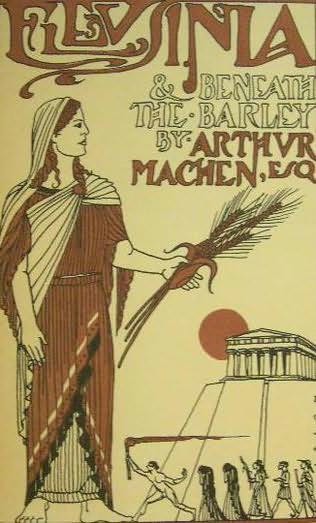
Álvaro Mielgo Gallego: I'd say it was Arthur Machen's fault. Months before The Future Fire's call for submissions for the anthology appeared on the net, I had been reading his long poem "Eleusinia" about the Eleusinian Mysteries, rescued from oblivion by the Friends of Arthur Machen society. That lead to more specific reading on the topic of the Mysteries in Ancient Greece, which in turn suggested the idea of "What if the consequences of a religious sacrament weren't only spiritual but also physical?"
For those who don't know him, Machen was a master of what we call nowadays weird fiction. In some of his tales (like "The Great God Pan") the characters suffer body and mind transformations related to wicked sexuality and ultimate sin. These subjects seemed very fitting for the reverse background of a trendy Neopaganism and a waning Catholicism in Catalonia.
The ending might be very loosely reminiscent of Borges' "El evangelio según Marcos," unfortunately without its terrific build-up for length's sake.
Do you feel a strong connection to the Mediterranean Sea itself?
I was born in Castille, a never-ending high plateau of wheat fields and wastelands. When I was little, the Mediterranean was a crowded, boiling place full of tacky tourists and a general ugliness. To be honest, that is still the picture you get when visiting most of the Eastern Spanish coast, and it'll probably get worse with time due to overbuilding. So it took me quite some travelling and reading to realize the enormous cultural and historical repository the Mediterranean Sea is, and to open my eyes to its dazzling beauty. It was a slow revelation. Now it feels unnatural not to drop by every couple of years.
You've been involved with another multilingual publication, Sadwrn. What do you think is the particular value of such projects?
Multilingual publications whet our appetite for new sounds, new concepts, new spellings or even alphabets. They also show us our ignorance (always humbling), and all the doors to wonders that are closed for us. They have a levelling power: you speak fairly well one or two languages, and there they are, only two among many, just as important as any of the others. The risk of alienating the readers is high, but it's absolutely worth it because of the way these projects reflect the multilingual nature of the world, something we tend to forget. They present to us meaning in a raw state, without translations. While reading Fae Visions of the Mediterranean we are reminded how multicultural the Mediterranean territories were and still are, a vast expanse where monolingualism rarely happened.
Sadwrn attempted this as well, although in a less focused way: it contained poetry, short fiction, interviews on diverse topics and experimental texts in English, Spanish, Welsh and Portuguese. I think it wanted to reflect, using a printed medium, on how the Internet has expanded our cultural menu.
All stories in this anthology have a strong connection to their location. What do you think is the influence of space and place on our memories and feelings?
From the point of view of the rambler, each place we go through and inhabit has its own personality and particular flavour. The relationship between place, feeling and memory is reciprocal: different spaces leave a strong imprint on us, but we also project on them feeling and memory. I'm thinking of Rousseau's "Rêveries", and the way he casts his own musings on the landscape around him. This creates an interplay of the imagination that is actually quite important in the way we relate to the world.
I hope that, by telling stories set around the Mediterranean, we're actively rebuilding a part of this net of meaningful imagined reality for some of the readers, at least in its most monstrous aspect.
Have you ever dreamt a fully fledged story?
Dreams usually don't offer straightforward narratives with a clear three-part structure, and I'm glad they don't because it's the only space nowadays where we can be in touch with the superreal. They always divert and take unexpected turns before you can grasp them. Maybe the main strand of a story is over, but you don't notice it because a new one has opened up. Once I was being chased by bald vampires in a soggy maze made out of cardboard boxes (like a kilometre-wide kids' fort) on a beach, probably in Valencia. Luckily enough that thread gave way to the problem of not having any oranges left, but I couldn't tell between the two until I woke up and analysed the whole dream.
Some other times they tease you with amazing stories you'll never get to enjoy, like when I was walking the streets of a colonial French city by the sea in North Africa, with its Haussmann-style boulevards and blue-roofed buildings. At every crossroads you found colossal, gleaming statues of Egyptian gods in basalt or marble. The dream ended quite suddenly, so all I could do was imagine how exactly the Egyptian religion had spread that far west and survived until the 19th century.
If you were a mermaid, would you try to save the shipwrecked sailors or to drag them down to your coraly kingdom?
Oh, I'd definitely drag them down. I live for that moment when desire, wonder and terror are blended in their eyes. I'm sure they're not personally to blame for the recent bleaching of my coraly kingdom, but I can't help it. Also, I've developed a taste for playing xylophone-based mambo music and believe me, fishbones just lack calcium.
What are you working on next?
I'm writing RPGs and LARPs at the moment, they're incredibly fun, collaborative and rewarding. They bring so many surprises every time.
On the literary side, I have two short tales brewing, but I still don't know when they will hatch, or even how to talk about them. One of them will feature the underground world of Madrid's web of tunnels and a nocturnal marriage; the other is at a much more embryonic stage.
Thank you, Álvaro!
Álvaro Mielgo Gallego’s “Ya duerme el mutado” can be found in Fae Visions of the Mediterranean.
Álvaro Mielgo Gallego has contributed comics, dérives and poetry to DIY-aesthetics and psychogeographical publications. He founded the short-lived Sadwrn, a multilingual zine on situationism, poetry and weird fiction. He currently lives in Madrid, where he produces many notebooks of gibberish every year, writes murder mystery games and secret RPGs.
TFF: “Ya duerme el mutado” is a dreamy, feverish microfiction in which passion (in both the carnal and religious senses) spills over onto the page. Where did the story come from?
Álvaro Mielgo Gallego: I'd say it was Arthur Machen's fault. Months before The Future Fire's call for submissions for the anthology appeared on the net, I had been reading his long poem "Eleusinia" about the Eleusinian Mysteries, rescued from oblivion by the Friends of Arthur Machen society. That lead to more specific reading on the topic of the Mysteries in Ancient Greece, which in turn suggested the idea of "What if the consequences of a religious sacrament weren't only spiritual but also physical?"
For those who don't know him, Machen was a master of what we call nowadays weird fiction. In some of his tales (like "The Great God Pan") the characters suffer body and mind transformations related to wicked sexuality and ultimate sin. These subjects seemed very fitting for the reverse background of a trendy Neopaganism and a waning Catholicism in Catalonia.The ending might be very loosely reminiscent of Borges' "El evangelio según Marcos," unfortunately without its terrific build-up for length's sake.
Do you feel a strong connection to the Mediterranean Sea itself?
I was born in Castille, a never-ending high plateau of wheat fields and wastelands. When I was little, the Mediterranean was a crowded, boiling place full of tacky tourists and a general ugliness. To be honest, that is still the picture you get when visiting most of the Eastern Spanish coast, and it'll probably get worse with time due to overbuilding. So it took me quite some travelling and reading to realize the enormous cultural and historical repository the Mediterranean Sea is, and to open my eyes to its dazzling beauty. It was a slow revelation. Now it feels unnatural not to drop by every couple of years.
You've been involved with another multilingual publication, Sadwrn. What do you think is the particular value of such projects?
Multilingual publications whet our appetite for new sounds, new concepts, new spellings or even alphabets. They also show us our ignorance (always humbling), and all the doors to wonders that are closed for us. They have a levelling power: you speak fairly well one or two languages, and there they are, only two among many, just as important as any of the others. The risk of alienating the readers is high, but it's absolutely worth it because of the way these projects reflect the multilingual nature of the world, something we tend to forget. They present to us meaning in a raw state, without translations. While reading Fae Visions of the Mediterranean we are reminded how multicultural the Mediterranean territories were and still are, a vast expanse where monolingualism rarely happened.
Sadwrn attempted this as well, although in a less focused way: it contained poetry, short fiction, interviews on diverse topics and experimental texts in English, Spanish, Welsh and Portuguese. I think it wanted to reflect, using a printed medium, on how the Internet has expanded our cultural menu.All stories in this anthology have a strong connection to their location. What do you think is the influence of space and place on our memories and feelings?
From the point of view of the rambler, each place we go through and inhabit has its own personality and particular flavour. The relationship between place, feeling and memory is reciprocal: different spaces leave a strong imprint on us, but we also project on them feeling and memory. I'm thinking of Rousseau's "Rêveries", and the way he casts his own musings on the landscape around him. This creates an interplay of the imagination that is actually quite important in the way we relate to the world.
I hope that, by telling stories set around the Mediterranean, we're actively rebuilding a part of this net of meaningful imagined reality for some of the readers, at least in its most monstrous aspect.
Have you ever dreamt a fully fledged story?
Dreams usually don't offer straightforward narratives with a clear three-part structure, and I'm glad they don't because it's the only space nowadays where we can be in touch with the superreal. They always divert and take unexpected turns before you can grasp them. Maybe the main strand of a story is over, but you don't notice it because a new one has opened up. Once I was being chased by bald vampires in a soggy maze made out of cardboard boxes (like a kilometre-wide kids' fort) on a beach, probably in Valencia. Luckily enough that thread gave way to the problem of not having any oranges left, but I couldn't tell between the two until I woke up and analysed the whole dream.
Some other times they tease you with amazing stories you'll never get to enjoy, like when I was walking the streets of a colonial French city by the sea in North Africa, with its Haussmann-style boulevards and blue-roofed buildings. At every crossroads you found colossal, gleaming statues of Egyptian gods in basalt or marble. The dream ended quite suddenly, so all I could do was imagine how exactly the Egyptian religion had spread that far west and survived until the 19th century.
If you were a mermaid, would you try to save the shipwrecked sailors or to drag them down to your coraly kingdom?
Oh, I'd definitely drag them down. I live for that moment when desire, wonder and terror are blended in their eyes. I'm sure they're not personally to blame for the recent bleaching of my coraly kingdom, but I can't help it. Also, I've developed a taste for playing xylophone-based mambo music and believe me, fishbones just lack calcium.
What are you working on next?
I'm writing RPGs and LARPs at the moment, they're incredibly fun, collaborative and rewarding. They bring so many surprises every time.
On the literary side, I have two short tales brewing, but I still don't know when they will hatch, or even how to talk about them. One of them will feature the underground world of Madrid's web of tunnels and a nocturnal marriage; the other is at a much more embryonic stage.
Thank you, Álvaro!
Álvaro Mielgo Gallego’s “Ya duerme el mutado” can be found in Fae Visions of the Mediterranean.
Wednesday, 21 September 2011
U is for Uploaded Minds
What this blog post is, and what it is not
The sub-genre of speculative fiction which we have called Uploaded Minds™ includes any milieu in which characters live out their lives within the confines of one or more computer-generated world. That we will one day achieve this is a conjecture is loaded with philosophical implications. Covering them all in detail would require a book, as well as a savviness in philosophy which I do not possess. Simply listing them would be little more useful than a grocery list, a handful of suggestions fit for a google search.
This blog, then, is not a philosophy lecture.
What it is, is a question of whether the sub-genre of Uploaded Minds may be of any interest to a magazine like The Future Fire.
The Relevance of Speculative Fiction
The Future Fire craves a socio-political angle. At first glance, that is a rather lenient requirement: most sub-genres of sf contain fiction that claims to qualify. Speculative fiction revolves around change, after all, and change affects society, or individual, and usually both. Just as mythology and the classic parables imply that history is cyclic and that we should learn from the tragic choices of its protagonists, so speculative fiction shines its fog-lights on the road ahead, revealing the silhouettes of obstacles before we drive over them, or worse, into them.
But a magazine that accepts everything is a magazine that says nothing. A line must be drawn to create an opinion. Socio-political fiction, then, must be relevant fiction.
By relevant we mean those stories that comment on our society’s current state of affairs or on the human condition (and impact of political positions on) in a universal sense, not necessarily today’s news headlines. The film GATTACA, for example, is a far-future science fiction, but it remains relevant because it questions an issue which remains alive with debate to this day, namely the tinkering of human genetics, the commercialization of such tinkering and the class discrimination that might result from it. For another example, look no further than global warming: ever since its threat was publicized by the media, all manner of doomsday movies have cropped up in cinemas.
But Uploaded Minds Is Hardly Relevant, Is It?
The above definition of relevance is at risk of being misinterpreted. One might be inclined to think that the scenario posited by a science fiction story must be plausible, at least in part, in order for it to be relevant. But if that were so, then fantasy, which is often labeled the literature of ‘that which could never be’, could never be relevant! And yet we know that in many cases it is. Why is that?
When people think uploaded minds, the first thing that springs to mind is usually the movie Matrix. Matrix sits somewhere in the middle of the spectrum. Let us examine the extreme end first: true uploaded minds, more aptly namely simulated reality.
Simulated reality is different than its cousin virtual reality (a common catch-all phrase). Virtual reality can be detected—think video games—whereas simulated reality is no different than a lucid dream, albeit moderated by external rules. The ultimate goal of the “uploaded-mind paradigm” is to shed away not just our senses and our input, but also our physical bodies, and beyond that, our brains. It is to become pure software, an infomorph.
Once we become beings of pure data, we are no longer anchored to our physical bodies for identity. The ramifications of such an existence are endless. We could back ourselves up, leading to indestructibility. We could upgrade to better versions, but then would these multiple versions function as separate, distinct individuals? Which version owns the property? Are they are legally regarded as one? And if so, which version get to take the important decisions? What of the world in which we live? Or worlds, rather, for what is to stop each of us from living in the world we prefer? Who governs and polices this world? How can anyone ever feel safe knowing that the entire universe is hanging from a plug? These are among a host of fascinating issues associated with infomorphia, and it is beyond the scope of this blog to explore them all.
The question we are trying to answer is how relevant these issue are, and can they help us gain insight on our current state of living, our civilization and where it is headed? How likely is that we will become pure software? Not likely, considering we cannot even explain consciousness let alone recreate it. (See ‘The Hard Problem of Consciousness’, a term in philosophy of mind that describes the difficulty in explaining how physical phenomena can lead to the rise of inner life).
Let us take one step back, and examine the pop-culture phenomenon that is Matrix. In Matrix, the human race is imprisoned in mind and body by machines that we ourselves created. It is not the intention of this post to explore the threat of sentient machines, but from the uploaded-minds perspective, the concept put forth by the movie is that we might plug a USB into our napes and so enter an entirely virtual world that defies the laws of physics and intellectual resistance. It is a scenario more plausible than the infomorph, but still highly hypothetical in its premise.
Stories like Matrix are very literal takes on the metaphors of mind. To think that voluntary worlds will be entering our lives loudly and predictably, like cars or computers did, is in my view somewhat naïve. We need just look at massively multiplayer role playing games (MMOs) and social networking (SN) to realize that virtual worlds are already ubiquitous in our lives. MMOs, large persistent virtual game worlds, are subsuming our entertainment. SN has taken over much of our social interactions. But it is more than just time-consuming, mind-numbing escapism that we are dealing with here.
These Realities Are Not Just Windows. They Surround Us.
In his story Tlon, Uqbar, Orbis Tertius, the Argentinian writer Borges described how a group of academics together creates a fictional world in what may be seen as a massive world-building exercise. During the process, disciples of this new reality start placing relics of the invented world in the real world, until eventually true history is entirely subsumed by the invented one of Tlon. As some clever writers have pointed out, this is already happening. Fans at conventions dress like their favorite fictional heroes and villains, buy merchandise, give their children the names of characters from these universes. More and more, we are attempting to drag fictional worlds into our lives.
We may not be uploading our minds to World of Warcraft and Facebook--indeed these games may expire harmlessly in a few years' time--but we would be foolish to not see them for what they are: they are like those round mirrors that stand at tight turns on roads, to help one see what lies behind the bend. In this case, what will happen if we do not delineate the boundaries of escapism.
Many already spend more time in MMO’s or socializing networking sites than they do disconnected from the screen. They prefer their ‘online personas’ to their offline ones. And in no way is it ending here. A large effort is underway to integrate SN’s and MMO’s: one may socialize and network in a separate world, while importing SN friends into an MMO world.
Instead of playing golf, businessmen will be raiding dungeons.
Perhaps this isn’t such a bad idea after all.
Should you send The Future Fire your World of Warcraft fan-fiction? Not exactly. What about stories where human consciousness survives in an entirely virtual (or should I say simulated) digital environment? We have seen that the sub-genre of uploaded minds is relevant despite its far-fetchedness, because despite appearances, the issues it raises may be transposed onto problems we are facing right now in the Information Age.
A story does not have to predict the future to be relevant, though some great works certainly have. A tale that nails tomorrow’s weather fluctuations or the winning lottery number will not make us think twice about today. A story about a far-flung intergalactic civilization where no man has ever touched another except through a multiplayer hivemind, very well might. Relevance is commentary, commentary through questions, imagination, speculation and unconsidered implications. Commentary is what The Future Fire is looking for, and what writers of all genres, not just speculative fiction, should be aiming for if they are to produce not just art, but an insight into the human condition.
The sub-genre of speculative fiction which we have called Uploaded Minds™ includes any milieu in which characters live out their lives within the confines of one or more computer-generated world. That we will one day achieve this is a conjecture is loaded with philosophical implications. Covering them all in detail would require a book, as well as a savviness in philosophy which I do not possess. Simply listing them would be little more useful than a grocery list, a handful of suggestions fit for a google search.
This blog, then, is not a philosophy lecture.
What it is, is a question of whether the sub-genre of Uploaded Minds may be of any interest to a magazine like The Future Fire.
The Relevance of Speculative Fiction
The Future Fire craves a socio-political angle. At first glance, that is a rather lenient requirement: most sub-genres of sf contain fiction that claims to qualify. Speculative fiction revolves around change, after all, and change affects society, or individual, and usually both. Just as mythology and the classic parables imply that history is cyclic and that we should learn from the tragic choices of its protagonists, so speculative fiction shines its fog-lights on the road ahead, revealing the silhouettes of obstacles before we drive over them, or worse, into them.
But a magazine that accepts everything is a magazine that says nothing. A line must be drawn to create an opinion. Socio-political fiction, then, must be relevant fiction.
By relevant we mean those stories that comment on our society’s current state of affairs or on the human condition (and impact of political positions on) in a universal sense, not necessarily today’s news headlines. The film GATTACA, for example, is a far-future science fiction, but it remains relevant because it questions an issue which remains alive with debate to this day, namely the tinkering of human genetics, the commercialization of such tinkering and the class discrimination that might result from it. For another example, look no further than global warming: ever since its threat was publicized by the media, all manner of doomsday movies have cropped up in cinemas.
But Uploaded Minds Is Hardly Relevant, Is It?
The above definition of relevance is at risk of being misinterpreted. One might be inclined to think that the scenario posited by a science fiction story must be plausible, at least in part, in order for it to be relevant. But if that were so, then fantasy, which is often labeled the literature of ‘that which could never be’, could never be relevant! And yet we know that in many cases it is. Why is that?
When people think uploaded minds, the first thing that springs to mind is usually the movie Matrix. Matrix sits somewhere in the middle of the spectrum. Let us examine the extreme end first: true uploaded minds, more aptly namely simulated reality.
Simulated reality is different than its cousin virtual reality (a common catch-all phrase). Virtual reality can be detected—think video games—whereas simulated reality is no different than a lucid dream, albeit moderated by external rules. The ultimate goal of the “uploaded-mind paradigm” is to shed away not just our senses and our input, but also our physical bodies, and beyond that, our brains. It is to become pure software, an infomorph.
Once we become beings of pure data, we are no longer anchored to our physical bodies for identity. The ramifications of such an existence are endless. We could back ourselves up, leading to indestructibility. We could upgrade to better versions, but then would these multiple versions function as separate, distinct individuals? Which version owns the property? Are they are legally regarded as one? And if so, which version get to take the important decisions? What of the world in which we live? Or worlds, rather, for what is to stop each of us from living in the world we prefer? Who governs and polices this world? How can anyone ever feel safe knowing that the entire universe is hanging from a plug? These are among a host of fascinating issues associated with infomorphia, and it is beyond the scope of this blog to explore them all.
The question we are trying to answer is how relevant these issue are, and can they help us gain insight on our current state of living, our civilization and where it is headed? How likely is that we will become pure software? Not likely, considering we cannot even explain consciousness let alone recreate it. (See ‘The Hard Problem of Consciousness’, a term in philosophy of mind that describes the difficulty in explaining how physical phenomena can lead to the rise of inner life).
Let us take one step back, and examine the pop-culture phenomenon that is Matrix. In Matrix, the human race is imprisoned in mind and body by machines that we ourselves created. It is not the intention of this post to explore the threat of sentient machines, but from the uploaded-minds perspective, the concept put forth by the movie is that we might plug a USB into our napes and so enter an entirely virtual world that defies the laws of physics and intellectual resistance. It is a scenario more plausible than the infomorph, but still highly hypothetical in its premise.
Stories like Matrix are very literal takes on the metaphors of mind. To think that voluntary worlds will be entering our lives loudly and predictably, like cars or computers did, is in my view somewhat naïve. We need just look at massively multiplayer role playing games (MMOs) and social networking (SN) to realize that virtual worlds are already ubiquitous in our lives. MMOs, large persistent virtual game worlds, are subsuming our entertainment. SN has taken over much of our social interactions. But it is more than just time-consuming, mind-numbing escapism that we are dealing with here.
These Realities Are Not Just Windows. They Surround Us.
In his story Tlon, Uqbar, Orbis Tertius, the Argentinian writer Borges described how a group of academics together creates a fictional world in what may be seen as a massive world-building exercise. During the process, disciples of this new reality start placing relics of the invented world in the real world, until eventually true history is entirely subsumed by the invented one of Tlon. As some clever writers have pointed out, this is already happening. Fans at conventions dress like their favorite fictional heroes and villains, buy merchandise, give their children the names of characters from these universes. More and more, we are attempting to drag fictional worlds into our lives.
We may not be uploading our minds to World of Warcraft and Facebook--indeed these games may expire harmlessly in a few years' time--but we would be foolish to not see them for what they are: they are like those round mirrors that stand at tight turns on roads, to help one see what lies behind the bend. In this case, what will happen if we do not delineate the boundaries of escapism.
Many already spend more time in MMO’s or socializing networking sites than they do disconnected from the screen. They prefer their ‘online personas’ to their offline ones. And in no way is it ending here. A large effort is underway to integrate SN’s and MMO’s: one may socialize and network in a separate world, while importing SN friends into an MMO world.
Instead of playing golf, businessmen will be raiding dungeons.
Perhaps this isn’t such a bad idea after all.
Should you send The Future Fire your World of Warcraft fan-fiction? Not exactly. What about stories where human consciousness survives in an entirely virtual (or should I say simulated) digital environment? We have seen that the sub-genre of uploaded minds is relevant despite its far-fetchedness, because despite appearances, the issues it raises may be transposed onto problems we are facing right now in the Information Age.
A story does not have to predict the future to be relevant, though some great works certainly have. A tale that nails tomorrow’s weather fluctuations or the winning lottery number will not make us think twice about today. A story about a far-flung intergalactic civilization where no man has ever touched another except through a multiplayer hivemind, very well might. Relevance is commentary, commentary through questions, imagination, speculation and unconsidered implications. Commentary is what The Future Fire is looking for, and what writers of all genres, not just speculative fiction, should be aiming for if they are to produce not just art, but an insight into the human condition.
Tuesday, 13 September 2011
M is for Magical Realism
When I hear “magical realism” I think of the works of Franz Kafka, Jorge Luis Borges, Gabriel García Márquez, Toni Morrison, Angel Carter, Isabel Allende, Salman Rushdie, Ben Okri, Jeannette Winterson. On the surface it is a genre that is barely speculative fiction, that is perhaps a slipstream attempt to write fantasy while remaining in the respectable realm of literary fiction. And on the other hand, most of the magical realist stories we have published over the years (‘Letting Go’, ‘Pianissimo’) have been social rather than political, moving rather than rousing. As the “magic” is typically underplayed in this type of fiction, what we are left with is human action and interaction, the heart of all good writing.
But there is more to magical realism than fantasy-lite. All of the authors listed above write unrelentingly political work, with settings where mythology and folklore, or the bizarre and the surreal, bleed into the all-too-real world; rather than providing escapism and excitement, the presence of magic serves to put the ugliness and violence of political abuse into starker contrast. This is the realism of our world, not safely distanced by a fantastic setting. This is the core to understanding our attraction to magical realism: the “realism” part of its name suggests that there is a tough core to the genre, a grittiness that puts it at (or slightly beyond) the darkest edge of the respectable literary spectrum.
In a magical realist story (like ‘Apala’, ‘In the Shadow of Kakadu’ or ‘Nasmina’s Black Box’) mysterious powers may seep into the “real” word without anyone batting an eyelid, and it may be handled realistically and with attention to human reactions and behaviour, but it doesn’t change the world. Corrupt politicians can still cover up their crimes; brutal military regimes can still repress all opposition; an ugly, bigoted mob can still brutalize a woman who dares to stand up; a native child can still be taken from his home by well-meaning colonials. Because a magical realist plot, like those of the best socio-political speculative fiction works, recognizes that it is human behaviour, cultural reactions, social interactions and political power that drive the world, not possession of a laser gun, ninja abilities, a divine parent or the power to speak to animals.
But there is more to magical realism than fantasy-lite. All of the authors listed above write unrelentingly political work, with settings where mythology and folklore, or the bizarre and the surreal, bleed into the all-too-real world; rather than providing escapism and excitement, the presence of magic serves to put the ugliness and violence of political abuse into starker contrast. This is the realism of our world, not safely distanced by a fantastic setting. This is the core to understanding our attraction to magical realism: the “realism” part of its name suggests that there is a tough core to the genre, a grittiness that puts it at (or slightly beyond) the darkest edge of the respectable literary spectrum.
In a magical realist story (like ‘Apala’, ‘In the Shadow of Kakadu’ or ‘Nasmina’s Black Box’) mysterious powers may seep into the “real” word without anyone batting an eyelid, and it may be handled realistically and with attention to human reactions and behaviour, but it doesn’t change the world. Corrupt politicians can still cover up their crimes; brutal military regimes can still repress all opposition; an ugly, bigoted mob can still brutalize a woman who dares to stand up; a native child can still be taken from his home by well-meaning colonials. Because a magical realist plot, like those of the best socio-political speculative fiction works, recognizes that it is human behaviour, cultural reactions, social interactions and political power that drive the world, not possession of a laser gun, ninja abilities, a divine parent or the power to speak to animals.
Friday, 2 September 2011
B is for Borgesian
Google’s doodle on the 24th of August celebrating Borges’ 112th birthday greatly pleased me since I have always felt the Argentinian writer never got the credit he was due. The fact that he never won the Nobel prize confounded me, just as it did the author himself: “Not granting me the Nobel Prize has become a Scandinavian tradition; since I was born they have not been granting it to me,” he once remarked. I was first introduced to the works of Jorge Luis Borges during an ‘Interactive Narrative’ module in Trinity College Dublin. I was blown away by the required reading text of ‘The Garden of Forking Paths,’ not just for its experimental narrative or its magical realism (my favourite genre back then) but for how the story eerily encompassed so many issues I was concerned with at the time. I got chills while I read a reference to the Irish historical period I was researching: the description of Richard Madden, the “Irishman in service of England” in the year 1916 of all years; one of the most turbulent in my country’s history, one that set in motion the long, violent and tragic process of Ireland gaining independence from Britain.
The mention of Dr Yu Tsun’s ‘resources,’ among them a red and a blue pencil – for years ‘my’ signature writing implements, ones that always seemed to evoke interest from others for some reason. I knew these parallels were sheer coincidences; however a small part of me liked to think that I was co-creating a sort of collaborative fiction with the deceased writer, that there was a sort of hive mind at work; not constricted by time, just like the forking paths he described in the story. It was as though one of those different yet equal paths through the networks of time had found itself in me, the reader…
After reading ‘The Garden of Forking Paths,’ such improbable and delusional notions seemed somehow plausible. Only the best fiction could induce such an immersive response in a reader; but for speculative fiction, the barre is raised even higher, as the author has to present unreal concepts convincingly. No better writer than Borges to successfully accomplish this however; anyone who can formulate the universe into hexagonal library rooms (as he did in ‘The Library of Babel’) is clearly adept at presenting the most complex ideas in a succinct and compelling way.
These days I am somewhat more objective about my love for Borgesian literature. Borges’ legacy is so widely encompassing it is hard to quantify its numerous and varied facets; but here are the areas that stand out for us in his vast contribution to literature:
Magical Realism and Surrealism
Borges’ work is full of monsters, alternate histories and fantasies, surreal stories that undermine traditionalist structures by their very eschewing of realism. Even if on the surface they may seem to be pure fantasy, Borges stories often twist reality (as in many entries in The Book of Imaginary Beings or A Universal History of Infamy), subvert it to comic effect, or warp reality in an absurdist manner, creating a new world which is then taken deadly seriously, literally, and in doing so reveals the absurdity of our own socially-constructed reality.Experimental narratives
Borges is known for his postmodern story structures; meta-fictions that address issues of writing, art, creativity and lying, implying that reality itself is as constructed as our stories and myths. He writes pieces that illustrate the social and historical contingency of writing, such as ‘Pierre Menard, Author of the Quijote’ (a theme he also addresses in the essay ‘Kafka and his Precursors’, further blurring the distinction between fiction and criticism).Other experiments with narrative form include ‘The Theme of the Traitor and the Hero’, a story disguised as the précis of a novel (also involving revolutionary Ireland!), or hoaxes such as his fake book reviews, which combine creation with the mischievous and postmodern wit that was his particular genius. If inventing stories is a form of lying, then what greater lie than to pretend not to be creating a story at all?
Bibliophilia
It is hardly surprising that Borges was a librarian. His love of books and learning is omnipresent in his writing, with motifs such as the library (‘The Library of Babel’), the encyclopaedia (‘Tlön, Uqbar, Orbis Tertius’) recurring with reassuring regularity. There is a circularity in a story about books destined to be printed in books, written by a man who will never read them by himself (Borges became blind mid-way through his career), but whose whole life was surrounded by them. Almost every novel, story, or film centered around a mysterious book or based in an antiquarian bookseller feels Borgesian to me.Borgesian stories in 'The Future Fire'
Given the great man’s range, we should think a bit about what would make a short story written today “Borgesian”. Recent authors who deserve this soubriquet might include mischievous and postmodern writers such as Umberto Eco and Salman Rushdie, cheeky and not afraid to be clever, always confounding expectations; writers such as Isabelle Allende and Ursula K. Le Guin who have adopted the sheer beauty and poetry of writing as core to everything they do; authors who exhibit the wicked inventiveness and bibliophilia in their twisted works, like Jonathan Carroll, Neil Gaiman and Clive Barker; absurdist fantasists like Rhys Hughes; and writers of mercilessly mocking, political meta-narratives like Joanna Russ. Many other authors who work in the genres of magical realism, surrealism, postmodern/metafiction, fantasy have drawn from the infinite library of Borges’ inspiration. These writers have helped to make our reception of Borges what it is today: as he himself said in ‘Kafka and his Precursors’, “every writer creates his precursors.”At another level, every author who lets their writing, while beautiful and exciting, reflect an undiluted political sensibility, could be deemed ‘Borgesian.’ Although Jorge Luis Borges himself was a social conservative, and we at TFF tend to a more progressive and speculative approach, his sensitivity to the social and political relevance in all stories, without needed to slap the reader in the face with it, is something we admire and encourage.
If you have written something “Borgesian” in any of the senses above; or if you want to try something unusual in structure or format or medium; or if you want to write a story that is disguised as a book review, as an exchange of blog posts, as a social media phenomenon; or if you want to publish a fake review of a nonexistent book in a reviews blog or a nonfiction section... Call us. I mean it—we are especially fond of this type of thing. (It’ll have to be good, as everything does, but we really are willing to be playful.)
Subscribe to:
Posts (Atom)