Showing posts with label cyberpunk. Show all posts

Friday, 12 August 2022

Micro-interview with Sarah Day

We ran a micro-interview with Sarah Day, author of “The Heart of the Party” in The Future Fire #62.


TFF: What does “The Heart of the Party” mean to you?

Illustration © 2022 Miguel Santos

Sarah Day: “The Heart of the Party” is an exploration of the consensuality of inclusion, basically—that we opt in to communities as much as we may perceive ourselves to be validated or included by a community's inclusion of us. Clear self-expression is a key value that contributes to how I practice my various identities, whether that means which ones I choose to express in a given moment, or the ones that are applied to me by social mores or stereotypes. Consciously choosing your community is way more empowering than accepting the defaults assigned to you, and I think that comes through pretty clearly in the text.

TFF: If a device enabled to share thought and emotions with other people, would you connect to it?

SD: No. I feel enough of people's emotions already without additional wetware. I also work in tech—it's impossible for me to imagine new technology without imagining its commercial or society-wide applications. The idea of normalizing shared emotions among the general populace sounds like a bit of a gender and racial nightmare. Even with all my privilege, I still experience the expectations around silent emotional labor applied to most women, and I definitely wouldn't want to give people more of a reason to expect that I would be doing more of that because I could perceive their feelings and thoughts. And like most power structures, the farther you get from being a straight able-bodied cis white man, the worse I imagine this would go: feeling the barista's racism as you queue up for your morning coffee, hearing a passerby's ableist thought as they navigate around your wheelchair. That's a hard no from me.

TFF: What are you working on next?

SD: I just sold my debut novella, Greyhowler, to Mark Teppo of Underland Press!


Extract:

Staring at the Patrollers across the street, I worried at my crippled implant the way I would work my tongue in an empty tooth socket, trying for the millionth time to activate it. No joy. The frizz of feedback in my hand told me they were still communicating, but the hardware was too damaged for me to hear them. I could guess their conversation, though; they were trying to understand why I’d flash an implant scar at them in broad daylight. Use of networking technology by civilians was illegal, and I was clearly a civilian.

Reminder: You can comment on any of the stories or illustrations in this issue at http://press.futurefire.net/2022/07/new-issue-202262.html

Wednesday, 16 March 2022

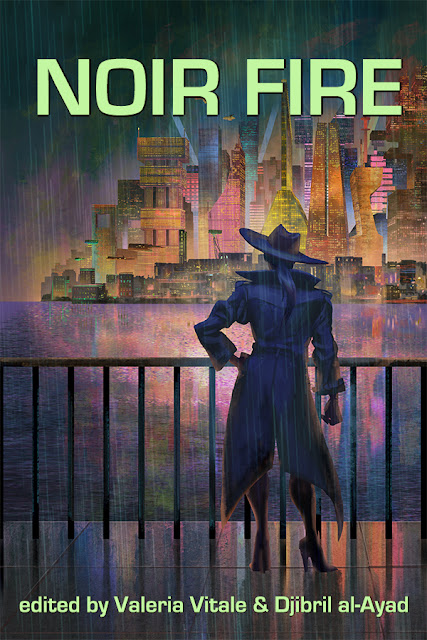
Noir Fire: Cover reveal

The observant and deductive among you will have noticed that Futurefire.net Publishing have been plotting a noir-themed speculative fiction anthology for a while. The print and e-book anthology of 14 stories will appear in a few weeks time, and there will be a sneak preview of a few of the pieces in the next issue of TFF magazine at the beginning of April. Watch this space for announcement of the table of contents. In the meantime, we are excited to share with you the fabulous cover image, which was painted for us by the stunningly talented Saleha Chowdhury.

We wanted a cover image that captured the Noir aesthetic, but with a bit more of a progressive, cosmopolitan, inclusive feel to it; an image ambiguous enough to evoke science fiction or fantasy, but with an explicit cyberpunk ambience; perhaps a female or gender-nonconforming character who was not just a victim or motivator for a mourning male protag.

Saleha gave us all of this in spades, and so beautiful and with layers of creativity to boot! We couldn’t be more chuffed! As excited as we are to share the lovely stories with you, this is just the icing on the cake.

Just wait til you see the glossy high-res version on the cover of the book itself.

Tuesday, 29 June 2021

Tech Noir special: in conversation with Zoë Blade

Way back in 2013 we published a story that could have been a paradigm for the speculative, progressive Noir crossgenre, in the form of Zoë Blade’s “Terminal City.” Fittingly, as we prepare for the Spec-Noir themed issue of TFF at the end of the year, we have invited Zoë over to talk about Cyberpunk and Noir aesthetic, social justice and speculative fiction, and transhumanism, among other things.
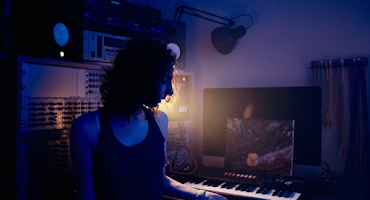

Zoë in the studioWhen she's not writing cyberpunk fiction, Zoë Blade can be found in her studio, making music for the leftwing side of YouTube.


The Future Fire: Would you like to talk a little bit about “Terminal City” to start out? We enjoyed this story not only because of the social-justice and dystopian themes, the alternative-history cyberpunk setting and classic Noir aesthetic, but also because of its unapologetically geeky and subculture references. It's also a powerful story in its own right, and it lets a little more hope creep in at the end than some Noir allows itself, but it by no means overturns the dystopian setting or guarantees a happy ending or improved circumstances for the protagonists. To what degree did you think about genre and aesthetic writing this story, as opposed to letting the plot and characters dictate elements like settings and environmental details?

Zoë Blade: Thank you! I think I started with an image in my head of someone using a public terminal in the rain. I'd read about the Esper machines in Blade Runner, how they were networked and performed all these other tasks besides zooming into photos. You can see a few in the film, but they're never mentioned. This was as interesting to me as anything in the film.

Companies, universities, and libraries used to have these big mainframes, that people would access remotely with dumb terminals instead of having their own computers. As a teenager, I was amazed when I first installed a Unix clone covermounted on a magazine. I got to play around with a tiny mainframe all of my own! It felt very empowering, the same way it felt getting my first home computer.

Another big part of the hacker community is phone phreaking, another large network you can only access in small glimpses. I'd also become fascinated by Kowloon Walled City, perhaps the most cyberpunk-looking place on Earth, a maze of rooms where everyone would steal everyone else's electricity and sublet wherever someone might conceivably fit, even in the middle of a diner or factory. So I kind of connected all these threads together.

At its heart, I think “Terminal City” is about a corporation trying to control a piece of technology, computing power, versus a flourishing community of street-level hackers trying to turn it into something everyone can use independently. It made sense to me to set it in an alternate history, where a phone company leased out accounts on their mainframe, that you could access via public terminals strewn throughout the city, and no-one had their very own computer, only leased terminals they could plug into their network and log onto their paid account. I think the main difference is that in real life, no corporation ever tried to suppress microchips, thankfully.

Perhaps it was mostly written out of frustration at what I saw as people ripping off the least interesting aspects of The Matrix. Behind the Bullet-Time effect and the violence was a tale of diverse hackers standing up against authoritarian white men in suits telling them who they couldn't be and what they couldn't do. In a BDSM club, naturally. Who doesn't want to visit that world?

TFF: What did cyberpunk mean to you? Is the character of the hacker an essential prototype, like the P.I. in Noir?

ZB: As a Brit who grew up in the eighties and nineties, it’s somewhat inevitable that I’d be immersed in the dominant popular culture of the time, hailing from the exotic lands of Japan and America. As a loner who enjoyed programming home computers like my trusty Commodore 64, my taste naturally skewed towards the usual suspects favoured by hackers: Blade Runner, Neuromancer, Ghost in the Shell, Snow Crash, Pi, and The Matrix. They feature hackers as heroes, an escapist fantasy for technically-minded shut-ins. And as a transgender woman, I naturally gravitated towards stories of people who modified or outright abandoned their own bodies, and questioned who they really were in spite of how others treated them.

It was only years later, as an adult, that I learned Brits and Americans had feared Japanese businessmen taking over their corporations, something they projected onto everything from Brazil to Die Hard. As a child, that fear completely went over my head. Of course the future was Asian. Watching Dominion: Tank Police, with its female protagonist, I’d associated more with that imagined world than any of the American ones.

As for the hacker: I try to avoid using the generic archetype characters I've seen mentioned in writing guides (“hackers are tricksters like the mythological Loki”) in favour of what I know: hackers tend to be technically knowledgeable yet socially naïve people who wield a lot of power with reckless abandon, for better or worse. I think that covers everyone from Aaron Swartz to Zuckerberg.

TFF: We’d like to ask you more about the relationship between body and identity, which is a popular trope in Cyberpunk, from machines that gain consciousness (or become more human than humans), to people trying to replicate or download their memories and feelings. How do you feel this concept resonates with those who have made the decision to modify or otherwise redefine their bodies?
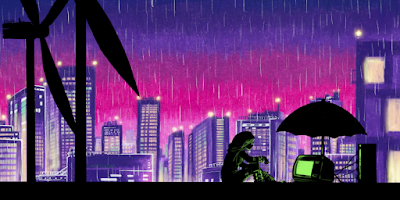
Terminal City, illustrated by MonosílaboZB: I suspect I'm far from the only transgender woman who felt Major Motoko Kusanagi from Ghost in the Shell resonated with her. Though in a way it's reversed, as she wasn't convinced she had a human brain, and felt that how other people treated her was what granted her humanity; whereas transgender people generally spend a lot of time and anguish working out exactly what and who their brain is, in spite of other people's disbelief.

What always seems absurd to me is how many cisgender people consider themselves to be transhumanists, imagining themselves to have escaped the rigid bonds of being overly attached to an unmodded body... and then proceed to be transphobic without missing a beat. If you're against people overriding their own endocrinological system, then what exactly do you want to allow people to do? I think for most transgender people who overly think things through, it's a natural extension to be very much in favour of everyone's bodily autonomy. A lot of us have firsthand experience of its necessity for happiness or even any kind of normal life.

It's also obviously a nice fantasy that you could transplant your brain into a body that hasn't been damaged from being on the wrong hormones, but allowing young people to block the wrong ones before they can take effect has presumably diminished the need for such escapist wishful thinking.

TFF: Cyberpunk literature and popular culture have probably made us imagine artificial intelligences as an expression of rigid objectivity. But now that we can actually see AIs at work, we see that they simply replicate the same biases that appear in the data that were fed to them. Do you think that this changes the way we look at AIs in cyberpunk, not as superior ethical and objective beings, but bearing the baggage of all our worst prejudices, power imbalances, and other ugliness?

ZB: I think there are two quite different concepts of AI here, leading many people to talk at cross-purposes. Cyberpunk imagines a general-purpose AI that's roughly analogous to a human brain: simple parts, replicated billions of times, interconnected. Like a human child, this new kind of lifeform would need to be carefully nurtured and loved in order to grow into a responsible adult. The main issue there being that only corporations and perhaps governments could afford such technology, at least at first, and they are far from loving parents. Raising a human child in such an environment would be unconscionable, and the scenario isn't improved with that child having thought processes that are utterly unfamiliar to us, and eventually far smarter than us.

What we instead currently have in real life are small, specific bits of computer code that were rapidly evolved in an automatic training process. You tell a computer “here's somebody doing a thing. Please write some random code and tinker with it until it does more or less the same thing as them.” All we've managed to do there is automate the biases of the person whose work is being replicated. All this technology, and we've simply automated racism. It's bias laundering, so managers can say “see? This machine's doing the same thing, and it can't be prejudiced, it's a machine.”

A third option I'm hopeful for is some kind of artificial intelligence that can look at the big picture and point out our biases. That can sift through all the data out there and work out various things we've misinterpreted, or that are statistically suspicious. Something too smart to say “Bob's giving more jobs to people named Greg than Lakisha, so I'll do that too, as presumably Gregs must be better at the jobs.” Instead, it might say “Bob's giving more jobs to people named Greg than Lakisha, so let's work out why this correlation exists,” then it would go off and look at all the worldly data it can find, and finally show how racism and sexism have tarnished all our knowledge and actions. But then, we don't need a machine to tell us that the system's rigged. We need to listen to all the minorities who have already been telling us for a very long time.

TFF: Is cyberpunk basically “tech noir” then?

ZB: Cyberpunk’s aesthetic is solid Noir. Hidden beneath the glamorous façade portrayed elsewhere, the seedy underbelly is populated by far more relatable characters, denied a place in mainstream society. Forced into black markets just to survive, their lyrical street slang obfuscates the illicit work demanded from them, at once publicly punished and privately required by polite society, from the sex work that exploits their perceived exoticism through to the corporate espionage that requires their unique skills.

The aesthetic is an easy sell, a cluttered mess of smoke, rain, neon, cables, litter, and the violence that inevitably engulfs black markets. The harder pill to swallow is that these seemingly superficial trappings are inexorably intertwined with the all too real poverty and discrimination endured by people denied legitimate jobs. It’s a genre of underdogs, relatable realism for some, poverty tourism for others. Because even your suffering is a commodity to be packaged and sold.

At the heart of the genre are clones, robotic replicas, and wholly new AI, all trying to break free of their bonds, placed on them by the all-too-human heads of megacorps and zaibatsu, who fully expect them to be as oppressive as themselves. While the fear of being literally inhuman is a modern one, being treated as such is all too real for many people.

Blade Runner is the epitome of this future noir, showing someone mercilessly hunting freed synthetic slaves only to have his own humanity in turn questioned. The aesthetics, themes, and plots are inseparable. Cyberpunk expresses our fight to have our humanity recognised, and our freedom granted.

TFF: Is there something else you’ve worked on recently that you’d like to tell us about?

ZB: Let’s go with Inhuman, a comic about a Japanese hitwoman who wakes up to discover she’s a synthetic replica of her former self, who her client is trying to kill. Which corporation would you want to have full autonomy of your body?

When an assassin regrets killing her latest target, she discovers how hard it is to quit her job and go freelance.

At its core, Inhuman is a story about a woman who has a phobia of electronic recreations of people, only to wake up one day to discover she's been made into such a recreation herself. She has to team up with her original human self in order to work out why the corporation she was working for robbed her of her body, and expose their secrets.

I originally wrote it as a screenplay, but as it's an original property and would need the kind of ridiculously high budget reserved for established franchises, I'm currently working with my regular artist Monosílabo to turn it into an online comic book. We’ll hopefully be sharing it soon on our online media, including https://twitter.com/zoeblade and https://twitter.com/monosilabo_art.

TFF: Thank you for joining us, Zoë!


If you fancy your hand at some speculative or progressive Noir short fiction or poetry, please consider sending something in for the TFF-Noir themed issue this year.

Tuesday, 3 December 2019

Retrospective on Sepulveda Baron

Guest post by J. Rama Stephens

Acclaimed futurist Sepulveda Baron, 62, has died suddenly, while transiting a full-body-scanner at Kuala Lumpur airport en-route to speak in Tokyo. The world has lost an intellect described by Locus Magazine as “a piercing searchlight into the darkest corners of dystopian fiction.”

Baron was the third child of Robert and Artemisia Baron. Her mother was a Republican survivor of the retirada following the Spanish Civil War, recruited from the Argelès refugee camp in France as an SOE courier, then as a clerk for MI6 from 1945. There, she worked with (and married) Sepulveda’s father, MI5 section head Robert Baron.

Sepulveda Baron’s early life was (by her account) happy. In a 2005 interview in the Guardian (the only time she talked to the press) she described a family home at Bletchley giving onto woodlands and the Grand Union Canal: “long summer walks on the towpath with my father gave me an early fascination with Victorian-era engineering and morality. That fascination never left me, but I did become more interested in digital tech—the kind that really gets under your skin.” Through her early years her mother often hosted a motley gathering of expat Republicans. Baron would sit in, sipping rioja. Her mother’s civil war stories and heart-on-sleeve politics would shape Baron’s approach to cyberpunk as “literary expression of late capitalism.” She refused to set foot in what she called “Franco’s neoliberal Spain,” but was plugged in to a network of expatriate connections, online and off.

Baron left home (and the South) to study Literature at Manchester, graduating to a Masters with first class honours. After a long correspondence she traveled in 1985 to Budapest to meet Laszlo Antal, a fiery literary critic at Eotvos Lorand faculty of arts. They married immediately and honeymooned at Lake Sevan in Armenia. The same year, the Hungarian regime declared Antal a “reactionary writer.” They fled together on a night train to Vienna (with the last of her US dollars Baron bribed the guard to let she and Antal ride in the conductor’s car, so they avoided the AVH secret police at the border), and they flew to the US, where Antal had the offer of a teaching job at Brown.

Ivy League America suited Baron. She took a PhD in European literature at Brown, and worked as a research assistant to Antal. Her early papers hint at later dominant themes—a relentless focus on the avant-garde, and fearless literary and genre juxtapositions. From 1984 Baron corresponded with (later) cyberpunk luminaries, including Cadigan, Vinge, and Gibson. I first met Baron at Brown, and she began to develop a following long before she had tenure—students and faculty would gather at her modest house for cheap Californian wine, readings, and (sometimes raucous) discussions. Baron was loud, forceful, and usually right.

In 1989 Antal’s affair with a grad student ended their marriage abruptly. Baron’s employment record shows she had applied for maternity leave the following year, so she’d likely arranged an abortion before walking out and flying home to England. The same year that Baron divorced Antal, she was employed as assistant professor (acting chair, SF Studies) at Liverpool. The next few years were almost impossibly productive—Baron published over 20 papers in 48 months, and most racked up citations at academic rock-star speed.

A fateful meeting with Zoltan Istvan at a futurist convention in Santa Clara in 1994 diverted Baron’s (stellar, but mainstream) academic career into something far stranger and more life-threatening. Istvan and the transhumanist community made a powerful impression on Baron. She embarked upon a year of “deep anthropology” at the Extropia Ranch, home to a well-funded transhumanist community in the New Mexico desert. The ranch was a self-contained world where smart drugs flowed freely, top surgeons performed implants, and (if their website was to be believed) novel couplings between machines, women and men were explored. One year became two, then five.

Baron became romantically involved with the Extropia family. In 1997 she married into the family as a whole in an unofficial transhumanist ceremony. She stayed on at the ranch writing and helping to raise the children who had the run of the compound. Baron claimed to have a large number of transhumanist modifications and body-implants over these years, but (unusually) none visible in everyday clothes; despite many rumours, she refused to talk about her body mods, citing a political commitment to ethical privacy and body autonomy. She often spoke publicly about one modification, however. Baron had early on augmented her vision, and continued to explore this area as the technology developed, splicing drone and webcam feeds into custom AI lenses, and often projecting the resulting combined feed in talks and lectures. This led to a collaboration with the machine-vision team at Cal Tech for her controversial 2004 foray into political sciences, darksight. This gem of tech-dystopian criticism cemented her reputation, with a prescient (pre social-media boom) take on privacy: “remote surveillance technologies are the ayahuasca of dieselpunk. From radar to CCTV, from packet sniffing to online ad-placement algos. Their history shows that the ageless dream of seeing further, expanding our vision into new wavelengths, inevitably collapses into a militarised panopticon, scrutinised by Telescreens and banishing transgressors to (real or virtual) island prisons.”

When Baron returned to Liverpool in 2004, her classes continued to explore the boundary between the individual and the network, and the implications for privacy and autonomy. Her 2007 class, cryptically entitled “the body electric—impossible bearings” has become apocryphal legend. Professor Steve Wright, a grad student that year, describes it as “psychedelic, atavistic and brutal. So confronting that many walked out, and many didn’t finish the year.” He also affirms that semester’s ideas shaped his life and work: “Baron could quote at length from books, films, and papers, and would do so freestyle, segueing from one writer to another, joining the threads into a tapestry of our darkest futures, a gleaming thread running back down through Mary Shelley, grounded in the golem of Prague, and Promethean clay.”

A second burst of productivity followed. This time the papers came slower, but two longer works were published in quick succession. In this period Baron finally engages with feminist literary theory. She is perhaps best known for her pithy quote ”cyberpunk and pregnancy are similar—they’re both about how a foreign thing inside your body changes who you are and gives you a new relationship with the future, which you couldn’t imagine before,” from the introduction to settler colonialism in cyberspace—the massacre of the digital natives (2008).

Baron continued teaching into the early ’10s, but her health declined, perhaps due to the number of implants (she flew twice to California to have some surgically removed), and perhaps due to long-term microdosing of LSD, which many Extropia alumni blogged about.

Baron taught until 2014, and 2015 saw her last monograph, the short (but often cited) Atavism in SF: character arcs recapitulate genre descent into dystopia.

Baron is survived by her older brother. She has bequeathed her manuscripts, correspondence, and considerable collection of late 20th century home computing hardware to the Swedish Internet museum, with an endowment to host a permanent online “Basilisk defence archive.”

Wednesday, 19 October 2016

Interview with Ernest Hogan

This week we’re joined by TFF old friend Ernest Hogan (who had a story in WSaDF, a mini-sequel in our ten year anniversary blog campaign, and has blogged for or about us a couple times before), to talk about his work, a forthcoming novel, art show, and the end of the world.

East L.A.-born Ernest Hogan is the author of Cortez on Jupiter, High Aztech, and Smoking Mirror Blues, which have given him the reputation as the Father of Chicano Science Fiction. His short fiction has appeared in Amazing Stories, Analog, Science Fiction Age, and many anthologies. His “Chicanonautica Manifesto” appeared in Aztlan: A Journal of Chicano Studies. His is also an artist. He blogs at mondoernesto.com and labloga.blogspot.com. His is married to the author Emily Devenport, and they live in Arizona.

We asked him a few questions:


The Future Fire: You wrote a mini-sequel to your story “Pancho Villa’s Flying Circus” from We See a Different Frontier, titled “Xiomara’s Flying Circus.” Have you written, or do you plan to write, any other stories set in this postcolonial steampunk universe?

Ernest Hogan: That whole universe started with the title “Pancho Villa’s Flying Circus.” I thought it up, laughed, wrote it down, and years went by before random historical details about pilots who flew for Villa and how Raoul Walsh went down and shot scenes of a silent film with him. My alternate universes tend to be something I encounter and they grow in weird ways. I had trouble getting into the story until I started thinking of it as a spaghetti western. It would be fun to expand both stories into sprawling novel like Ishmael Reed’s Yellow Back Radio Broke-Down or Mumbo Jumbo, but genre publishers like their novels to be slam-blang action adventures that nerdy teenaged girls can relate to, which makes it hard for sixty year-old Chicano writer. I may go back to the universe if an opportunity arises, which could happen.

TFF: You also inspired the We See a Different Frontier campaign with your coining the term “recombocultural.” Can you tell us a bit about this concept, and why you think it’s important to speculative and postcolonial fiction?

EH: I was influenced by Ishmael Reed (uh-oh, I evoked him again) in his pioneering use of the term “multi-cultural” in an essay about artist using material from different cultures. I saw it as a natural for science fiction and fantasy (in fact, fantasy was multicultural before it became a commercial genre package in the seventies). Then I started getting flak from right-wing sci-fi types who were afraid I was trying to oppress them with political correctness—even though I ain’t never been politically correct. I realized that what I was doing was more than multiculturalism. I started using recomboculturalism to explain myself. Recombo as in recombinant DNA, mixing stuff up from all over, coming up with something different, with the whole being more than the sum of the parts. Chicanos have the term rasquache that overlaps with the concept. Maybe it’s more than a concept or style. It’s more like a way of seeing, and a way of living. It scared some folks. Then there are those who like the idea of recombozoid monsters running amok, transforming the landscape. And then again, some of us are recombozoid monsters.

TFF: You’re working on a new edition of your Chicano cyberpunk novel Smoking Mirror Blues at the moment. How much will you rewrite or revise from the first edition?

EH: Actually, this will be the third edition of Smoking Mirror Blues. The first was in 2001 from Wordcraft of Oregon. In 2012, I did a self-published ebook. I went over it with a fine-toothed comb, and did some minor changes—changed a few technical terms that have become dated, and such, but I essentially left it the way it was originally published. I will be doing a new introduction that will tell the long, twisted tale of where the book came from, and how it came to be written, and eventually published. It’ll also tell of how my career crashed and burned and my life went off in an unexpected direction.

TFF: What is the most amusing, surreal or unexpected writing prompt that reality ever gave to you?

EH: My relationship with reality is all tied in to my creative process that these things happen on a day to day basis. I go through life, and the interaction spawns art and writing, like the wreckage left behind after a kaju monster attacks. It makes my life pretty surreal. Like the homeless schizophrenic who bristled like he wanted to fight and told me, “I’m watching you, CLOSELY!” a little while ago. Maybe he wanted me to write about him.

TFF: Have you ever found or left a message in a bottle? Would you like to?

EH: Being a writer is like putting messages in bottles all the time. I find them when ever I find something I enjoy that’s not a product of the multinational corporate entertainment industry. Communication is often one way, or takes a long time. Navigating timespace can be a bitch, but it’s worth it.

TFF: What ancient divinity would you like to meet and what would you ask them?

EH: I do hear Tezcatlipoca whispering in my ear from time to time. It’s where my wilder ideas come from. I try to talk to him, but he doesn’t listen, just goes around causing trouble. Life would be so dull without him. Or maybe it’s just my bad attitude.

TFF: One day you open the door to go to the grocery store and a holographic version of yourself at the kerbside yells at you, “No time to explain—get into the car!” What do you do?

EH: Get on of course. Actually, this is similar to an unfinished story about my alter-ego, that’s titled, “Bring Me the Brain Of Victor Theremin.”

TFF: You’re a writer and a visual artist. What’s the relationship between your stories and your drawings? Do you have characters hopping from pages to sketchbooks and vice versa?

EH: I started out wanting to be a cartoonist, like a lot of writers of my generation. I never could manage to land a good, paying cartooning gig. Also, society doesn’t like people who can do too many different things. “Make up your mind! This is the age of specialization!” they would tell me, so, for the sake of professionalism, I tried to keep my writing and drawing separate, but the artificial barrier keeps breaking down. I recently wrote a story—actually, more like a novella—about the Calacanaut, the skull in a space helmet that I use as a personal icon, that will be published soon in a yet-to-be-titled anthology. Another border breaking down…

TFF: Can you tell us anything about the upcoming art gallery show you’re involved with?

EH: It’s evolving and mutating as I type this… After I published some covers of some of my old sketchbooks in Chicanonautica, my column for La Bloga, it caught the attention of Josh Rios, an academic/artist. He used the word “dadaistic.” We started corresponding, and he included some of my drawings in a installation/performance he did at Sector 2337, in Chicago, and some of my drawings even sold. Since then he’s used some of my drawings—and writing—in another show, we keep corresponding, and things develop… This latest “show” or whatever the proper word is, will take place in Mexico, so I’m in the process of getting a passport, because they’re supposed to pay for expenses, and all that good stuff. At this point, I don’t feel that the details are solid enough to reveal in a public forum. Thing change in the talking stage. I’ve been through this before, and it’s best to wait for things to get settled, but once they do, I’ll be ready to go full-throttle self-promotional.

TFF: What would be the most important thing for you to hold onto if civilization started to break down in your city?

EH: My city? Some people think it’s already happened here in Glendale, Arizona, the Detroit of the Southwest. My wife and I find it just fine, though we may choose to retire in some other town. If things got bad here, we’d probably just move. If we had to leave forever, in a hurry, I’d probably grab artwork and sketchbooks, and maybe some books that I want to read. My writing is backed up online, but maybe copies of my books would come in handy. Oh yeah, our electronic gadgets, if they still worked.

TFF: You mentioned that you’re currently looking at some unfinished novels, to see which you want to write next, which can have shorter pieces cannibalized from, etc. Can you give us any sneak previews?

EH: All of my unfinished novels have bits that could probably be cannibalized for sneak previews. I could look through them, if you’re interested…

Thanks for joining us, Ernest. We’d love to take you up on that sneak preview some day!

Saturday, 2 August 2014

Accessing the Future: anthology fundraiser

Quick Pitch


We are running a campaign via IndieGogo to fund an anthology of dis/ability-themed speculative fiction, Accessing the Future, co-edited by Kathryn Allan and Djibril al-Ayad, to be published by Futurefire.net Publishing.

Support the anthology here: http://igg.me/at/accessingfuture

This anthology will call for and publish speculative fiction stories that interrogate issues of dis/ability—along with the intersecting nodes of race, nationality, gender, sexuality, and class—in both the imagined physical and virtual spaces of the future. We want people of all abilities to see themselves, as they are now and as they want to be, in our collective human future. The call for stories will open as soon as the fundraising campaign ends in September.

Who We Are


Futurefire.net Publishing is the publisher of both The Future Fire magazine of social-political speculative fiction, and of two previous anthologies, Outlaw Bodies (2012, co-edited by Lori Selke) and We See a Different Frontier (2013, co-edited by Fabio Fernandes). Djibril al-Ayad, a historian and futurist, co-edited both volumes and has edited TFF since 2005.

Kathryn Allan is an independent scholar of feminist SF, cyberpunk, and disability studies, and is the inaugural Le Guin Feminist Science Fiction Fellow (2013-14). She is editor of Disability in Science Fiction: Representations of Technology as Cure (2013, Palgrave MacMillan), an Associate Editor and Reader of The Future Fire, and her writing appears in both academic and popular venues. She tweets and blogs as Bleeding Chrome.

The Anthology Details


Inspired by the cyberpunk and feminist science fiction of yesterday and the DIY, open access, and hacktivist culture of today, Accessing the Future will be an anthology that explores the future potentials of technology to augment and challenge the physical environment and the human form—in all of its wonderful and complex diversity.

We are particularly interested in stories that interrogate issues of dis/ability—and the intersecting nodes of race, nationality, gender, sexuality, and class—in both physical and virtual spaces. Dis/ability is a social construct, and all bodies do not fit into or navigate the material environment in the same way(s). Personal and institutional bias against disability marginalizes and makes “deviant” people with certain differences, but it doesn't have to be that way.

We want to ask:
  • How will humanity modify the future world?
  • What kinds of new spaces will there be to explore and inhabit? Who will have access to these spaces and in what ways?
  • Given that we all already rely on (technological) tools to make our lives easier, what kinds of assistive and adaptive technologies will we use in the future?
  • How will augmentations (from the prosthetic to the genetic) erase or exacerbate existing differences in ability, class, gender, sexuality, nationality, and race?
  • What does an accessible future look like?

Accessing the Future will be a collection of speculative fiction that places emphasis on the social, political, and material realms of being. We aren’t looking for stories of “cure,” that depict people with disabilities (or with other in/visible differences) as “extra special,” as inspirations for the able bodied, or that generally reproduce today’s dominant reductionist viewpoints of dis/ability as a fixed identity and a problem to be solved. We want stories that place emphasis on intersectional narratives (rejection of, undoing, and speaking against ableist, heteronormative, racist, cissexist, and classist constructions) and that are informed by an understanding of dis/ability issues and politics at individual and institutional levels. We want to hear from writers that think critically about how prosthetic technologies, new virtual and physical environments, and genetic modifications will impact human bodies, our communities, and the planet.

Monday, 16 July 2012

SCIFIISTA RUMBLINGS IN DE-COLONIALIZING AZTLÁN


by Ernest Hogan

So it's not just me. Things are happening here in Azltán, the Aztec homeland, the part of the United States of America that was once Mexico. The future has arrived, and it's firing imaginations.

It started with a post by Rudy Ch. Garcia, Spic vs spec – 1. Chicanos/latinos & sci-fi lit, in La Bloga about his story “Last Call for Ice Cream” in the webzine Flurb. A critic said, “It has so much slang that it become tiresome very quickly.” After a few brain clicks, Rudy asked, “Do Chicanos/latinos read sci-fi?” and “How many are writing sci-fi? Should more latinos be writing it?

This got responses from science fiction writing Latinos that triggered Spic vs spec – 2. providing some background, and answering questions from the readers.

So I had to devote my next Chicanonautica column (every first and second Thurday in La Bloga), to Sci-Fi Evolution and Revolution in the Global Barrio in which I gave examples of science fictional art and even polticial discussion, gave some advice to aspiring scifiistas, and even plugged The Future Fire and We See a Different Frontier.


In Spic vs spec – 3. Rudy went on to ask about where science fiction readers are (both Anglo and Latino), the need for entry-level books in the genre, and that “future jobs will be filled by someone who will likely have an interest in sci-fi lit.”

The series ended with Spic vs spec – 4. Rudy got a response from a publisher that was interested in, and had published multicultural science fiction and fantasy for, the young adult audience and gave a nod to David Macinnis Gill's Black Hole Sun, a YA about a Latino mercenary on Mars.

I went on with another Chicanonautica, Chewing Scifiista Holes in the Tortilla Curtain with links to blogs dealing with science fiction, fantasy, and horror in Spanish, plus a few others to help rescue sci-fi from the monocultural ghetto.

And not to be outdone, Rudy announced the approaching publication of his novel, The Closet of Discarded Dreams, a post-cyberpunk tour-de-force that boldly demonstrates how Chicano is a science fiction state of being.

Things have being stirred up. I hope some writers who hadn't considered science fiction as a possibility are creating visions of the future the likes of which no one has ever seen.

And I encourage those of you who haven't checked out La Bloga to do so. Some very interesting things are happening there.


Ernest Hogan is the author of the pioneering Chicano science fiction novel Cortez on Jupiter. His infamous short story “The Frankenstein Penis” has recently become available in the anthology Love That Never Dies. His blog is Mondo Ernesto.

Thursday, 12 July 2012

Outlaw Bodies ToC

We’re delighted to be able to announce the table of contents of the forthcoming Outlaw Bodies anthology, published by The Future Fire and guest co-edited by Lori Selke.

  • Emily Capettini, ‘Elmer Bank’
  • Anna Caro, ‘Millie’
  • Fabio Fernandes, ‘The Remaker’
  • Vylar Kaftan, ‘She Called me Baby’
  • Lori Selke, ‘Frankenstein Unraveled’
  • Stacy Sinclair, ‘Winds: NW 20 km/hr’
  • M. Svairini, ‘Mouth’
  • Jo Thomas, ‘Good Form’
  • Tracie Welser, ‘Her Bones, Those of the Dead’
Plus introduction by Lori Selke and afterword by Kathryn Allan.

Outlaw Bodies will be available in print and e-book (PDF, Epub, Kindle) from early November 2012. (e-ARCs available from September: contact me if you’re interested in reviewing a copy.)

Monday, 2 January 2012

Outlaw Bodies

Outlaw Bodies, a themed anthology from The Future Fire
Call for Submissions


The “Outlaw Bodies” issue of The Future Fire will gather together stories about the future of human bodies that break boundaries—legal, societal, biological, more.

In the future, what sorts of bodies will be expected and which will violate our expectations—of gender, of ability, of appearance, of functionality? What technological interventions with the "natural" body will be available, expected, discouraged, restricted, forbidden? How will societies ensure conformance to their expectations—through law, through which incentives and disincentives? How will individuals who do not conform to embodied expectations (by choice or otherwise) make their way in these future worlds?

The anthology seeks stories that interrogate these questions from feminist, disability rights, queer, postcolonial and other social-political perspectives, especially intersectional ones, for a special issue on the theme of “Outlaw Bodies,” to be guest co-edited by Lori Selke.

Word count is flexible, but we are unlikely to accept any story over 10,000 words. Send your stories as an attachment to: outlawbodies.tff@gmail.com. We prefer .doc, .docx, .rtf or .odt files—query first for any other format.

Deadline: May 1, 2012.
Payment: $35/story.

About the publisher: The Future Fire is an e-published magazine showcasing new writing in Social-Political Speculative Fiction. See our manifesto at http://futurefire.net/about/manifesto.html for more details.

About the editor: Lori Selke has been published in Strange Horizons and Asimov’s. She’s been active in queer, sex radical and feminist activist circles for over two decades. She is also the former editor/publisher of the tiny lit zine Problem Child.

Tuesday, 20 September 2011

T is for Transhumanism

By Sam Kepfield

Transhumanism is not a new concept. The quest to improve the human organism, and thereby improving human civilization, can be traced to pre-Biblical times, such as Gilgamesh’s quest for immortality. Subsequent quests, such as Ponce de Leon’s search for the Fountain of Youth, affirmed the notion in popular culture.

Some early strains of transhumanism focused on improvement through self-actualization, such as Friedrich Nietzsche’s “uberman.” Beginning in the late 19th century, the Industrial Revolution shaped transhumanism, turning it into a technology-based notion. Naturally, as the Information Revolution came of age in the 1960s, transhumanism became closely identified with artificial intelligence and/or computer technology.

Man and machine are already merging. Pacemakers are a commonplace medical device. Artificial hearts, pioneered with the Jarvik-7 in 1982, are slowly becoming routine. Within the last several years, the “total artificial heart,” has been used in clinical trials. The prototype uses electronic sensors and is made from chemically treated animal tissues, called “biomaterials”, or a “pseudo-skin” of biosynthetic, microporous materials.

Cybernetic limbs are moving closer towards Luke Skywalker’s hand from The Empire Strikes Back. DARPA and Southern Methodist University are working on a fiber-optic nerve connection from the brain to the limb, allowing a direct interface, rather than relying on muscles to move the limb. In theory, this could allow the limb to “feel.” In twenty years, a prosthetic limb may be indistinguishable from a real limb—although the art-deco steel design from Creative DNA Austria’s Lukas Pressler and Nico Strobl looks like a classic sci-fi cybernetic limb, with a variety of different apps—sort of a Swiss Army limb.

The trend doesn’t stop there. A Dutch team in August 2011 announced the creation of “bulletproof skin,” made from spider silk and human skin cells, capable of stopping slow-moving bullets. Given ten years, skin” able to stop regular-velocity bullets does not seem beyond the realm of possibility, and in fact seems quite likely.

Man and machine will continue to blend until, at some point, they become indistinguishable. Ray Kurzweil calls this event “the Singularity,” and in a Time magazine article earlier this year, Kurzweil stated that the Singularity will occur in 2045. At that point, human and artificial intelligence will become as one, meaning—what, precisely?

Pessimists believe that it will spell the end of human civilization, as AI and nanotechnology utterly transform homo sapiens, voluntarily or (worst case) involuntarily. The positive ramifications could mean assistance for those with physical disabilities—artificial limbs or even bodies for those with physical injuries or disabilities, nanotechnology to fight disease. The potential applications are limitless.

The recent announcement that a UK laboratory had created 150 human-animal hybrids touched off a controversy over parahumanism, which could be called a subset of transhumanism. Few details were released; the ostensible reason for the creation of the hybrid embryos was disease research. However, it’s not hard to imagine the creation of a human embryo with certain animal genes mixed in—perhaps the night vision of a cat, a bat’s radar-like means of navigating, reflexes a cheetah, perhaps a digestive system modeled after a bovine, able to consume anything. It’s old stuff to anyone who read Cordwainer Smith’s 1962 short story “The Ballad of Lost C’Mell” as a youth.

Legal? Most likely yes; Britain’s Parliament passed the Human Fetilisation Embryology Act in 2008 which permitted such research. Ethical? Well, that’s a whole different subject—and it’s one of the ways science fiction can lead the discourse.

Science fiction has, of course, been at the leading edge of the curve on transhumanism. Mary Shelley’s Frankenstein: Or, the Modern Prometheus (1818) is, arguably, one of the earliest science fiction novels. Victor Frankenstein seeks immortality for mankind by mixing organs and limbs from the dead, and re-animating them. It’s a crude form of genetic engineering, but Shelley blends science and philosophy, which is the essence of good science fiction—that is, the stuff that makes you think, and lets you learn more than you ever did in high school science class.

The cyberpunk movement of the 1980s is generally credited with making the notion of human/machine melding a staple of popular culture, with works such as William Gibson’s Count Zero or Neuromancer, which display a nihilistic, shallow pop-culture slant. In contrast, Thea Von Harbou’s Metropolis (1927), later brought to the screen by Fritz Lang, features an android named Maria, copied from a human Maria, who assumes leadership of a worker’s mob who seek to destroy the city’s power generation machinery. Both works have barely-disguised Socialist leanings.

Bernard Wolfe’s Limbo (1954) is the first cyberpunk book. Wolfe foresees a post-World War III future in which the amputation of limbs and their replacement by mechanical limbs becomes a means to channel warlike aggression into peaceful means. Martin Caidin’s Cyborg (1972), which was turned into the popular TV series The Six Million Dollar Man, carried the idea into the popular imagination.

Frederick Pohl’s Man Plus (1976) explores the cybernetic transformation of the human body to survive on the surface of Mars, with no artificial assistance. Pohl goes beyond the merely physical and focuses on what happens to a man’s mind when his body is no longer human—does his mind change as well?

J.G. Ballard wrote in 1971 that “everything is science fiction. From the margins of an almost invisible literature has sprung the intact reality of the 20th century.” Ballard’s words are even more true as we begin the second decade of the 21st century. Transhumanism or para-humanism will continue to be fertile ground for those writing science fiction. The traditional “hard” science fiction, with spaceships and colonies will still provide numerous opportunities for social commentary on mankind’s urge to explore, and how that exploration can shape mankind and the type of social organization he favors—Allen Steele’s Coyote series is the best example today.

Trans- or para-humanism allows a talented writer to go to inner space, to ask even more fundamental questions, such as what makes us human, or what separates man from the Other, or eve if there is any separation. As transhumanism and parahumanism become reality, not everyone will embrace the products of such experiments, even if the results of the experiments are all too human in appearance. Technological advance does not take place in a social/political vacuum, and while those of us in the science fiction community may give our support in varying degrees to the concept made flesh, others will stoke a backlash. Witness the reaction against the British experiment above. Mankind has shown himself to be all to willing to separate out some other group from the mainstream, and give it a lower status. Slavery from pre-Biblical times, the Jews, Africans who became African-Americans, native populations in America and elsewhere, and the GLBT community in the present day, all have been seen as less than human, and subjected to all manner of sanctions from loss of civil rights to mass extermination. There is no reason to believe The Future will be any more enlightened—see A.E. Van Vogt’s Slan (1940) as the best example. Perhaps science fiction can clear the way for this next step in our evolution, to make it acceptable and even normal to the population at large, making our community even more relevant and necessary if we are to survive as a species.

Saturday, 3 September 2011

C is for Cyberpunk

Cyberpunk is often mischaracterized as being science fiction about computers and hackers. It is true that some of the best golden age cyberpunk contains the features identified by participants in a Twitter #Cyberpunkchat discussion in early 2011 as core to the genre: “science fictional setting; use of computer technology core to the plot (the ‘cyber’); preferably a dystopian or hyper-corporate society; protagonists who are anti-establishment rebels, activists, underdogs, or hackers (the ‘punk’).”[1] These are, as the group recognised, almost entirely features of William Gibson’s Sprawl novels rather than of any coherent genre. The editors of and contributors to the Mirrorshades cyberpunk anthology, published at the height of the cyberpunk craze in 1986, included many stories with no computer elements at all, and in some cases highly Weird or Fantastic rather than science fictional. (Indeed there are more computer tech stories in Rewired, the 2007 “post-cyberpunk” anthology, who claim to rebel against their cyberpunk roots, than in Mirrorshades.)

As defined by Sterling, cyberpunk is a movement in science fiction that was inevitable in, and perhaps technically restricted to, the 1980s. It combined the New Wave ethos of Ellison, Delaney, Moorcock and Ballard, with the surreal or psychedelic techno-literacy of Farmer, Dick and Pynchon. The Cyberpunks were a generation of writers who came of age in a decade that was science fictional (at least by the standards of all earlier generations): personal computers made their way into every household, portable communication devices became commonplace, electronic communication entered the public consciousness; all of these things were a source of great excitement (techno-fetishism), but also of social vertigo, fear of rapid change, and a certain anarchic, revolutionary danger. Most importantly, they were obviously going to change the world, whether you believed that would turn the old power structures upside down in favour of a democratic utopia, or that it would destroy everything. (Obviously it has done neither, because the old élites, the capitalist rich and the privileged, are still in power, but it has also changed everything.)

Whether we live in a cyberpunk or a postcyberpunk world, therefore, writing about these changes, whether they be informatic, biological, cybernetic, economic or social-political requires real foresight into the way the modern world works and the way we interact with it. If you have a streetwise sympathy for the underdog, a penchant for questioning conservative mores, the vision to extrapolate these changes into the future, the energy for a rock n’ roll lifestyle, and the courage to question every level of your perceived reality, then you are probably a cyberpunk, and you will probably write the kind of speculative fiction that The Future Fire is looking for.

[1] The consensus was that cyberpunk literature or film needs to have some elements of: science fictional setting; use of computer technology core to the plot (the “cyber”); preferably a dystopian or hyper-corporate society; protagonists who are anti-establishment rebels, activists, underdogs, or hackers (the “punk”). In addition to these fairly basic requirements, it was generally felt that certain settings and flavours helped set the cyberpunk theme for a piece, including: “used world”, graffiti, garbage, derelict neighborhoods, music, young protagonists, body art/modification, home-made/modded tech. Likewise some genres and settings are so strong that even if the story otherwise fit the criteria defined above, they would overshadow it and not really feel like cyberpunk (e.g. space opera: Alien and Firefly/Serenity both have cyberpunk elements, but we don’t really call them cyberpunk shows per se). It was also recognized that a lot of these features are part of our consciousness as a direct result of the “canonical” cyberpunk text, William Gibson’s Neuromancer, and this is not necessarily a weakness of this definition. (Carlisle 2011)