Showing posts with label mythology. Show all posts

Tuesday, 14 April 2026

Micro-interview with Marc A. Criley

And today we’re joined by Marc A. Criley, author of the wonderful “A Multitude of Sparks Descend” in The Future Fire #75, for a micro-interview and chat about creation myths, antiquities and writing.


Art © 2026 Melkorka
The Future Fire: What does “A Multitude of Sparks Descend” mean to you?

Marc A. Criley: I wanted a creation myth that really focused on the joy of creation and bringing life to the universe. Two deities, lovers, one intimately working hands-on with dirt, water, air, and DNA; the other acting on the grandest of cosmic scales. Tragedy strikes and it seems all hope is lost, but soon the universe of life they sparked into being join the search and the rescue, proving that friends are everywhere and hope is never truly lost.

TFF: What would be the most terrifying thing about being in outer space?

MAC: The most terrifying (and exhilarating) thing about being in outer space is knowing that you’re wholly dependent on the few dozen cubic meters of home world that you’ve brought with you.

TFF: One hundred years in the future, one of your descendants finds something that used to belong to you. What would you like that to be?

MAC: The five thousand year old stone knife blade that me and my dog found up on the hill behind my house. Pass it on.

TFF: What is the most important thing to remember about writing?

MAC: Do not compromise or allow your voice, the unique way in which you write, to be diluted. That voice is what makes your writing yours and yours alone.

TFF: What are you working on next?

MAC: Active in the queue is a story about journeying to the literal end of the universe; a sinner trying to reclaim his humanity one saved life at a time; and 10,000 gods in a space elevator.


Extract:

I hear the echo of your joy; your laughter spun into nebula, open cluster, gamma ray jets; imprinted on cosmic dust and intergalactic magnetic fields. An intergalactic palimpsest beneath white noise.

Reminder: You can comment on any of the writing or art in this issue at http://press.futurefire.net/2026/02/new-issue-202675.html.

Monday, 18 March 2024

Micro-interview with Jennifer R. Donohue

Jennifer R. Donohue, author of “The Ensanguined Shore” in The Future Fire #68, joins us for a chat about mythology, mythography, and the sea.


Art © 2024 Sebastian Timpe

TFF: What does “The Ensanguined Shore” mean to you?

Jennifer R. Donohue: I’ve been a reader of Greek mythology practically since I could read; D’Aulaire’s Book of Greek Myths is one of the first longer books I remember reading. I checked it out from my local public library, and pored over the stories and the illustrations. I even have a copy of that same edition now, that I bought at a church rummage sale. I don't have it at hand, so I can't double-check how whether/how detailed the material from the Iliad is there, but the Harpies and Sirens are definitely mentioned, and that’s largely where “my” sirens come from, bird people with wings, but also arms, and bird legs, and powerful voices that can hurt, or soothe, or beguile. I read the Fagles translation of the Iliad in college, and the detailing of everybody's interpersonal conflicts on the beach outside of Troy, in addition to the ongoing war, really gripped me. Transporting it to a future setting, and inserting a journalist like National Geographic or Evan Wright’s Generation Kill, was an approach that flowed freely once I happened upon it, and there were some scenes that I had crystal-clear in my mind's eye as I wrote them, like I was scrolling through the longform article that Patty would later publish.

TFF: What is your favourite (real or literary) sea creature and why?

JD: I really like crabs, actually. Horseshoe crabs specifically, and that's reflected in my short story “Nothing Left But Mud,” which takes its title from “The Crab Who Played With the Sea” by Rudyard Kipling. I like crabs in general, though, I think that they're weird and interesting little guys, and certainly have more crab stories in me. I don't think it's because my Zodiac sign is Cancer, but maybe that's a strong contributor and I'm just in denial about it.

TFF: What are you working on next?

JD: I've got Run With the Hunted 7: [title to be determined? maybe The Casino Job] started for its October release. I’m also releasing, throughout 2024, a werewolf trilogy! Learn to Howl comes out on March 5, and the other books will come out in July and September.


Extract:

Most of us have bags packed when it comes down from command that there’s a freeze on leave, again. Groans and growls ripple through the ranks as us officers are told via HUD, and we tell our soldiers.

Reminder: You can comment on any of the writing or art in this issue at http://press.futurefire.net/2024/01/new-issue-202468.html.

Monday, 11 March 2024

Micro-interview with Sebastian Timpe

Today we’re chatting with Sebastian Timpe, artist of “The Ensanguined Shore” in The Future Fire #68.

TFF: How did you go about illustrating “The Ensanguined Shore”?

Sebastian Timpe: While reading through “The Ensanguined Shore” I was gripped by the image of Patty’s best photograph. I knew that had to be one of the illustrations for this story. I scoured the story for all descriptions of the sirens, I love the way Jennifer Donohue gives us just enough detail to imagine them but not confine the audiences imagination. For the second illustration I had never created anything with a mech suit in it and I wanted a challenge.

TFF: Do you have a superstition or quirk you insist on while working/painting?

ST: Given my most recent experience with extreme wind and rain storms knocking out the power to my house for a week, my new superstition is any time the wind blows make sure my computer is charged!

TFF: Would you rather be on a ship that is about to leave or that is bringing you home?

ST: Headed home; home is where the cat is.

TFF: Tell us about an artist whose work you’re particularly enjoying at the moment?

ST: Andrew Salgado is a painter I’ve admired since high school. I just adore his expressive portraits and use of color.

TFF: What is your favourite example of hopeful, cosy or low-stakes SFF or horror?

ST: While Star Trek is my go to for the coziest of vibes, fan fiction always has something to warm my heart.

TFF: What else are you working on now?

ST: In December I finally got my hands on the Time Warp Puzzle: Rock the Cats Paw which I created in collaboration with Da Vinci’s Room games. It was the first puzzle I have ever put together and it was a blast. Now I am on a mission to create art for puzzles—it’s such an exiting genre because you can create really detailed works meant for a large format.


Reminder: You can comment on any of the writing or art in this issue at http://press.futurefire.net/2024/01/new-issue-202468.html.

Friday, 31 August 2018

Map of the Monsters of London (with giveaway!)

One not very well known fact about monsters is that they love cities. We tend to imagine them in caves and forests, but, really, when asked, most monsters confess that they quite enjoy the urban life. It maybe that they like window-shopping. Or it maybe because of their centuries-old fondness for buildings.

If you think about it, monsters really look at ease on top of grandiose monuments. Temples, churches, banks, bath houses. I guess they like to look down at us humans, walking on the streets. Some, you can tell, feel a sense of ownership of the building and look like they would do anything to protect it. Others know they were more of an aesthetic choice, so it’s another kind of vanity that you can read in their eyes. And there are some that look like they have been put there just to mock you. Or to make you smile.


There are very many of them, peacefully inhabiting our cities. You don’t believe me? If you live in London, just try looking around when you take a walk. I bet you will see at least two monsters that you never noticed before: on a big door knocker, on a statue in the park, to the sides of a gate. Unlike more rural kinds, city monsters really like to be seen. Actually, if you wave at them when you spot one, you’ll definitely make their day! We have decided to compile a map of the monsters of London, to see how many we can collect. At the moment, the map only shows the location of a tiny fragment of the very large family of London monsters, but we definitely hope to keep adding information. Feel free to browse it, to read the short news about our city monsters, to use it to organise monster-themed walks. Or, you could become a monster watcher yourself and help us spot city monsters in their natural  habitat (without disturbing them, of course!). You can join the Map of Monsters of London team by taking a picture of a monster anywhere in London and tweeting it with some geographical information (postcode or address) and the #MakingMonsters hashtag.

To the best picture of a London monster, the editors of the Making Monsters anthology will award an e-copy of their monstrously gorgeous book. Now, some simple rules to contribute to the map and participate to the give away

  1. Don’t forget to use the #MakingMonsters hashtag otherwise we won’t see your tweet!
  2. We only accept entries for monsters located in London. We will be delighted to see city monsters from other places, but they won’t be placed on the map (for obvious reasons) and won’t participate to the giveaway.
  3. If you don’t live in London (or don’t have time for an excursion) you can always send us a pre-existing picture, as long as it has the appropriate copyright and credits.
  4. What monsters do we want? All classical monsters like mermaids, sphinxes, dragons, chimeras, unicorns. But also green men, monstrous gargoyles, horned and goat-footed demons. And all hybrids. Yes, including angels.
  5. If you could add a couple of lines of information about the monster you photographed that would be even more awesome.

So, let’s go out looking for monsters! I suspect they are all excited now! Check the dragons on old buildings, the mermaid on the local swimming pool logo, the gorgon painted on an old vase in a museum. We are especially interested in all ephemeral depictions of monsters that are doomed to disappear, like graffiti or advertising hoardings.

P:S: We didn’t manage to spot a Medusa yet. Can you?

Thursday, 21 December 2017

Colouring Monsters

To celebrate our love for monsters, and in particular for the most rebellious mythical creatures from the Classical past, we have collected some beautiful depictions of monsters, all from the public domain, and made them available for you to colour in the Colouring Monsters booklet. This means that you are free to download and modify all the images but, above all, that you should have fun with them! If you don't have any means to print a copy of our colouring book, or if you think that this will make a nice Christmas gift for a monster enthusiast in your life, you can order a printed copy on Lulu.com, at cost price.
Choose the gloomiest or the brightest colours, add details and speech balloons to the scene, use whatever technique or material inspires you the most: pencils, crayons, glitter, newspaper collage, coffee stains, eye shadow… whatever! Finally, share the fun with us, using the #ICSmonsters hashtag! We can't wait to discover what new make-overs you give to our monster friends!

Take the monsters with you during the winter break. They are very well behaved, and they might even help you with the most awkward moments at family gatherings.

This colouring book is a companion to our forthcoming project, in collaboration with the Institute of Classical Studies, Making Monsters. If playing with the colouring book inspires you with a monstrous story… send it to us! We are still open to submissions.

Tuesday, 21 March 2017

Recommend: mythological heroines

We're going to be running a new series of posts over the next few months, in which we ask readers to recommended their best examples of a particular literary genre, type of person, or other cool topic. To kick off the idea, we would like you to tell us your favorite mythological heroines—and why, what makes them amazing, heroic, feminist, progressive, compelling, whatever. Please leave a comment with your examples, justifications or pure gushings of love. To get you started, we’ve asked a few editors, authors and other friends of TFF to give their recommendations.

Margrét Helgadóttir (web page; FB)

Among the most famous and widespread of Inuit myths is the legend of the goddess known as Sedna, Nuliayuk or Taluliyuk, the Mother of the Sea. More than one version of the Sedna creation myth exists but each describes how her father, for different reasons, takes her to sea in his kayak, chops off her fingers, and then hands, when she attempted to return to the boat. She sinks to the bottom of the Arctic Ocean and her body parts become the animals of the sea and she becomes the Mother of the Deep, the woman who controls all sea beasts and is half-woman and half-fish.

I find the legend about Sedna very fascinating. Despite her cruel death she gains a major role in the Inuit everyday life. The Arctic Ocean is a major food source and Sedna was worshiped by hunters who depended on her goodwill. She was considered a vengeful goddess, and hunters must placate and pray to her to release the sea animals from the ocean depths for their hunt. Other legends however tell about the good woman who lives under the sea who will keep children away from the dangerous places when they play on the shore. Mythology also says that when an Inuit breaks a taboo in society, Sedna’s hair gets filthy and entangles the animals, preventing the hunters from catching any food. The shaman must clean her hair and talk with her to find out which taboos were broken and communicate these lessons back to society.

Rachel Linn (author page)

The first time I remember hearing about Yuki-onna was in Kwaidan, a film by director Masaki Kobayashi that consists of a series of supernatural stories. Yuki-onna’s nature is difficult to pin down, but she is along the lines of a spirit or ghost and she often appears during snowfall. There are varied stories of Yuki-onna, though most of them begin with a mortal man falling in love with her and end with her disappearing like melting snow.

Yuki-onna is usually portrayed as a perilous influence, but I find the idea of her comfortingly heroic because of my own experiences with snow. I am particularly frightened of hypothermia because I became cold enough to hallucinate the first time I went for a hike in the dead of winter. I often feel that I am only a capable mountaineer with the help of modern insulation technology—water/windproof jackets, chemical warmers, etc.—and have a hard time valuing what I have done because of this. While on cold weather mountaineering or backpacking trips, as I fight with the cold, the image of Yuki-onna stepping out of a snowy forest in below-freezing temperatures (naked or dressed in a delicate kimono), is eerily reassuring. (The book YÅ«rei: The Japanese Ghost is a great account of ghosts and spirits in Japanese culture, if you want to learn more.)

Jessica Campbell (web page)

I first got excited about Psyche while I was working on my undergraduate thesis on fairy tales and discovered how similar “Cupid and Psyche” was to my favorite tale, “Beauty and the Beast.” Psyche’s story is complicated by the fact that for a long time she interacts with Cupid only in the dark and therefore does not know what he looks like; her jealous sisters feed her suspicion that he hides his appearance because he is some hideous beast. But it turns out that her mysterious lover is actually better than a human—he is a god, and an extremely attractive one at that. Now, as a queer person, I love the statement on nonnormative relationships that we can read into this development: a lover of an unexpected kind may turn out to be exactly the one you want. Oh, and did I mention that Psyche goes on a quest to recover her lover from the machinations of his controlling mother, Venus, at the end? For an intriguing fusion of this story with “Beauty and the Beast,” check out Tanith Lee’s story “Beauty” from the delightfully titled 1983 collection Red as Blood: Tales from the Sisters Grimmer.

Valeria Vitale (TFF)

I encountered Isis, Egyptian goddess of magic and the Underworld, when I was working on the 3D reconstruction of a temple dedicated to her. The story that won my heart is a peculiar one. During a (divine) family dinner, Set, a jealous rival of Isis and her brother-spouse Osiris, challenges all the guests to fit into a beautiful wooden box. If you think that it doesn’t sound like a good idea to step into something that your arch-enemy has built and that looks very much like a coffin, you are not being too suspicious. Once Osiris is inside the box, Set nails it quickly and dumps it in the river.

When Isis finds out what has happened, she immediately goes looking for the body of her partner, to properly bury him. She travels Egypt from corner to corner. I imagine her on a small boat, always followed by one or two silent crocodiles. And finally she finds the box floating! But Set, furious that his plan has been spoiled, chops the body into 14 parts and scatters them all around Egypt. Again, Isis starts her search. Patiently and stubbornly, she collects all the pieces of Osiris’ body to bring him back to life with magic. She finds all but one: his phallus. There are a couple versions of what happened next. One says that another god gave her a golden phallus for Osiris. In my favorite, though, she makes one herself, from mud, and then “blows life into it” (yep!). I love Isis’ determination, her proactive optimism, her faith in her own strength and resources, her unshaken loyalty. I like that it’s her rescuing the male character. Her story may also hint at the fact that a couple doesn’t need a biological phallus to have good sex :-)

Dolly Garland (web page; twitter)

A quintessential Hindu woman, idolized for her inner fire—born of the literal fire—Draupadi is often cited as the catalyst for the great war of Mahabharata. Though she plays such a pivotal role in the epic from which the Hindu scripture Bhagavad Gita is derived, Draupadi is rarely mentioned as a heroine or a central character, let alone a superhero. If she is, it is as the cause of the war, or as an example of a “typical” mischief-making female.

Though far from flawless, she was truly the woman behind the men. I believe the reason she was a designated catalyst of the Mahabharata (the Great War) in the long game played by Lord Krishna to rejuvenate the human race was because while her husbands—the mighty Pandavas—were brave and true of heart, they hid behind duty and tradition. Draupadi forced them to acknowledge that if they stand for truth and justice going to war was the right thing to do. She was the catalyst because she possessed the strength to do what hundreds of men could not—to raise her voice against injustice rather than hide behind duty and tradition.

In the Indian society which still, in 2017, often values traditions above everything else, Draupadi, a character that is so embedded in mythology and thousands of years old, is a true superhero.


Now tell us about your favorite mythological heroines in the comments!

Monday, 23 May 2016

Nymphs and Naiads #FaeVisions

Guest Post by Jenny Blackford

Nymphs were the fae of ancient Greece—tall, beautiful supernatural women who were the embodiment of springs and rivers, trees and pools, mountains and caves. They were seriously powerful, more or less immortal, and permanently fixed at the age just between girlhood and marriage. Any spring or pool or river, even within a town, could safely be assumed to be inhabited by its own nymph or nymphs who were worthy of worship. So could trees and groves, hills and mountains. And the Greeks sensibly left offerings for the nymphs in all of these places. There were names for all the different types of nymphs—a naiad was a water nymph, an oreiad was a mountain nymph, etc.—but they could safely be referred to en masse as nymphs.

The word nymph (in ancient Greek, numphÄ“) simply means “a girl of marriageable age”, but nymphs were not merely tall, beautiful, and female. Like all fae, and supernatural beings generally, they could also be dangerous.

Their presence could simply influence one to inspired speech—as Socrates said the nymphs of the nearby stream inspired him in the Phaedrus. Sometimes they healed the sick, though in folk belief they also were responsible for stealing away healthy babies and leaving changelings in their place. A man who saw a nymph could become nympholeptos: “taken by the nymphs” or “possessed by the nymphs,” never the same again—perhaps not so different from our “off with the fairies.” And there were folktales of fairyland-type exploits, where the nymphs tricked people into spending days or weeks with them that turn out to be years and centuries.

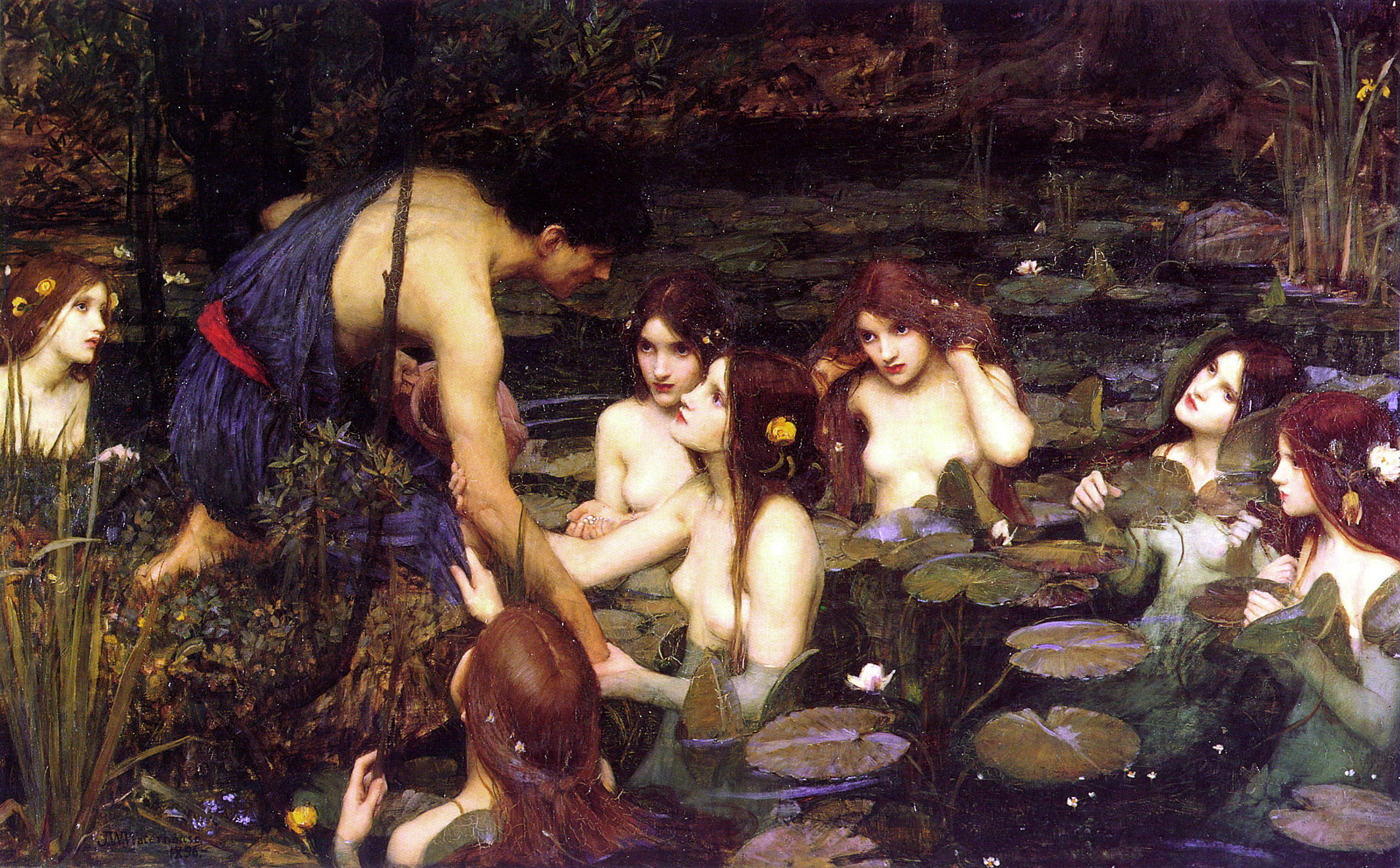
The most famous story of a person taken by the nymphs was Hylas, the beautiful young man beloved by Herakles. It happened while Hylas and Herakles were sailing towards Colchis with Jason and the Argonauts. According to Apollonius of Rhodes in his Argonautica, Hylas went looking for water one evening, and the naiad of the spring fell in love with him. He bent over the spring, she put one arm around his neck, ready to kiss him, and pulled him in with her right hand. Herakles searched and raged, but Hylas was never seen again.

Other versions of the story involve multiple naiads, and those were clearly what John William Waterhouse had in mind in his wonderful painting Hylas and the Nymphs. I’ve owned a print of it for decades, and it hangs over my bath.

Why, I wondered, should only men fall in love with nymphs? The narrator of my poem is a woman “taken by a nymph.”

Jenny Blackford’s poem “Liquid Pleasure” can be found in Fae Visions of the Mediterranean.

Tuesday, 17 May 2016

Interview with Lyndsay E. Gilbert #FaeVisions

The latest Futurefire.net Publishing volume, Fae Visions of the Mediterranean, is an anthology of horrors and wonders of the sea containing 24 stories and poems. One such short story, Lyndsay E. Gilbert’s “The Strangest Sort of Siren,” is one of the darkest pieces, populated by monsters and rulers of the underworld, featuring betrayal and abuse and a naval passage to hell. We asked Lyndsay a few questions about her work.

Lyndsay E. Gilbert is an English teacher from Northern Ireland, where she lives near an ancient castle by the sea surrounded by many pets. She loves lyrical prose, myth, magic, fairy tales and folklore. She writes poetry, short stories and YA novels. You can find her blog at lyndsayegilbert.wordpress.com.

TFF: “The Strangest Sort of Siren” is a very dark, unromanticised twist on Greek mythology—channelling tragedy but not confined by canon. What did the story mean for you?
Lyndsay E. Gilbert: I have always had a deep interest in the story of Hades and Persephone. I wrote this story as a further exploration of a poem I wrote on the topic this year called Persephone Grown. I keep contemplating how Persephone is never given much of a choice, six months with her abductor followed by six months with her mother. She never gets to grow up. She is never given any agency beyond the eating of the fruit in the underworld which is usually seen as an accident. I wanted to hear her voice.

This led next to wondering about the handmaidens who were with Persephone on the day she was taken. Persephone’s mother Demeter was said to have cursed them, transforming them to wicked Sirens. When I started to write on the blank page a handmaiden, held apart from her sisters, appeared immediately and she had a story all her own to tell.

What is your connection with the Mediterranean Sea?
When I saw the call for submissions to the anthology I questioned if I really had a claim on the Mediterranean. Enough to allow myself to enter. (I’m very tough on myself apparently!)

I am from Ireland. We are rich in our own mythology and folklore. It was this folklore that led me to explore other lore from other parts of the world, and I fell in love with the amount of lore coming from the Mediterranean. It molded my imagination as a girl in the same way that fairytales did (and Brian Froud’s Labyrinth let’s be honest—another alluring retelling of the Hades/Persephone myth when you think about it!)

In the end I decided the lore of the Mediterranean was as much a part of my creative self as that of the Ulster warrior Cuchulain!

In your story, sunken ships go to the underworld. Was that simply needed by the plot or do you like to think there is some truth in that?
This is a brilliant question! I think there must be some truth in that considering the amount of ghost ships said to still be sailing the oceans. I was writing “The Strangest Sort of Siren” by the seat of my pants and the idea just presented itself really naturally. In order to be a ghost, a ship must first have a soul. People name a ship and put their lives in its care. So if a ship’s soul goes to the underworld, perhaps someday it too can forget its past and be reborn.

Which underrated English author do you think all your students should absolutely read?
I use short stories to expose my students to amazing new YA authors being published in anthologies quite a lot. The curriculum is awash with the usual white, English dead men. There’s a very real level of snobbery surrounding authors who are still alive it seems! On top of that there’s the academic snobbery surrounding spec fic. Ultimately though, if I had my way, I would unflinchingly bring stories about LGBTQA+ youth into the classroom. We need much more diversity in the curriculum instead of paper thin references to it in school bullying policies. Children of all types of sexualities, backgrounds and races deserve to be represented. So in this vein I guess I’m not suggesting any particular underrated author, I want my students to read authors and stories about people from all walks of life.

What fantastic creature from your part of the world would you most like to go to a party with?
When I first read this question I had a horrible vision of a cartoon leprechaun leaping away with my lucky charms. Terrifying! I would most like to go to a party with a Bansidhe. I think we would have a wail of a time. (I didn’t know I was going to make that pun until it happened and I apologize profusely for it—actually no I don’t, I’m still chuckling at it.)

In all seriousness though, I know a lot of people who have had actual experiences with these disturbing ghost women, and I think Bansidhes deserve to go to a party and have a bit of fun. It can’t be easy having to warn unsuspecting people of an imminent death in their family.

If you were the captain of a ship, what would you name her?
Now that I’ve written my story I might just name her Sappho’s Siren.

What famous work of art would you like to hang over your bed?
Van Gogh, Starry Night. It makes me think of the peace of night time, but also of being in the in-between, not asleep or awake, slipping into dreaming and letting the imagination shift our perspective.

Do you have any recently publications that readers could look up if they want to see more of your work?
My short story “Under the School” was published at Youth Imagination last year, and my novel Blood, Glass and Sugar is a YA urban fantasy retelling of Snow White.

What are you working on right now?
I’m always working on a jumble of things. Right now my two novel projects are the sequel to Blood, Glass and Sugar and a dystopia called The Last Age of Sorrow, where unhappiness has been outlawed. I’ve got lots of short stories on the go too.

Thank you, Lyndsay!

Lyndsay E. Gilbert’s “The Strangest Sort of Siren” can be found in Fae Visions of the Mediterranean.

Monday, 16 May 2016

We have our own monsters #FaeVisions

Guest post by Arrate Hidalgo.

I’m from a land most people know as Spain. But my sea is not the Mediterranean Sea. I grew up 20 minutes away from the Cantabrian coast: that’s the same waters that lap around Britain, the island I currently call home. But when northern Europeans hear me complain about the London heat, they assume I come from a warm place, with palm trees, perhaps.

I am from the Basque Country. Our days are grey, wet, gently bleak. (Or they used to be: climate change is taking care of that.) Stereotypically rebellious, or perhaps just a bit out of the way, the Basques were left pretty much alone during the pre-modern invasions and settlements from the Mediterranean, aided by our uninspiring agricultural potential. That means we kept our own language and, until not that long ago, our own religion—goddess and all—and creatures such as the river-dwelling, duck-footed lamiak who would build a bridge for you overnight every now and then. Especially if you left them some food.

We have our own monsters, too. Or do we? There is a giant called Tartalo, or Torto, who lives in a cave and herds sheep, which he eats alongside the occasional human. Legend has it that he was once fooled by a young man who escaped from his lair by hiding under a sheep. Did I mention Tartalo only has one eye? Ring any bells yet? This story carries the scent of an inland sea, warmer waters, pungent flowers that open at night, sardines charred on coals nested in the sand. It’s impossible to know when the Cyclops was transplanted into a story about Tartalo. Just like with Scandinavian myths, most of what we know about pre-Christian Basque beliefs was retrieved in Christian times.

Whatever the case, the truth is that our mountains might have been a deterrent for ancient foreigners to make a life in them, but not for stories to find a way in, transforming in the process. The Mediterranean reaches further than we think, surfing inwards as well as outwards on travellers’ tongues. And right now it rushes in with stories that we refuse to hear.

The horrors of the Mediterranean are far from supernatural for the thousands who are leaving everything behind in order to reach a safe haven from a man-made hell. Thousands of lives are perishing in high sea or stranded in the very real islands of mythical Greece, unaided and ignored. Fortress Europe is allowing for families to be divided, for children to be abandoned at their peril, facing all too human dangers.

Fae Visions may be an anthology of the marvellous and the strange, but in the process it has created a real space that brings people and places together. Its pages speak many languages, they reach out and gather us around them. It reminds us that the borders that keep us apart are as strong as our will to wish them gone. Of course, some will take more work to break than others. But in the meantime, we share the wonder of story, and that is no small thing.

Arrate Hidalgo is the translator of “El baile de la Hipacotora” in Fae Visions of the Mediterranean

Monday, 9 May 2016

Mythology and the Mediterranean #FaeVisions

Guest post by Lyndsay E. Gilbert

I’ll admit up front that, coming from the Emerald Isle, the Mediterranean for me once meant a place where it doesn’t rain all the time, and where there are hot beaches to lounge on for a few weeks in the summer holidays. As I grew older however, I fell in love with stories, history and folklore and before I knew it I was on a journey of the mind and imagination which would open up a treasure chest of cultures and inspiration.

I started with the folklore of Ireland and that was a springboard from which I launched into the roots of places and peoples unfamiliar to me.

I dabbled in Paganism as a teen and my passion for knowledge of gods and goddesses across the world continued to mount. When I found out that a school near me taught Classical Civilizations at Advanced Level I immediately enrolled there and my love of Greek and Roman history and mythology deepened. The scope just kept widening as I researched around school topics and learned of the connections between different Mediterranean countries. I tracked the births and movements of certain cults and the evolution of many gods and goddesses.

My Fae Vision for the anthology, ‘The Strangest Sort of Siren’ was born from my obsession with the Hades/Persephone myth. The whole idea of it terrified me, especially when we learned about wedding rights in ancient Rome and how they would stage a pretend kidnapping of the bride, who had to scream and struggle before being taken off by her new husband.

I couldn’t help but feel for Persephone, forced to live one half of her days in her kidnapper’s underworld domain, and the other half under the watchful eye of her Mother, like a maiden who would never be allowed to grow and become her own self. My story was a way of rescuing Persephone from the perpetual cycle of daughterhood and wifehood and giving her back something that is her own. A truth inside her that no one can control or take away.

The picture above is one I drew to represent the memories and dreams of both my main character and Persephone. I’m not a great artist, but I do enjoy depicting my characters.

Lyndsay E. Gilbert’s “The Strangest Sort of Siren” can be found in Fae Visions of the Mediterranean.

Saturday, 11 April 2015

Call for submissions: Fae Visions of the Mediterranean

Fae Visions of the Mediterranean
Edited by Valeria Vitale and Djibril al-Ayad

Call open until November 13, 2015 for:
(a) Microfiction in Mediterranean languages;
(b) all stories by North African or Near Eastern authors


Call for stories:

Quivering mirages, ghost ships, glossy scales slipping away beneath the waves; we are seeking progressive and inclusive short stories about wonders, terrors, omens, sea-monsters, apparitions and other folk creatures and horrors from throughout the Mediterranean region. You might find inspiration in medieval bestiaries and the margins of maps and manuscripts; stories whispered by pirates in the long nights at sail; horrible and marvellous visions shaken travellers barely dare to recall; names of creatures known by everyone in the streets around the harbour; particularly troubled nightmares you had or someone shared with you.

The rules:
  1. The editors are looking for uncanny stories up to 5 000 words, illustrations/comics up to 12 pages, or poems up to 40 lines.
  2. The anthology will also include micro-stories of approximately 500 words written in all languages of the Mediterranean. Authors may send stories in any language. Authors should additionally include a cover letter in English, Italian, French, Arabic or Spanish (these are the languages we can read).
  3. Stories may be horror/fantasy, magical realist, surreal, absurdist, pirate stories, ghost stories, folk tales or fairy tales. All stories should be set on or around the Mediterranean Sea. The editors would like to see the cultures and legends of the Mediterranean reflected in the stories.
  4. Stories will be free-standing and individual. The anthology is not a shared-world or otherwise constrained to a joint narrative or structure.
  5. The editors welcome fiction by authors from the Mediterranean region, particularly North Africa and the Near East. The editors also welcome fiction written by other under-represented groups (such as women, queer/trans/nonbinary, non-anglophones, people of color, people with disabilities, etc.).
  6. Story submissions should be sent as a .doc, .docx or .rtf attachment to faevisions.med@gmail.com by Friday, November 14, 2015; the call is closed to general submissions, but two categories of story are still welcome: (a) Microfiction (up to 1000 words) in any Mediterranean languages; (b) stories in English (up to 5000 words) by North African or Near Eastern authors.
  7. Reprints and multiple submissions are welcome, but please do not submit stories that are simultaneously under consideration elsewhere. The editors will reply to all submissions as quickly as possible. The editors are NOT interested in fan-fiction.
  8. This anthology will pay €30 plus royalties for first world print (or reprint) and e-book publication rights for 1000-5000 word stories, comics and poems. Flash and micro-stories will be paid €15 plus royalties.*
  9. The anthology will be edited by Valeria Vitale and Djibril al-Ayad, and published in print and e-book by Futurefire.net Publishing in early 2016.
* Please note that you should decide whether you want to sell first print rights for this relatively low rate; you will only be able to sell a story again as a reprint after it has appeared in this anthology.

Keywords:
  • absurdism; Albania; Algeria; bilingual; Borgesian; Bosnia-Herzegovina; Ceuta; comics; Corsica; Croatia; Cyprus; Djerba; djinn; dreams; Egypt; Elba; fantasy; fata morgana; folklore; France; ghosts; ghûl; Gibraltar; Greece; horror; illustration; Israel; Italy; Jebel Tariq; journeys; Lampedusa; Lebanon; Libya; Majorca; Malta; manuscripts; maps; Marmara; microfiction; mirage; Monaco; Morocco; mythology; naznaz; nightmares; Palestine; Pillars of Hercules; pirates; poetry; postmodern; Sardegna; seamonsters; sea stories; shaitan; shipwreck; Sicily; sirens; Slovenia; Spain; surreal; Syria; travelogue; Tunisia; Turkey; uncanny; weird; world literature.