Don Riggs is an occasional reviewer for TFF-R, as well as poet, scholar, teacher, aficionado of monsters and Alice in Wonderland adaptations. We’ve been working with Don for a couple years now, so we thought we’d invite him over to talk a bit about his work and passions.
Don Riggs went to Dickinson College where he studied Myth, the University of North Carolina where he studied Comparative Literature (Medieval), taught French in South Carolina, was a massage therapist in Mechanicsburg, Pa., taught Humanities and Art History at Harrisburg Area Community College, earned an M.A. in English/Creative Writing/Poetry, and has taught English at Drexel University in Philadelphia. His books of poetry include Bilateral Asymmetry (Texture Press, 2014) and Made of Words (Faurit din cuvinte) (Orizont Literar Contemporan, 2015). He analyzed John Langdon’s Alice and the Graceful White Rabbit at Cambridge University in 2015.
We asked Don a few questions. The Future Fire: Who was your favourite mythical hero or heroine when you were young?
Don Riggs: Depending upon your definition of "mythical," it would either be Bilbo Baggins, the DC Comics Superhero Green Lantern, the fairy tale anonymous Little Tailor (of "Seven at One Blow"), or Merlin (are any of those mythical, strictly speaking?). I equivocate because, as an undergraduate, I pursued a self-developed interdepartmental major in Myth (I think it was called "Myth in the Western Tradition"). For that, I studied many theories on Myth, including that of Northrop Frye, who distinguishes different historical periods including: the Mythic (where the protagonists are gods), Romance (where the protagonists are demigods, like Hercules), High Mimetic (where the heroes are human beings of elevated status, like Oedipus, Agamemnon, etc.), Low Mimetic (where the protagonists are "ordinary people," like so many of us, neither gods nor despicables), and Ironic (where the protagonists or heroes are subhuman, like Gregor Samsa who, after a night of troubled dreams, awoke to find himself transformed into some disgusting vermin). Bilbo Baggins is Everyhobbit, and I would think of him as Low Mimetic, thus not mythic—at least, in that sense. Merlin I would find a hero (well, a prominent character) of Romance, and possibly Green Lantern as well.
What attracted you to speculative fiction in the first place?
DR: The world they lived and moved in was magical. Also, the Dutch expression, "Als je ben niet sterk, je moet slim zijn" (If you are not strong, you must be smart) worked more obviously in that kind of fiction than it did in my experience of reality. Again, Bilbo Baggins provided me with a model, as a "courage-teacher" (borrowing the term from Ginsberg, re Whitman). There was an element of the uncanny that operated quasi-naturally in speculative fiction, such as the incident, in Sigurd of the Volsungs, when Sigurd is roasting the heart of the dragon Fafnir over the fire (I picture him holding his sword, with the dragon's heart skewered on it), and touches it with his finger to see if it is done: naturally, he burns his finger and immediately brings it to his mouth to cool; having tasted the dragon's blood, he understands the language of the birds, and he hears one telling another that it's too bad he's going to give the roasted heart to Regin, who will then kill him, so he eats it himself and kills Regin. That very realistic sucking his burnt finger leading immediately to understanding the language of the birds is emblematic of what I love about speculative literature.
What monster lives under your bed?
DR: For years now I have slept on a futon directly on the floor, squeezing out whatever monster. However, before that, it was something faceless but with grasping hands. Probably something in the style of Arthur Rackham. If you look at Rackham's monsters from Rossetti's "Goblin Market," you will see some very uncomfortable images; also, from Matthias Grunewald's "The Temptation of St. Anthony," as well as Bosch's depiction of the same matter, and lo and behold Max Ernst did a temptation of St. A. as well. All of those monsters qualify for me as scary as need be…
What ring would you add to Dante’s inferno?
DR: The ring of the Deadly Dull, who do whatever they can to squash imagination and creativity. The ring of the freshmen who regularly introduce themselves to me by saying they want, or expect, or will be too hard-working not to get an A. They will sit there, grading endless piles of freshman writing, impelled by the independently moving forefinger and thumb to circle every error, discuss any divergence from clarity. At the same time, the grader will be gripped by a paralyzing sense of guilt, even before anything happens. And after having graded the enormous pile, student after student will come up begging to do "extra work" to help "bring the grade up."
What artist, dead or alive, do you think would have been the best choice to illustrate Tolkien’s Lord of the Rings?
DR: The artist, whose name I don't know, who illustrated his first edition of "Farmer Giles of Ham," the quasi-medieval drawing style. I also think Arthur Rackham would have been good, but as for painters, the evil spawn of Morgoth and Sauron would have been done well by Francis Bacon. The good characters (Gandalf, Aragorn etc.) would have been well illustrated by John Trumbull (cf. his "Battle of Bunker Hill").
What is the first rule of storytelling that you teach in your classes?
DR: I don't teach any rules; I hope that I exemplify them when I read out loud to the class. I do this often, and perhaps this is the rule: storytelling is a spoken art form, with music and expressiveness in the delivery.
Now give us an example of when to break that rule!
DR: When you are reading silently to yourself, late at night, to the light of one lamp only, and you are transfixed by watching the world unfold around you in you mind and beyond.
Don (R) with John Langdon (L)
and the Rabbit (C)
You have spoken and written about several modern adaptations of Alice in Wonderland. Which of the countless re-writings is the most unusual you’ve come across?
DR: John Langdon's Alice and the Graceful White Rabbit, currently the object of a kickstarter fundraiser. Langdon retells "Alice" with a densely woven overlay of allusions, evocations, and puns tying the original story to a layer of classic rock songs.
And which is your favourite Alice?
DR: The original, with the Tenniel illustrations.
Are you a poet who also teaches, or an academic who also versifies?
DR: A poet who also teaches, but I must admit that my day job takes the vast majority of my time and energy. Still, I write my 14-line poem every morning, and it's no longer a question of needing discipline to do it; I simply do it as inevitably as I get up in the morning. My thought is that I will continue writing long after I have retired from teaching (though I can't afford to do that for a long time, if ever!).
How do myth, monsters, illustration and/or scholarship influence your own poetry?
DR: My three self-published chapbooks (Walks, 1983; Hermenoodles, 1988; Self-Portraits in Words and Images, 1997) have at least one illustration (by me) on each page, with each poem, while Self-Portraits are calligrammes, where the lettering of the poems are also the lines of the drawings. Left is an example. Another is from Poems for the Writing, by Fox and Levin, illustrated by Don Riggs.
The cover of my book of poems, Bilateral Asymmetry (2014), illustrates how monsters sometimes fit in; I like dragons but don't feel comfortable writing about them; ordinary things become monsters in my poems, as in "Dialogue of the Hands": The right hand, in a fit / of characteristic pride, / yelled at the left hand, / "You foot!" / --the most devastating curse it knew. / The feet stood by, / silent as oxen. (from Walks 1983).
Scholarship is impossible to weed out from my poetry, because I write about what I know, and therefore refer to things I've read and seen in my research. For example:
2. Made of Words
Mon cher Edgar, poems are made of words,
said Mallarmé to Degas, when Degas’d said
he’d such great ideas for poems, but
they never worked out.
Just as a painting
is made up of brushstrokes, he could well have
pointed out, not some puffy-eyed woman
sitting dispirited behind absinthe
next to a red-nosed, scruffy, bearded man
decades the worse for Bohemian wear,
the memories of his student days dabs
of color on the fragmented fog of his
canvas.
Life flows by on the sidewalk
as her gaze glazes over. He shrewdly
speculates on how he can score some opium.
That is from Made of Words which was published in Bucharest in 2015, with facing-page Romanian translation.
You’ve been reviewing for TFF-R for a couple of years now. What moment stands out for you, of the items you’ve reviewed?
DR: The moment that first springs to mind is my review of Anna Patrick's Meditations in Wonderland (2015), because it came for review just after John Langdon and I had come back from Cambridge, where I had read my paper on his version of Alice. That immersion in the original material at the conference and in my paper on the Langdon version put me in a perfect situation to see what Anna Patrick was doing in her really quite incredible—and very different—version of Alice.
What's the most interesting thing you have ever found in the garbage?
DR: Whoa. What a question. I think a letter that a woman whom I had yearned for had written me after a visit: the letter itself was extremely understated, but the underlying emotion was incredibly powerful. (It was in a box of materials I had intended to throw out, but had only made it as far as the attic.)
What are you working on now? Anything forthcoming to look forward to?
DR: I'm preparing myself to interview Samuel Delany in mid-December, so when I have the chance I'm reading as much of his work and works about him as possible.
I'm reading a novel by Alex Kudera, Auggie's Revenge (2015), to write a review for a publication in Romania (I don't know the name of the journal).
I'm getting ready to write a paper on Peter Jackson's series of videoblogs that he made to prepare the way for the release of his first Hobbit movie (An Unexpected Journey). I am looking at the series of videoblogs, released in ten units over the 20 months preceding the release of the first film, as a campaign to create a viewership/community to anticipate the release of the film, using Henry Jenkins's theory of intermedia outlined in his book Convergence Culture, and I will present this paper at the International Conference on the Fantastic in the Arts in Orlando, FL in March 2017.
I have been posting a daily poem on my Facebook page for well over a year now, and I'm getting ready to publish a number of them in a collection of Facebook Poems in the near future. Whether I will illustrate them depends upon how much time I have. Many thanks for joining us, Don!
Speculative Fiction Writers Discuss Polyamory and Diversity
Moderator Su J. Sokol, author of the Sunburst Award-nominated Cycling to Asylum, speaks with panelists Redfern Jon Barrett, Jacqueline Koyanagi, B R Sanders, and RoAnna Sylver. Su J Sokol (SJS): Polyamory in speculative fiction is nothing new, but some would say it’s been enjoying something of a renaissance. What’s your analysis? Also, do you see differences between past depictions of polyamory and what you’ve been seeing more recently?
Redfern Jon Barrett (RJB): There's absolutely a sweeping transformation going on right now with polyamory and the media. I think it was inevitable as same-sex marriage became more widely accepted—those doom and gloom homophobes who screamed that 'polygamy will be next' weren't so far off the mark (as they bitterly pointed out in British and Irish newspaper columns in response to my calls for polyamory rights.) Much of the public has accepted love between consenting adults, and if there's nothing wrong with two men or two women being in love, well, why not more than that? It's prompted huge interest. As for how they're depicted, I think it depends on the writer's class, gender, and social views more than time. There are works created now which show a very patriarchal mode of polyamory, and works in the 70s which are very queer and egalitarian. The main thing that's changed is the language used, particularly since the word 'polyamory' started being used in the 90s.
B R Sanders (BRS): Definitely we've seen polyamory represented before. There is Poul Anderson's Virgin Planet. There is Heinlein's Stranger in a Strange Land and The Moon is a Harsh Mistress. It's been around forever, but what's historically bubbled to the surface has struck me as a very male gaze-y portrayal and understanding of what polyamory could be.
I don't know that the frequency with which polyamory has been represented has changed, but I would say that the way it's been represented has begun to shift. I still see the kind of male-gaze-SO-SHOCKING-PUSHING-THE-ENVELOPE type depictions, but sprinkled in amongst them, are kinder, slyer, and often queerer depictions. Normalized depictions. These newer depictions are more often rooted in the nuts and bolts of relationships, relationships that feel lived in and populated by distinct individuals. The older ones are statements and idealizations rather than real relationships, and the participants are interchangeable.
SJS: Another question I have is whether you think that polyamory is more present in speculative fiction—particularly in dystopian and utopian fiction—than it is in general or mimetic fiction, and if so, why you think that is.
RJB: As a writer I’ve found that speculative fiction often grants us freedoms the present can't allow, a space in which alternate ways of living can gain a greater sympathy from the reader than one which might conflict with their idea of how things should be done right now. Somehow 'what can be' is less threatening than 'what we can change more immediately.' I think that's the reason polyamory (along with a whole host of other issues) turns up more frequently in future-based fiction. My first novel Forget Yourself was speculative for that exact reason, as were many of my short stories. People approach speculative and science fiction with an open mind.
A year ago I gave a paper for a polyamory conference in Lisbon, in which I explored ethical nonmonogamy in utopian science fiction. This led to two works in particular: Robert Heinlein's Stranger in a Strange Land (1961) and Marge Piercy's Woman on the Edge of Time (1976). I think Piercy's queer feminist vision presents the stronger basis for a poly future, but we can see through Heinlein's book how influential such works can be, as it sparked many 'free love' groups and movements in the decades that followed.
Perhaps it's because the future has such potential as a place of hope: we're more willing to believe in an alternative if it's a little distanced from the world we live in now.
SJS: Yes! So much of what you say here resonates with me. And it's cool that you mention Marge Piercy's Woman on the Edge of Time. This is one of my absolutely favourite novels. I read it when I was very young and it influenced my thinking a lot, as well as my own writing. In fact, like Piercy's book, my novel Cycling to Asylum presents both a dystopian and utopian vision of the future at the same time, though in my story I use two different cities—New York and Montréal—to do this. (Can you guess which is which?)
I’d forgotten about the poly aspect of Piercy's utopian society! It's funny, because my novel also includes the beginnings of a strong poly relationship between my two main adult characters and a third character. And it’s true what you said, Redfern—I did feel freer to express my political ideas, including about non-traditional relationships, in the context of a near-future speculative fiction novel. But now I’ve written a new manuscript that puts the type of MMF triad I'd created in Cycling into the story in a very front-and-centre way. I’m not sure I could’ve done that without having written the speculative fiction story first. And I do think that people consider my new manuscript to be more risqué because it is contemporary, mimetic fiction instead of SFF. (OK, and maybe also because it has a lot of explicit sexual content.)
RoAnna, what are your thoughts? I understand that you like to write "oddly hopeful dystopia books." Can you also tell us about that?
RoAnna Sylver (RS): I think that Redfern is onto something, absolutely: Spec-fic gives us freedom to express ourselves in ways we can't in modern-day/realistic fiction. Readers do seem to find poly or otherwise-nonconventional relationships 'more risque' here than if they're SFF. Sometimes it's easier to accept the unfamiliar if it's in the future or another planet, or 'just a dream.' I like the more optimistic way Redfern put it, though, that "people approach speculative and science fiction with an open mind."
I don't think I've seen many poly characters or relationships in utopian or dystopian fiction. Maybe writers want their dys/utopian worlds to be relatively close to reality, and including 'unrealistic' relationships and/or marginalized identities might break readers' suspension of belief. At least readers who don't fall into the above identities ... which is a sad thought. Better, more varied representation is the answer again. See enough of us, and the world will know we're no more extraordinary than any other human, certainly not an alien or magical being. We're cool, but not unrealistic!
Thank you for asking about my 'oddly hopeful' dystopian books! There's a ton of dystopian fiction around now, probably because the world can be a scary place. It serves a purpose. We need to express our fear. But we also need to know hope still exists. In Chameleon Moon, everyone has been imprisoned inside a city called Parole, and left to die above a lake of fire. Parole is a visual metaphor of living while marginalized through identity, orientation, disabilities/chronic illnesses. It is about isolation, pain, fear —and hope, survival through love. A warning, and a reassurance. Look where we're heading, in many cases, already there. But look how much we can survive. Look how strong we are already, how beautiful, how lovely, how brave.
SJS: Thanks, RoAnna, that sounds great. So what do folks believe are some of the most common misconceptions about polyamory? Do you address these misconceptions in your writing, and if so, how do you do that?
RJB: The misconception on polyamory I find most troubling is the unending assumption that it's all and only about sex. Yes, sex can be a significant and wonderful part of our relationships, but it's called polyamory for a reason—if we were simply looking for sex then we'd just have open relationships. In reality there are many types of bonds covered in polyamorous webs and constellations, and not all of them are sexual. Some very romantic, deep, and involved loves I've had have been entirely free from any kind of sex, and that's not to mention the fact that many asexual people are polyamorous.
It bothers me because that the same societal drive to limit discussions on polyamorous people to the sex they have is one which has long been used against those of us in the LGBTQ community. It's getting better, but focusing only on the sex queer people have rather than the love we share has long been used as a means of marginalising, dismissing, and mocking us, and I fear that the same tactic is being used against poly individuals. Even many of my own friends and relatives did the same at first, until they saw my family and how happy we are--and really that's the way to counter these assumptions. Familiarity brings understanding, not contempt.
That's why, when writing about polyamory in my novel The Giddy Death of the Gays & the Strange Demise of Straights I made sure to focus on the nonsexual romantic love which develops between two heterosexual roommates Richard and Dom, and the relationship they build together and with Dom's girlfriend Caroline. It's weird and new and it takes a great deal of adjustment, but it's recognising different forms of love and celebrating them which can truly allow us to move on both as individuals and a society, in all its bizarre diversity. There are speculative snippets throughout looking into the changes in their lives and to the world around them, exploring how attitudes to polyamory might change in the future.
BRS: So the biggest thing to learn about relationships in general is that they are all different, and what's true in one does not necessarily hold true in another. Polyamory makes this necessarily more complex since it factors in more people. My polyamory doesn't look like someone else's polyamory. And my polyamory with one partner doesn't really look like my polyamory with another partner. It's all a negotiation, a work in progress, a series of moving parts. Its biggest commonality is that its a huge amount of communication and transparency (mine is, anyway). It's not easy, but it's rewarding, and it works for me.
I tried to get this across in my book Ariah. Ariah, Sorcha, and Shayat each have to negotiate their relationships with each other as their triad begins to form and change. It happens pretty organically, but it also happens in a cultural space that doesn't have room for what they are trying to do--and they aren't going to be able to do it without talking it through it and being on the same page.
I also want to echo what Redfern Jon Barrett said about polyamory being reduced to sex. As an asexual person, for me, reducing polyamory to sex is deeply erasing. I am not in it for sex; my partners are not with me for sex. There is a qualitative difference in the kind of love I have for them and how I feel about my friends.
SJS: Yes, those kind of misunderstandings can be very harmful. I wonder—is polyamory one of those areas where it’s better not to write about it if you are from outside of that community, so to speak? Or is this something that anyone could write about, regardless of their actual relationship histories?
RS: I feel like with any marginalized identity, someone writing their own experience is going to be the most direct and realistic expression—ideally, many different expressions, since no identity is a singular entity and everyone experiences them in different ways. My experience of being poly will inevitably be different than somebody else's, and the only way to get an ‘authentic’ picture of what it's really like is to have as many of these voices heard as possible. That said, I don't think it's absolutely necessary for somebody to be established in the community (which can be hard to find sometimes, even with the aid of the internet) or have 'experience' to write about polyamory. It certainly helps, but experiences are such a spectrum (and the 'am I ___ enough' hurdle is steep) and good representation itself is so rare that I think whenever SFF with positive/accurate/well-written poly characters and storylines exist, it's cause for celebration. (And I've seen it happen more times than I can count with my own friends: if a writer is exploring these themes with a serious and genuine draw/interest/importance, not just chasing a trend, they're probably questioning themselves. If a non-poly writer ends up 'in the community' before long, I wouldn't be surprised.)
BRS: I think it's like anything else, really—as long as you do your homework, you can write about it really well. And that goes for being both inside and outside of a particular community. I am poly, but that doesn't mean that I am necessarily going to write about this well. I could have a very narrow perspective on it if I didn't step back and think about it and explore multiple angles of it. I think by virtue of being within a certain community you are more likely to be exposed to the multiplicity of a given community and therefore less likely to fall prey to stereotypes about that community in your writing—but it's not a given. It's really about doing the legwork. I think, as writers, there's a kind of Hippocratic Oath at play: a first, do no harm ethos. Make sure you interrogate why you want to write about a certain group of people, then make sure you talk to those people and understand what life is actually like for them.
SJS: There are some people who believe that monogamy is a more natural or desirable state or institution, whereas others may believe that a polyamorous lifestyle is the more natural and/desirable. Would you say that your inclusion of polyamorous relationships in your writing is more descriptive or prescriptive? What do you think, Jacqueline?
Jacqueline Koyanagi (JK): I aim for descriptive depictions; the last thing I'm interested in is prescriptively encouraging people to pursue one relationship path over another. If I want to encourage anything, it's the idea that nourishing relationships are best found after conscious self-examination. What do you want? What do you need? What can you offer others in relationship? Where are you growing and how does that fit into your patterns of behavior? Instead of swallowing what we're prescribed by culture without question, let's figure out what works for us and move forward from there. It may turn out that what one wants is perfectly in line with what culture teaches us, but it's often the case that we have to carve out a place for our needs and desires that doesn't quite gel with tradition. Whether that place involves monogamy, polyamory, or some other relationship style ... well, that's up to you and the people you become involved with.
SJS: Yeah, I'm pretty sure we can all agree that forcing people to be, for instance, either monogamous or polyamorous would be a bad idea. Yet, at the same time, I am curious to know if there are other thoughts on this question. People may legitimately feel that certain types of relationship styles are more or less likely to be healthy or sustainable. For instance, Redfern: Having read some of your writing—including both of your novels and, especially, the short story "Liquid Loyalty"—I do get some sense that you have more of an "advocacy" stance on this subject.
RJB: Wow, I'm really flattered that you've read all that! I have been a strong advocate for polyamory, but at the same time I agree with both of you —it should be about choice, not enforced transformation. I've long believed the polyamory-monogamy spectrum to be a form of orientation—a romantic orientation—where some people are innately more suited to polyamory, some to monogamy, with many people being more flexible and falling somewhere in the middle. I've campaigned so that people have the option to be who they are, however they love. Fiction is a wonderful tool for spreading that kind of awareness. The more people become familiar with and understand polyamory, the more they can open up to who they potentially are, or if they're more mongamously inclined, the more likely they are to accept those who are different. It might be idealistic, but I really believe we can reach the same level of tolerance and equality which has been achieved so far with same-sex relationships.
SJS: There are many possible types of polyamorous relationships, structures, and institutions, and some of them resonate quite differently than others. Can you speak about representations of polyamory that you’d like to see more of, as well as some that you might like to see less?
JK: Really, with any representation—be it relationship style or anything else—I want to see diverse depictions. I don't just want to see polyamorous triads, I don't just want to see hierarchical polyamory, I don't just want to see relationship anarchy or solo polyamory. I want to see it all. I want us to explore the myriad ways we can organize relationships, reject organization, and/or manifest something entirely unpredictable. I want to see relationships with diverse races and genders and religions or lack thereof. I want to see relationships of mixed sexual orientations, and the challenges that can arise thereof. I want to see it all.
SJS Very beautifully put, Jacqueline! How about you RoAnna? Are there relationships or related social structures that you are longing to see more of in fiction? And could you also speak about things that you are less anxious to find in stories—for instance, tired tropes, depictions that reinforce negative stereotypes, or any other representations that you could do without seeing again?
RS: Jacqueline's answer is spot-on. There are as many kinds of poly relationships in the world as there are people in them! I want to see more 'more' as well, especially mixed orientations and relationship dynamics. Queerplatonic relationships as well—I don't remember ever having seen one in a book; that would mean a lot. Here too, diverse representations of any experience is always better. You get to ‘feel more parts of the elephant,’ as it were. Anything that demonstrates the richness and vastness of who we are. Infinite diversity in infinite combinations, to borrow a Trek-phrase.
Here's one of the very few songs I know that actually talks about polyamory—and it illustrates another point. "The Perils of Poly," by Bone Poets Orchestra/Gaia Consort.
I find the song cute and fun, but by the bridge ("hot bi babe/chasing everybody like they're candied fruit", "what's got us terrified is that we'll really fall in love") I'm rolling my eyes. Because yeah, that's what everybody thinks, 9 times out of 10, that the be-all is casual hookups. Sure, that's a valid experience, but when that's the only picture anyone has, it's a little discouraging. I want more in fiction, of all kinds. I'd especially like to see healthy and realistic poly, people working out their problems, communicating, and coming to resolutions.
SJS: I just checked out the video. Thanks for adding a bit of fun and music to our panel discussion, RoAnna, and yeah, I hear you!
So are there other types of non-traditional relationships folks think should be better represented in speculative fiction or fiction in general?
BRS: I would love to see asexuality and asexual people in relationships written about more and with more depth and plurality. There are definitely tropes there to avoid (that ace people are broken, or cold, or incapable of romance or relationships). But ace people do exist and do have families and lovers.
JK: I'd like to echo BR's call for more asexual representation. I've only recently come out publicly about my own asexuality, in part due to the myriad misconceptions that slam into you the moment you start talking about it. Both asexuality and non-monogamy are far more diverse than stereotypes suggest; we've barely scratched the surface in fiction. I'd also like to see more stories in which the gradient between friendship and romance is blurred, or where friendship is a deliberate, ongoing commitment the way romance is. More characters hopping off the relationship escalator, or at least interrogating and dismantling their assumptions about relationships so that they might build something of their own.
RS: Relationships with neurodiverse and/or disabled people are incredibly important, to me personally, and to see in general. Both between two or more ND/disabled people, and able-bodied/neurotypical people. It's something we don't get nearly enough of and therefore there's very little understanding of physically or mentally ill people/how we interact and fit together in what can be incredibly meaningful, beautiful relationships. Or any concept of how we can have amazing adventures or be heroes, or attractive/romantically desirable. My feelings here are similar to the ones I have about polyamorous characters being left out of so much fiction, or LGBT in general—audiences are being robbed of awesome characters and stories, and we're not being seen for the whole, multidimensional people we are. I want every poly/lgbt/disabled reader to know exactly how valid they are. Sometimes it's the first time you've ever heard or felt it, and that is the most important feeling in the world.
BIOS
Su J. Sokol is an activist, a cyclist, and a writer of speculative and interstitial fiction. A former legal services lawyer from New York City, she immigrated to Canada with her family in 2004 and now makes Montréal her home. Her debut novel, Cycling to Asylum, was long-listed for the 2015 Sunburst Award for Excellence in Canadian Literature of the Fantastic. Su’s new manuscript, Run J Run, is about the conventions of friendship, polyamorous love, chosen family, and the treatment of the mentally injured in our society.
Dr. Redfern Jon Barrett a polyamory rights campaigner and author to novels The Giddy Death of the Gays & the Strange Demise of Straights (finalist for the 2016 Bisexual Book Awards) and Forget Yourself. They currently divide their time between Britain and Berlin, where they live with their two partners.
Jacqueline Koyanagi writes science fiction and fantasy featuring queer women of color, folks with disabilities, neuroatypical characters, and diverse relationship styles. Her debut novel, Ascension, was released from Masque/Prime books at the end of 2013, and landed on the 2014 James Tiptree Jr. Honor List. Folks can find her work at jkoyanagi.com, and she’s active on Twitter @jkoyanagi.
Pronouns: they/them/their. B R Sanders is a white, genderqueer writer who lives and works in Denver, CO, with their family and two cats. B writes about queer elves, mostly, as featured in their two novels, the award-winning ARIAH and their debut novel RESISTANCE, both of which are set in the same universe. Their writing can be found here: https://brsanderswrites.com/
RoAnna Sylver (Amazon) is passionate about stories that give hope, healing and even fun for LGBT, disabled and other marginalized people, and thinks we need a lot more. Aside from writing oddly hopeful dystopia books, she is a blogger, artist, singer and voice actor. She lives with family and a small snorking dog, and probably spends too much time playing videogames. She has recently released a rewritten 2nd edition of Chameleon Moon, which she says is a lot more true to myself and the original intent—and has a lot more poly/nonbinary/asexual-explicit content.
You may already have seen the campaign for Piracity: an anthology of pirate-themed SFF stories from authors in Bristol and the Caribbean, edited by Joanne Hall and Roz Clarke and to be published by Wizard’s Tower Press if successful. It’ll be a great project, and you should of course back it if you can afford to, to get the chance to read some lovely stories.
Never one to pass up an opportunity to have fun while spreading word about a good project at the same time, we’re going to hold a virtual pirate fest next weekend. Would you like to join us?
We’ll have some kind of party, perhaps in a pub, perhaps in someone’s house, where some of us dress/act/talk like pirates, just for the laugh. We’ll post pictures to social media, so others can join in wherever in the world you all are. We’ll mention the #Piracity hashtag and/or the link to the Kickstarter as we go, so our friends know what we’re partying about. If you want to play, feel free to organize your own party, tell us about it if you like, and post your own pictures to the same hashtag on Twitter, FB, Tumblr, or your social media of choice (with the link somewhere in the thread if possible). Let us know, and we’ll repost you at some point over the weekend as well. It’s only a virtual fest if we all play and have fun together!
(By the way, we do realize that some of you will be marking Trans Day of Remembrance this weekend. Indeed, Cheryl Morgan, who owns Wizard’s Tower, will be attending TDoR ceremonies in Bath and Bristol on Thursday and Friday night. We fully understand and respect the need of the trans community to mark this important occasion. Cheryl tells us that after two very sombre events she could do with a night of relaxation at the weekend. If others among you have a similar need to unwind we’re happy to provide an excuse.)
“We know how precious the water is. We know that we must stand for the water. Every time we drink water, we remind ourselves how important the water is. Don’t you do that?”
—Ladonna Brave Bull Allard, Standing Rock Sioux Tribe
Our friend A.C. Buchanan (whose powerful story “Puppetry” was in the Accessing the Future anthology last year) and who edits Capricious magazine of literary speculative fiction and criticism, is currently running a fundraiser on Indiegogo to pay pro-rates for a special issue of speculative stories which not only use gender diverse pronouns, but embrace them and celebrate the diversity of gender. Capricious is a lovely magazine, and this looks like being a great issue. We urge readers to support if you possibly can, pre-order an e- or print copy, a story critique from the award-winning editor, or even a fuzzhog! A.C. came by to tell us a little bit more about their thinking behind this issue.
When I talk about the use of gender diverse pronouns (like singular they, sie/hir, e/eir, or many other options) in fiction, I’m usually met with one of two responses. One is excitement and interest, perhaps by non-binary people who see opportunities for people like them to be better represented, perhaps by those who see potential for worldbuilding and exploring different conceptions of gender, or maybe by those who are simply interested in language. The other is more cynical: “I don’t understand them” or “they’re all new and invented language” or “they’re confusing to the reader.”
There’s something circular about these more negative perspectives. If too many people—be they editors or readers—are wary and confused by gender diverse language, then not enough gets written or published, which means people stay wary and unfamiliar. Readers who want to see people like them and their friends represented—or just that there’s a possible alternative to dominant ideas about gender—can’t find the stories they need, perhaps don’t even know what to look for.
As a non-binary person, gender diverse language is essential for describing my reality; as a speculative fiction writer and editor I believe that our explorations of other worlds and possible futures can only be constrained and dampened if we are limited by language tied to assumptions of binary gender. And as the editor of Capricious magazine, I want to do something about that.
Stories using gender diverse pronouns are always welcome in Capricious—we’ve published two in our first year—but I want to specifically showcase and celebrate their usage with a special double issue, available in both print and electronic formats. I’d really appreciate your help to make it happen by supporting our crowd-funding campaign. You can support the Capricious SF fundraiser, or pre-order your copy, at https://www.indiegogo.com/projects/capricious-the-gender-diverse-pronouns-issue-fantasy/
This week we’re joined by TFF old friend Ernest Hogan (who had a story in WSaDF, a mini-sequel in our ten year anniversary blog campaign, and has blogged for or about us a coupletimes before), to talk about his work, a forthcoming novel, art show, and the end of the world.
East L.A.-born Ernest Hogan is the author of Cortez on Jupiter, High Aztech, and Smoking Mirror Blues, which have given him the reputation as the Father of Chicano Science Fiction. His short fiction has appeared in Amazing Stories, Analog, Science Fiction Age, and many anthologies. His “Chicanonautica Manifesto” appeared in Aztlan: A Journal of Chicano Studies. His is also an artist. He blogs at mondoernesto.com and labloga.blogspot.com. His is married to the author Emily Devenport, and they live in Arizona.
We asked him a few questions: The Future Fire: You wrote a mini-sequel to your story “Pancho Villa’s Flying Circus” from We See a Different Frontier, titled “Xiomara’s Flying Circus.” Have you written, or do you plan to write, any other stories set in this postcolonial steampunk universe?
Ernest Hogan: That whole universe started with the title “Pancho Villa’s Flying Circus.” I thought it up, laughed, wrote it down, and years went by before random historical details about pilots who flew for Villa and how Raoul Walsh went down and shot scenes of a silent film with him. My alternate universes tend to be something I encounter and they grow in weird ways. I had trouble getting into the story until I started thinking of it as a spaghetti western. It would be fun to expand both stories into sprawling novel like Ishmael Reed’s Yellow Back Radio Broke-Down or Mumbo Jumbo, but genre publishers like their novels to be slam-blang action adventures that nerdy teenaged girls can relate to, which makes it hard for sixty year-old Chicano writer. I may go back to the universe if an opportunity arises, which could happen.
TFF: You also inspired the We See a Different Frontier campaign with your coining the term “recombocultural.” Can you tell us a bit about this concept, and why you think it’s important to speculative and postcolonial fiction?
EH: I was influenced by Ishmael Reed (uh-oh, I evoked him again) in his pioneering use of the term “multi-cultural” in an essay about artist using material from different cultures. I saw it as a natural for science fiction and fantasy (in fact, fantasy was multicultural before it became a commercial genre package in the seventies). Then I started getting flak from right-wing sci-fi types who were afraid I was trying to oppress them with political correctness—even though I ain’t never been politically correct. I realized that what I was doing was more than multiculturalism. I started using recomboculturalism to explain myself. Recombo as in recombinant DNA, mixing stuff up from all over, coming up with something different, with the whole being more than the sum of the parts. Chicanos have the term rasquache that overlaps with the concept. Maybe it’s more than a concept or style. It’s more like a way of seeing, and a way of living. It scared some folks. Then there are those who like the idea of recombozoid monsters running amok, transforming the landscape. And then again, some of us are recombozoid monsters.
TFF: You’re working on a new edition of your Chicano cyberpunk novel Smoking Mirror Blues at the moment. How much will you rewrite or revise from the first edition?
EH: Actually, this will be the third edition of Smoking Mirror Blues. The first was in 2001 from Wordcraft of Oregon. In 2012, I did a self-published ebook. I went over it with a fine-toothed comb, and did some minor changes—changed a few technical terms that have become dated, and such, but I essentially left it the way it was originally published. I will be doing a new introduction that will tell the long, twisted tale of where the book came from, and how it came to be written, and eventually published. It’ll also tell of how my career crashed and burned and my life went off in an unexpected direction.
TFF: What is the most amusing, surreal or unexpected writing prompt that reality ever gave to you?
EH: My relationship with reality is all tied in to my creative process that these things happen on a day to day basis. I go through life, and the interaction spawns art and writing, like the wreckage left behind after a kaju monster attacks. It makes my life pretty surreal. Like the homeless schizophrenic who bristled like he wanted to fight and told me, “I’m watching you, CLOSELY!” a little while ago. Maybe he wanted me to write about him.
TFF: Have you ever found or left a message in a bottle? Would you like to?
EH: Being a writer is like putting messages in bottles all the time. I find them when ever I find something I enjoy that’s not a product of the multinational corporate entertainment industry. Communication is often one way, or takes a long time. Navigating timespace can be a bitch, but it’s worth it.
TFF: What ancient divinity would you like to meet and what would you ask them?
EH: I do hear Tezcatlipoca whispering in my ear from time to time. It’s where my wilder ideas come from. I try to talk to him, but he doesn’t listen, just goes around causing trouble. Life would be so dull without him. Or maybe it’s just my bad attitude.
TFF: One day you open the door to go to the grocery store and a holographic version of yourself at the kerbside yells at you, “No time to explain—get into the car!” What do you do?
EH: Get on of course. Actually, this is similar to an unfinished story about my alter-ego, that’s titled, “Bring Me the Brain Of Victor Theremin.”
TFF: You’re a writer and a visual artist. What’s the relationship between your stories and your drawings? Do you have characters hopping from pages to sketchbooks and vice versa?
EH: I started out wanting to be a cartoonist, like a lot of writers of my generation. I never could manage to land a good, paying cartooning gig. Also, society doesn’t like people who can do too many different things. “Make up your mind! This is the age of specialization!” they would tell me, so, for the sake of professionalism, I tried to keep my writing and drawing separate, but the artificial barrier keeps breaking down. I recently wrote a story—actually, more like a novella—about the Calacanaut, the skull in a space helmet that I use as a personal icon, that will be published soon in a yet-to-be-titled anthology. Another border breaking down…
TFF: Can you tell us anything about the upcoming art gallery show you’re involved with?
EH: It’s evolving and mutating as I type this… After I published some covers of some of my old sketchbooks in Chicanonautica, my column for La Bloga, it caught the attention of Josh Rios, an academic/artist. He used the word “dadaistic.” We started corresponding, and he included some of my drawings in a installation/performance he did at Sector 2337, in Chicago, and some of my drawings even sold. Since then he’s used some of my drawings—and writing—in another show, we keep corresponding, and things develop… This latest “show” or whatever the proper word is, will take place in Mexico, so I’m in the process of getting a passport, because they’re supposed to pay for expenses, and all that good stuff. At this point, I don’t feel that the details are solid enough to reveal in a public forum. Thing change in the talking stage. I’ve been through this before, and it’s best to wait for things to get settled, but once they do, I’ll be ready to go full-throttle self-promotional.
TFF: What would be the most important thing for you to hold onto if civilization started to break down in your city?
EH: My city? Some people think it’s already happened here in Glendale, Arizona, the Detroit of the Southwest. My wife and I find it just fine, though we may choose to retire in some other town. If things got bad here, we’d probably just move. If we had to leave forever, in a hurry, I’d probably grab artwork and sketchbooks, and maybe some books that I want to read. My writing is backed up online, but maybe copies of my books would come in handy. Oh yeah, our electronic gadgets, if they still worked.
TFF: You mentioned that you’re currently looking at some unfinished novels, to see which you want to write next, which can have shorter pieces cannibalized from, etc. Can you give us any sneak previews?
EH: All of my unfinished novels have bits that could probably be cannibalized for sneak previews. I could look through them, if you’re interested…
Thanks for joining us, Ernest. We’d love to take you up on that sneak preview some day!
Alison Littlewood (whose satirical short story “Always Look on the Bright Side” was published in TFF #12 back in 2008, and reprinted in TFF-X last year) has a new novel out, a dark fairy tale titled The Hidden People and published by Quercus. Alison joins us to tell us a bit about the inspiration for the book, but first, the blurb…
Pretty Lizzie Higgs is gone, burned to death on her own hearth
But was she really a fairy changeling, stolen away by the Hidden People under the Hill, as her husband insists?
Albie Mirralls met his cousin Lizzie only once, at the Great Exhibition in 1851, when she enchanted him singing a hymn under the grand glass and iron arches of the Crystal Palace. Unable to countenance the rumours that surround her murder, he leaves his young wife in London and travels to the Yorkshire village where his cousin lived. Halfoak may look picture-perfect in the blowsy, sun-drenched days of high summer, but it’s steeped in superstition and older, darker beliefs.
Albie is a modern man, a rational man of science, but as he begins to dig into Lizzie’s death, he discovers far more than he could ever have imagined, for in this place where the old holds sway and the Hidden People supposedly roam, answers are slippery and further tragedy is just half a step away.
It seems a long time since I first had the inspiration for The Hidden People. It began with reading about the case of Bridget Cleary, who was burned to death in 1895 by her husband. He believed her to be stolen away by the fairies and replaced by a changeling, and claimed he was merely trying to drive it out and reclaim his true wife.
I’ve adored fairy tales since I was a child. As a writer, I’ve long been fascinated by the little folk, particularly in their darker aspects. Bridget Cleary’s case was too real for me to write about directly—she was an actual person after all, and what happened to her was horrific and tragic. I used the concept as a starting point however, and it encompassed several of my interests. It takes place when the old tales have intersected with and intruded upon reality. Stories are changing people’s lives. And changeling lore is fascinating—what if the people around us were not who we believed them to be? Not being able to take anything at face value, having to delve beneath, can be at once intriguing and disturbing. And it raised issues of the nature of belief itself—why do we believe, and what is the relationship between those beliefs and reality? And all this at a time when the coming of the railways and new technologies, the march of progress across the land, was meant to have driven out such superstition.
My subject raised more questions than I had originally anticipated. I was halfway through the book before I realised it was going to turn out a rather different creature than the one I’d expected. But perhaps that’s what happens when you mess with the folk! Now, I might go and scatter a little milk for them on the hillside, to keep them happy…
William Squirrell, editor of Big Echo: Critical SF, interviewed by Michael Díaz Feito
Big Echo: Critical SF is a new online zine of thoughtful and considered ‘scientific’ science fiction. The first issue went live August 3, 2016 at bigecho.org. It features stories by Vajra Chandrasekera, Gord Sellar, Z. Finch (whose ‘Sonnets from the “New Heart’s Ease”’ appeared in TFF #35), Peter Milne Greiner, and Michael Díaz Feito (whose ‘Holy Many-Minds Home’ was in TFF #36).
Michael asked William Squirrell a few questions about the new zine.
Michael Díaz Feito: Why did you want to start Big Echo?
William Squirrell: The short answer is: why not? A friend and I just thought it would be fun to do something collaborative and creative, so we did. We certainly aren’t trying to carve out a niche in a crowded market or anything like that; on the contrary, I am much more interested in the performativity of SF than the SF short story as a commodity. I like to pretend the sensibility at Big Echo is punk rock: provide a stage on which people can try things out, try things on, experiment, push boundaries. When you are working with ideas and language, particularly when you are trying to do so at the very edge of your ability, it’s nice to have an enthusiastic audience, to have an echo chamber so to speak, and I suppose that’s what we aspire to, to provide a sympathetic space in which writers can take risks.
MDF: What does “critical” SF mean to you, and why is it an important distinction?
WS: That word signals pretty specific affinities. I am very curious about SF that is thoughtful, concentrated, that pushes beyond fannish “wouldn’t-it-be-cool” enthusiasms. While it is precisely those enthusiasms that are responsible for the vibrancy and energy which make SF such an attractive form, the euphoric rush to imagine the future frequently populates that place with an awful lot of unspoken and unthought assumptions about the way the world is and the way it ought to be. This observation is itself on the threshold of cliché, but it continues to hold true. It is most obviously the case in terms of how gender and race have been represented in the genre, but I’m thinking about other conventions as well; the ideas people have about politics, class, and wealth; about humanity; nature and culture; technology; history and progress; about thinking; and writing itself—how characters, narratives, language, etc., all fit together.
Critical SF would be SF in which such assumptions are questioned, deconstructed, reconstructed, satirized, reversed, or otherwise messed about with, not in an effort to educate or preach, but simply as a matter of course, as part of the fun. I’m not against glorious innocence and stonking good stories, but Star Wars and Stranger Things are hardly the horizon beyond which thought should refuse to pass and at which all pleasure must cease. We’re after SF which always wants to look over the next hill.
MDF: Are there any specific models for the kind of work Big Echo wants to publish?
WS: I don’t want to lay out one of those “who-begat-who” intellectual genealogies, or formulate a manifesto (at least not yet), but William Burroughs and Gertrude Stein are great examples of not the style we’re after, but the attitude: aesthetic and conceptual adventurousness. When I’m reading, I’m less worried about how slick or professional or plugged-in the writing is than that it confronts me, that it is committed to the mystery of it all. It sounds so sentimental and starry-eyed, but what the heck — Big Echo is the Steve Earle of online SF zines. We’re looking for fearless hearts.
MDF: How did the first issue come together?
WS: Hustle. I spent a lot of time digging through various venues’ archives looking for stories that struck a chord, then I’d cold call the writer and make a pitch. I don’t know how many people thought it was a scam or I was some creepy fanboy stalker (I’m not, really, and if anyone I spammed is reading this, the invitation to participate still stands). Gord Sellar and Vajra Chandrasekera were probably the biggest names I approached, and they were both so generous and enthusiastic about the project that it gave me a lot of confidence, but on the whole I tried pretty hard to identify fresh, clear voices. To be honest I still can’t believe how easily and well it came together. I wasn’t deliberately looking for people who suffer from the poet’s obsessiveness about the perfect word, but I struck gold with you lot. Every story is so carefully crafted, so distinct, singular even. I was laughing with delight as I read them. I wanted to stop strangers in coffee shops and make them read it all with me: “Look! Holy shit, look at this! Look what someone wrote!” I still feel like that.
MDF: What are your plans for future issues? Will Big Echo consider poetry or comics, have themed issues, print anthologies, etc.?
WS: It’s a sign of my utter lack of imagination that I hadn’t really thought of such things, but yes. Yes. Poetry, comics, translations, critical essays, plays; send them in, we love it all.
I have a couple of ideas for themed issues, but I have to talk to my partner about those before I start publicizing them. And we want to get another couple of issues under our belt first.
As for print anthologies, the idea appeals if for no other reason than “things,” things are nice to have and hold, especially things one has participated in the production of, and in theory I suppose it might be a means of generating a little revenue for all those starving writers. We’ll see how it all goes.
MDF: Any advice for writers submitting to Big Echo?
WS: Write. Submit. Repeat.
Thank you for joining us, William.
Big Echo: Critical SF remains open for submissions to issue #2, which is due out in early November 2016, see http://www.bigecho.org/submissions.
Tomorrow sees the US release of Nisi Shawl’s long-awaited African steampunk novel Everfair, a book that asks the question: what if the people of the Congo had access to steam power and technology in the nineteenth century, before they were colonized by Belgium? We invited Nisi to come say a few words about her book here.
I told Djibril I would write a paragraph about my novel Everfair. I’d rather offer you something different to read, though: thoughts on this novel’s growth medium. Everfair, I’d better first tell you, is a steampunk novel that’s primarily set in an imaginary Utopia in late 19th and early 20th century central Africa.
So where’d it come from? Yes, I’m the one who wrote my novel’s text. I had help, though. People gave me money, and ideas, and medicine, and food. Books. Flowers. Tea. Places to stay. They combed my hair, treated me with acupuncture, trimmed my toenails. That nurturing environment is what I’m calling Everfair’s growth medium. It holds my novel’s roots.
In my WisCon 35 Guest of Honor speech I proposed the idea that genius is not the manifestation of a single being but of a whole community. I said the same thing on Everfair’s acknowledgments page. I don’t know if what I’m manifesting is genius, but I’m very sure it’s an expression of my community and our concerns, from the pleasures of steeping ourselves in the sensory delights of technology to the ambiguities of fully nuanced interactions between a supposedly united mind’s conflicting yet simultaneously held beliefs.
My community is where Everfair is rooted, where it derives from.
And, in a truly fair turnabout, my community is also the atmosphere into which my novel unfurls itself and the light towards which it reaches.
When you read it, Everfair is fulfilled.
One early reviewer claims my novel is an “important entry in the movement for greater diversity in sf.” It only enters the movement through your eyes, though. It’s only important when it’s important to you.
Thank you for reading my book.
In a starred review, Publishers Weekly said of Everfair, “A compelling debut novel … Shawl deftly wields a diverse cast of characters to impressive effect, taking readers from the Victorian era to WWI and its aftermath. This highly original story blends steampunk and political intrigue in a compelling new view of a dark piece of human history.”
Nisi Shawl has posted on her website various teasers and extras, including photos of objects that inspired the story, an essay on sexuality and morals in 19th century Congo, the outline of a play performed in the novel, and other materials. There is also an extract of Everfair at the Macmillan website, where you can buy or preorder the novel.
I like a good dystopia as much as the next science fiction fan: 1984, The Hunger Games, Parable of the Sower by Octavia Butler, Windswept by Adam Rakunas, and pretty much anything by Philip K. Dick, to name just a few. A dystopian setting offers plenty of built-in conflict, the protagonist is always an underdog who’s easy to root for, and the dark future usually extrapolates some recognizable element of contemporary society.
As a writer, though, I prefer to play in more optimistic worlds. Sure, things can and have gotten pretty bad throughout human history, but if I’m going to spend months or years imagining a setting and the characters in it, I’d rather have fun with them.
My novel Waypoint Kangaroo takes place in a largely post-racial, multicultural society that is enhanced by technology in positive ways. Most of the story takes place aboard an interplanetary cruise ship traveling from Earth to Mars—in this future, millions of humans are living on other planets, and space tourists are commonplace.
Perhaps the most pessimistic part of this future is how long I think it’ll take us to colonize the Solar System. I don’t specify a precise date in the book, but in my mind, it’s about two hundred years from now. Not so long that our culture and language have mutated beyond recognition, but long enough—I hope—for us to have overcome a lot of the social issues we’re wrestling with today. I wanted my story’s conflicts to be less about the color of anyone’s skin and more about the content of their character.
It will come as a surprise to no one that I’m a big Star Trek fan, and the Kangaroo-verse is most like Deep Space Nine in terms of outlook: the main character works for a Section 31-like spy agency, and there are still great political divides within humanity that cause interesting problems. When Waypoint Kangaroo opens, it’s been only a few years since Mars fought a war to win its independence from Earth (which I imagined as something like the American Revolution—i.e. a policy dispute that escalated out of control for various complicated political reasons).
Now that the war with Mars is over, Earth tourists want to go see the red planet again. And that, in a nutshell, is my version of utopia: a place where everyone can share their own heritage in a non-confrontational, amicable way. Where we acknowledge history but celebrate diversity without prejudice. Also, you can buy a t-shirt.
I don’t know what the future will actually look like. But we all get to choose whether we live in hope, or in fear. And I choose hope. I will always choose hope.
Once a Silicon Valley software engineer, Curtis C. Chen now writes speculative fiction and runs puzzle games near Portland, Oregon. His debut novel Waypoint Kangaroo (Thomas Dunne, 2016) is a science fiction spy thriller about a superpowered secret agent facing his toughest mission yet: vacation.
Meet Curtis in person this September 10th in San Francisco! He’ll be at Borderlands Books with Patrick Swenson in the afternoon, then joining Anuradha Roy and other Writers With Drinks at The Make-Out Room in the evening. Details for both events at: http://us.macmillan.com/tour?isbn=9781250081780
We’re delighted to welcome TFF author James Bennett, who is about to release his first fantasy novel with Orbit Books, a thrilling epic in which myth and urban modernity clash (preorder link), and that we’re really looking forward to read. James was kind enough to come and answer a few questions about his work.
James Bennett is a British writer born in Loughborough and raised in Sussex, South Africa and Cornwall. His travels have furnished him with an abiding love of different cultures, history and mythology. He's had several short stories published internationally and Chasing Embers is his debut fantasy novel. James is currently adrift around London before embarking on his next adventure and his next book…
The Future Fire: You had two stories published in TFF in 2005/6, ‘Lost Chapters: A fairytale’ and ‘Half Light House’ (which was also reprinted in the 2015 anthology, TFF-X). Which of these stories stands the test of time better, for you? What did it mean to you at the time you wrote it?
James Bennett: I did! Interestingly, I think ‘Lost Chapters’, a story about fairy tale characters trapped in an old book, holds a seed of the series I’m writing now, this idea of a supressed magical world just out of sight. Of course, that idea filters down from Narnia and no end of Fantasy novels that I read throughout childhood, but I like the idea of a known fantasy world, one that most of us aren’t privy to – a conspiracy between humans and the fabulous, if you will. But I think ‘Half Light House’ has aged better. You’re always learning and ‘Half Light House’, while an experiment at the time, was probably the first hint of me finding my voice. When I wrote it, I remember thinking, ‘God, you might actually be able to do this!’ And that’s a feeling I now encourage in all newbie writers. You know, push yourself.
TFF: You have a written many stories involving monsters (dragons, the African/European Monsters anthologies)—do monsters have a special fascination for you? Do they allow you to write themes or stories that purely human protagonists would not fit into so well?
JB: Weird as it sounds, I identify with monsters far more than I do with human characters. This kind of started happening as I was growing up and eventually matured into the Ben Garston novels. Monsters are underdogs. They live on the fringes. They deal with a lot of fear and the threat of violence. And some monsters, I reckon, don’t really deserve that reputation. Some are just trying to survive, pushed to the brink of extinction by a wantonly advancing civilisation. That’s what I wanted to speak to in these stories, to get under the skin of monsters and try to see things through their eyes. A human element creeps in, regardless. Maybe the whole thing is a metaphor. Sometimes humans are the most monstrous of all…
TFF: There is a lot of talk about inclusivity and diversity in speculative fiction at the moment, especially with the excellent Hugo results this week; how do you approach diversity in your work, perhaps especially in Chasing Embers?
JB: I’m really pleased about the Hugos results, particularly after all the attempts to derail the awards by others. I think Jemisin and Okorafor et al have displayed incredible fortitude and grace in the face of a lot of hateful crap flung at them. It’s truly admirable and when you read the work, you just know these writers have worked twice as hard as anybody else to get where they are, so it’s very well deserved. For me, I think things in fiction are slowly shifting and some of us writing now are coming from an entirely different place, a place where perhaps there isn’t as much privilege and inclusion, where there are different cultures around and experiences outside the ‘socially enforced norm’. I didn’t want to write an all-white, all straight, male-focused book set in jolly old England. I never will. It’s why I’m such an advocate of diverse artists speaking up for themselves and rising to share an equal platform in the mainstream genre, as in all walks of life. Ultimately, we’ll get more out of it. It’s a tremendously exciting time to be involved in SF.
TFF: What was the process of working with Orbit on your book like?
JB: Exciting! I’m lucky enough to be working with some of the best editors in the known world. Anna Jackson, Lindsey Hall and James Long have all been a fantastic resource of guidance and advice during the shaping of these books. Everything is a conversation and we all want the books to be the best they can be. On a personal note, it did take a little adjustment. You write for years by yourself with no deadline, without knowing if you’ll even be published or if anyone will read your stuff. Then that gets flipped on its head, so it’s a totally different game. You’re discussing your characters with people in London and New York, not to mention a handful of early readers. But it’s all good. It’s obviously preferable, for a writer.
TFF: How is the promotion for Chasing Embers going?
JB: So far, the response has been great. It’s such a simple idea, really, but it seems to catch on. We’ve had some successful Goodreads giveaways, I ran a Twitter competition that went down well and there’s going to be a nationwide competition from Orbit where readers can win a stack of cash, so that’s fun too. People have been incredibly supportive and that’s very humbling. You want to do your best. It’s heartening to see that we’re not bored of fairy tales yet, though like the genre itself, we’re going through a growing up phase, I think.
TFF: You’ve lived in a lot of places in your life, including recently stays in the wilds of Wales, urban London, and the fiery summer of Catalonia. Does this broad experience feed into your writing, do you think?
JB: Absolutely. But change is my constant, going back to my earliest memories. I was raised all over England and then when I was 11, we emigrated to South Africa. I’ve lived in Cornwall, Scotland and Holland. In the past year I’ve been across Russia, China and visited Istanbul. But it isn’t new for me. Growing up, I went to 23 or so different schools (I lost count) and I haven’t stayed in one house longer than 3 years in my whole life. At this point, when I’m not travelling or planning to travel, things don’t feel right. So yes, it all feeds into my writing. It’s the only life I’ve known.
TFF: In which city in the world are you most likely to meet a magical creature?
JB: Oh, they’re everywhere, aren’t they? Most of them are hiding in human skins. Dragons prefer London. Vampires tend to like Paris or Barcelona. Wizards love Berlin. Moscow has a fair share of goblins. China is full of ghosts. And Africa is where the gods sleep.
TFF: Where would you like to go back to, or what completely new place would you visit next?
JB: It’s rare for me to want to return anywhere. There is so much to see! London is kind of my hub, so I’m always swinging through there. I adore Paris and I could live in Barcelona quite happily for the rest of my days. But I’m going to check out the Americas next.
TFF: Chasing Embers is the first in a series: do you already know how the whole story will pan out? Do you plan first and then write, or write first and then mould? What non-spoilery hints can you share with us?
JB: You know, when I wrote Chasing Embers it started off a short story purely for fun. That somehow became a novel (yikes!), but hand on heart, when I got a book deal I panicked a little over Book 2. I’d only thought ahead in the vaguest sense and there is always the fear that you can’t top what you’ve already done. So my research increased and I put my heart and soul into the series as whole, thinking about where it could go, what journey lay ahead for Ben and the other Remnants, where it would all ultimately lead. So yes, I sketch out a railway, as such, but the train remains a colourful mess of ideas chugging along it. And I could even derail it at some point. Book 2 is a darker book, perhaps a more mature one, with higher stakes and graver consequences. Ben isn’t going to get away with anything. He broke the Lore. He’ll have to answer for that. Things are about to go up in flames.
TFF: Apart from the rest of this series, what are you working on next?
JB: I’m hoping to put together two collections of short stories for release late next year, tentatively titled Exploding Myths, which are spin offs from the Ben Garston world, and Other Stories, which will collect, well, my other stuff, mostly spooky with some noir and a dash of satire thrown in. This is only a loose idea at present, however. Apart from that, like most writers, I have more ideas than I probably have time. I’d like to write a historical fiction/horror novel that’s been bubbling away for a while now. Watch this space. James Bennett will be signing books at the official launch of Chasing Embers at the Forbidden Planet Megastore on Shaftesbury Avenue, London, on September 10th between 1–2pm. All welcome!
GOH Speech for WisCon 40 (2016) Posted for Sofia Samatar
Today is James Tiptree, Jr.'s birthday, and to celebrate, the Guests of Honor from WisCon 40 are putting our speeches online. This is my speech, delivered at WisCon on May 29, 2016. You can also read speeches by Justine Larbalestier and Nalo Hopkinson. Many thanks to The Future Fire for giving my words a home!
In the next few minutes, friends and colleagues, I’d like to talk to you about flight.
The critic Alastair Fowler once said: “Genre is much less of a pigeonhole than a pigeon.” I’ll say that again: Genre is not a pigeonhole, it’s a pigeon! I’ve always loved that image: genre taking flight. In reality, however, many of us who write some type of genre fiction often do find ourselves pigeonholed in unfortunate ways. We can find we’re expected to write to a template, to follow certain conventions or risk the rage of the comments section: “That’s not science fiction!” On the other hand, by non-genre readers, we’re often simply dismissed. A friend of my husband’s parents, on learning that I write fantasy, quite literally laughed in my face.
But for me, genre is a pigeon. It allows me to take flight. I wrote my first book in South Sudan, and my second in Egypt. I worked pretty much in isolation, showing my work to only one person—my husband Keith, fortunately an excellent reader. I’d never taken a writing workshop—just two college courses, one in fiction and one in poetry. I didn’t even know enough to follow writers on the internet—well, in South Sudan I didn’t have internet, but even in Egypt, where I did, I just didn’t know what you’re supposed to do. Only later did I learn what you probably know already—that there’s a thing called Clarion, that people often publish short stories before novels, so other people will have heard of them, and so on. I overwrote horribly and would spend years trimming to find the stories buried in my mess, but the point here is not that my writing process sucks, it’s that I loved it. I was flying.
I started the Olondria project in 1998. By 2004, I had very ugly drafts of two novels. I decided to start seeking a literary agent.
Dear Ms. Samatar: We read your material with great interest and enjoyed your vivid sensory details and clear writing style. However, I am sorry to say we must pass on representing this particular project. Your work seems to fall somewhere between fantasy and literary fiction, and we have trouble seeing how to market it in today’s competitive book publishing industry.
Dear Ms. Samatar: Thank you for the opportunity to read your manuscript. Unfortunately, I’m going to pass. I love your writing, but your work is not typical commercial fantasy, and while that makes it attractive in some ways, it also makes it a marketing challenge that my agency is not prepared to take on.
Dear Ms. Samatar: It is with an incredibly heavy heart that I am writing this. I adore A Stranger in Olondria. When I first started reading it I thought it could cross over into mainstream audiences. Your writing is beyond beautiful but at the end of the day the fantastical places just kept me from envisioning how to sell it. I wish you would just write some historical fiction! With your flare for incredible narrative language, it would be an instant bestseller.
I have a lot more letters like that but I won’t bore you. Let’s say goodbye to 2004. And 2005, and 6, and 7, and 8, and 9 for good measure. Those were some depressing years. The good news is, I revised my work a lot—I had decided I would never send the same manuscript out twice, so after each rejection I’d read the entire book over again, trimming, tweaking, tightening, rewriting. And I wound up with a pretty good novel. I wish I could tell you that I eventually found the right agent for that novel, but I never did. What I did do was come here, walk up to the Small Beer table, buy some books—which is crucial, always buy a book!—and say, “So. I’ve written this novel…”
What does all this say about the potential for writers to really explore the possibilities of genre fiction, to push genre, to get it off the ground? Well, it suggests that the odds against succeeding with this kind of project are pretty high. So why do it then? Why not simply follow the rules, if, like most of us in this room, you’re lucky enough to know them? Well for me, the reasons for taking the risk are the same as the reasons for writing in the first place: truth and pleasure.
Yes, truth. Fantasy expresses truths that often can’t be told through realist narratives—truths of emotion and perception that fall outside the rational, truths at the level of dream. As artists we need to tell our stories truly in all their variety. When genre becomes rigid, we lose this possibility. It becomes impossible to find publishers for work that challenges genre boundaries, for work that looks in any way different, and that includes work with protagonists of color, queer protagonists, disabled protagonists. Now it may sound like I’m talking about two very different things right now, and in a sense I am—one is an issue of form, right, the need to be able to tell fantastical stories that don’t follow genre fiction’s rules, and the other is an issue of content, of what kind of characters are represented in the fiction, whose story is being told. But form and content are always related and so are these two issues. The formal issue, the problem of that genre rigidity that demands stories follow a certain form, is a diversity issue, it is a race issue, it is a feminist issue. Right, because although it’s great to see diverse characters on fantasy and science fiction book covers, and we need that, it’s not enough if the story inside the covers follows the same old pattern. And in fantasy, to speak of my own subgenre of epic fantasy, the pattern requires war, it requires conflict, it requires accepting that violence is the only way to solve that conflict, it requires a single hero who rises above his fellows, and I say his advisedly, to crush his enemies—hey, that’s not a story that works for some of us. Some of us are not interested in that story, and I put it to you that the reason we’re not interested is that that pattern grows out of and supports a system that is hostile to us.
It’s worth the risk, I think, of spending years trying to get published, the risk of being a “small author,” to tell your truth. It’s worth it to make genre stretch its wings. We need pigeons, not pigeonholes; we need forms that are flexible and malleable enough to express the truth of our differences. The great genre-busting writer Carole Maso asks, and this is a long quote but it’s deep, so stay with me: “If writing is language and language is desire and longing and suffering, and it is capable of great passion and also great nuances of passion—the passion of the mind, the passion of the body—and if syntax reflects states of desire, is hope, is love, is sadness, is fury, and if the motions of sentences and paragraphs and chapters are this as well, if the motion of line is about desire and longing and want; then why when we write, when we make shapes on paper, why then does it so often look like the traditional, straight models, why does our longing look for example like John Updike’s longing?”
In fantasy and science fiction we might ask—why does our longing so often look like Isaac Asimov’s longing? This is the genre of possibility! After all, many people are drawn to the worlds of fantasy and science fiction because they feel like outsiders, they feel like they don’t belong in this world. The tropes of fantasy and science fiction can be powerful vehicles for expressing the sense of dislocation experienced by those who are physically and psychologically on the outside. I myself am drawn to these genres partly due to the experience of growing up between cultures that everything around me insisted could not exist together: half of my family are Somali and Muslim and the other half are Swiss-German Mennonites from North Dakota. What does that make me? It might mean I’m from the future, it might mean I’m a citizen of an alternate universe, but either way it complicates my relationship to this world. It makes me long for ways of being I don’t see in the world around me, and that’s not John Updike’s longing, it’s not Isaac Asimov’s longing, it’s particular and I believe worthy of expression.
Longing brings me to desire, it brings me to pleasure. Pleasure, I said earlier, is, along with truth, the reason for taking the risks involved in making genre fly. I’m talking about writing. I’m talking about the free play of the imagination, about being in the zone. Writing is magic. Writing, I’ve always thought, is basically a more intense form of reading, which is to say, a slightly less intense form of flying. That experience is worth any risk. It’s worth confronting our fears of rejection, of being perceived as “too confusing” or “too literary” or “too feminist” or “too black.” It’s worth confronting our own socialization toward genre patterns of individual heroism and triumphalist violence that may not express our real longings. It’s worth trying to find out what those longings are, and that’s a risk too, it can be terrifying. “How can you hesitate?” demands the great writer Katherine Mansfield. “Risk! Risk anything!”


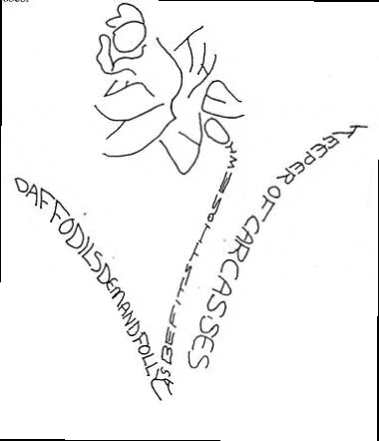


![[ Issue 2016.38; Cover art © 2016 Martin Hanford ]](http://futurefire.net/images/f38cover.jpg "[ Issue 2016.38; Cover art © 2016 Martin Hanford ]")


