Showing posts with label Don Riggs. Show all posts

Thursday, 12 October 2017

Recommend: Monsters of the World

For this month’s recommendation post, we’re asking readers to tell us about their favorite monsters of the world. What inhuman or almost-human beast, hybrid, giant or otherworldly creatures most fascinates, terrifies or speaks to you? As usual we have asked a handful of authors, artists and other friends to prime the pump with their suggestions, but what we really want is to hear from you.

Jo Thomas (Journeymouse; Elkie Berstein trilogy)

It probably comes as no surprise to people who know even a little bit about me that my favourite kind of monster is werewolves. After all, I’ve written three books that involve killing and/or living with them: 25 Ways To Kill A Werewolf, A Pack of Lies and Fool If You Think It’s Over. I’ve even written blog posts about why I decided to write werewolves, the rules I use, and what I see as the history I'm tapping in to. (Although I’m not an academic who specialises in werewolves in historic literature, and I may be wrong or filtering out the stuff I don’t make use of.)

However, here’s the thing. Furry monsters have been the most intriguing to me for a while, even before I had dogs of my own and even before I started trying to work out how they would actually, well, work. Werewolves seem to represent the monster within, the animal nature that's hiding inside every human being, just waiting for that “it’s in my nature” or “it’s just the way I am” excuse to come trotting out. I want to be better than that. I want to be a human being, a person in control of themselves. On the other hand, there are times I envy these monsters, even if it’s a curse and it means they are forced to exist outside of community and civilisation. After all, they get to be a rampaging monster with no thought to the consequences.

Ernest Hogan (Mondo Ernesto)

The best monsters though are the ones that haunt your dreams, give you nightmares, and change the course of your life. So I'll have to go with the mutant slaves from the original 1953 version of Invaders from Mars—those bug-eyed, furry brutes with visible zippers down their backs. In the dreams at least, there was only one, and he was coming after me. I would go to adults, but they couldn't see—or even believe in—him. This developed into a phobia of monsters, and hatred of science fiction.

Then one nightmare, after some adult had told me there was no such things as monsters, I turned around, and there he was. I grabbed one of his arms, and it snapped off, and crumbled. He was made of the same delicate, almost solid smoke of the Magic Snakes fireworks. I punched him, and he fell apart like those flimsy snakes. I was no longer afraid of monsters. I loved them. And I loved science fiction, too. Since then, my life has been full of monsters. It makes me smile.

Alina Dimitrova (academic page)

Baba Yaga is… an old Slavic perception of horror. In the numerous variations of her legend, spread over an enormous territory, she appears as an anthropomorphic, monstrous-looking figure, a cannibal and terrifying magician who hates humans. Dwelling in a deep forest outside the human realm, she is profoundly related to the wilderness and to nature cults. Her house on chicken legs reflects in a curious way an ancient burial custom of cremating the dead in small wooden huts built on tree stumps. Absorbing elements of witch and goddess, and often associated with some female evil spirits that exist beyond the Slavic imagination (just compare the horrifying tale of Hansel and Gretel…), her multidimensional figure provides infinite perspectives for exploration that trigger the curiosity of the researcher.

The most astonishing aspect of her mythological image is her ability to turn into a positive character that helps humans, sometimes involuntarily, especially the young hero who struggles to accomplish his task and save the day.

Don Riggs (faculty page)

I was born in the Year of the Dragon. A tarot instructor once said of the King of Staffs in a spread I head dealt myself with my own deck, a card which features an old dragon, “That is your job”—not realizing that I also worked at a school with a dragon as its mascot!

The dragon has differing associations in different cultures. Largely negative in Western culture, in Chinese tradition the dragon is associated with rationality (as opposed to the passion of the tiger). In the Near Eastern roots of Western Culture, the dragon is associated with the Female, as in the Babylonian Tiamat, which was slain by Marduk. Merlin Stone, in When God Was a Woman, argues that the killing of dragons by (male) heroes in Western myth and folklore reflects male fear of the primordial Mother Goddess, whom they were trying to obliterate even in memory. Tolkien glossed the medieval dragon as an emblem of “malitia,” or malice, and it is with this in mind that one may read Smaug in The Hobbit as manifesting pride, wrath, avarice, and possibly even sloth (sleeping on a pile of treasure for 100 years).

Literary dragons that have inspired me include: Fafnir, whom I remember from reading Sigurd of the Volsungs; the unnamed dragon from Beowulf; the combination of the two in Tolkien’s Smaug, also the delightful Chrysophylax, from Farmer Giles of Ham; the dragon in Ursula K. LeGuin’s A Wizard of Earthsea; Anne McCaffery’s dragons; Lawrence Ferlinghetti’s The Great Chinese Dragon.

Katharine A. Viola (art page)

My favorite monsters are trolls. I have been fascinated by these creatures since I was a child. I love how they are a diverse creature with several different species; mountain trolls, forest troll, etc. I particularly love how they are depicted as larger (much larger) than humans, but not too intelligent; they are scary and intimidating, yet easily escapable if you can outwit them.

Now tell us about your favorite/most nightmarish monsters in the comments. If you prefer, you can share your favorite monsters as images on social media, and have a chance of winning a prize (see rules from Classics International). And if you haven’t had enough of monsters, there’s a whole evening of them in London next Tuesday: Why do we need monsters?

Monday, 17 April 2017

Recommend: Optimistic SF

This time, we're asking for recommendations of optimistic science fiction. Please leave your suggestions in the comments below. First, a few ideas from editors, authors, reviewers and other friends:

Tracie Welser (author page)

A common enough complaint about science fiction is that much of recent writing in the genre is dystopian or deeply pessimistic. Gone are the golden age stories about exploration and hope, to which I say "good riddance," as much of the sense of wonder and speculation of those years drew heavily on imperialist themes and angles of approach to "others." It seems inevitable that trends such as social suppression of dissent, growing divide between economic classes, environmental degradation and rapidly changes in technology produce distinctly dark responses from science fiction writers. Lauren Buekes' Moxieland comes to mind. In the early aughts, this complaint seemed louder than usual (just search for "positive science fiction" to take a peek at posts from Time and others decrying the grimness of SFF books and film). There were even suggestions that negative stories stifle scientific innovation, rather than inspire.

I, for one, think dystopian narratives while not inherently hopeful are backdrops for hope, where solidarity and struggle are elevated. The popularity of dystopia themes in young adult fiction (ie, Hunger Games) is not so surprising, as the sub-genre is inclined to take risks and whack fascism firmly on the nose, a sensibility enjoyed by young readers and adults alike. Similarly, seemingly hopeless stories, of shattered civilization and economic despair (Oryx and Crake, The Wind-up Girl) offers some kernels of resistance and revolution. Attempts at overtly positive science fiction in the recent past are harder to come by.

Two that come to mind are METAtropolis edited by John Scalzi. A series of shared world stories by different authors, the collection posits some realistic (read: gritty) futurism but with hopeful notes about urban community. The second is the anthology Hieroglyph, which includes the notable, playful story by Charlie Jane Anders titled "The Day it All Ended." The history of the Hieroglyph Project itself is fairly interesting, a deliberate effort to create and publish more positive visions of science fictional future.

Maureen Kincaid Speller (Paper Knife)

The world is not an optimistic place right now; it’s been a long time since science fiction felt optimistic, to the point where the issues explored over the last twenty or thirty years in fiction have become commonplace in daily life. In common with many, I fear for the future and often find it hard to read sf these days because the brain can only stand so much dystopia. It was a genuine pleasure, then, to read Lavie Tidhar’s Central Station recently and to feel that perhaps not all has been lost. Tidhar’s fiction doesn’t offer much in the way of solutions but there is the promise nonetheless that life will continue, and not necessarily a bad life either. The people (and I use this term in the broadest sense) who gather around the Central Station to sell food, tend bar, collect books, solve problems, look out for one another, fall in love, practise their religions, aren’t so far removed from the people I know. It is both encouraging and comforting to know that at least one writer believes in the persistence of ordinary daily life, no matter what.

Don Riggs (faculty page; alumnus page)

When I was in the 8th grade, I first learned about the Big Bang theory—the actual theory, not the television sitcom. The ultimate implication of the universe starting off with a bang and an unceasing expansion is entropy, which is the tapering off of the energy of the universe until the Heat Death of the Universe happens. I was thoroughly depressed by this, and so, when our next theory was presented, the Oscillating Universe, where the universe expands as far as it goes until it then is sucked back into another primordial point of all matter, which will again explode in another Big Bang, I decided that was the theory I wished to embrace. “Utriusque Cosmi,” a short story by Robert Charles Wilson (in Neil Clarke’s Galactic Empires, 2017), combines the story of a sixteen-year- old girl living in a trailer with her meth-addict mother and her abusive boyfriend, with that of that girl’s future self, “raptured up” to the Fleet of the intelligences of creatures saved from dying worlds, itself pursued by the Invisible Enemy, which ultimately turns out to be a group of Elder Beings that in turn “rapture up” the Fleet and thus survive the next collapse of the universe.

Stephanie Saulter (author page)

It’s a shame that science fiction isn’t a more generally optimistic genre. Too often we extrapolate possible futures so dire and hopeless the message seems to be that humanity is aboard a rocketship to all-but-inescapable doom, or at best unalleviated misery. I can’t think of too many writers who buck this grim trend, but among the few is the late and greatly lamented Iain M. Banks, whose Culture novels are the ultimate vision of a far-future, galaxy-spanning, inclusive and egalitarian polity in which humans are only one of many species and virtually omniscient AIs, instead of being the harbingers of our destruction, are committed and wryly indulgent protectors of organic life. The Culture’s liberal ethos combined with flexibility and at times ruthless pragmatism allows it to withstand assaults from without and respond to concerns from within. I’d suggest The Player of Games for a first visit.

Another exception is the grande dame of speculative fiction, Ursula Le Guin. Her SF looks at harmful gender and social constructs, the iniquities of politics and commerce, and conflicts between ideology and idealism with an eye less to endless iterations of the problem than envisioning possible solutions. The Dispossessed is an extraordinary book.

What are some other positive examples of science fiction? Please share recommendations in the comments.

Wednesday, 30 November 2016

Interview with Don Riggs

Don Riggs is an occasional reviewer for TFF-R, as well as poet, scholar, teacher, aficionado of monsters and Alice in Wonderland adaptations. We’ve been working with Don for a couple years now, so we thought we’d invite him over to talk a bit about his work and passions.

Don Riggs went to Dickinson College where he studied Myth, the University of North Carolina where he studied Comparative Literature (Medieval), taught French in South Carolina, was a massage therapist in Mechanicsburg, Pa., taught Humanities and Art History at Harrisburg Area Community College, earned an M.A. in English/Creative Writing/Poetry, and has taught English at Drexel University in Philadelphia. His books of poetry include Bilateral Asymmetry (Texture Press, 2014) and Made of Words (Faurit din cuvinte) (Orizont Literar Contemporan, 2015). He analyzed John Langdon’s Alice and the Graceful White Rabbit at Cambridge University in 2015.


We asked Don a few questions.

The Future Fire: Who was your favourite mythical hero or heroine when you were young?

Don Riggs: Depending upon your definition of "mythical," it would either be Bilbo Baggins, the DC Comics Superhero Green Lantern, the fairy tale anonymous Little Tailor (of "Seven at One Blow"), or Merlin (are any of those mythical, strictly speaking?). I equivocate because, as an undergraduate, I pursued a self-developed interdepartmental major in Myth (I think it was called "Myth in the Western Tradition"). For that, I studied many theories on Myth, including that of Northrop Frye, who distinguishes different historical periods including: the Mythic (where the protagonists are gods), Romance (where the protagonists are demigods, like Hercules), High Mimetic (where the heroes are human beings of elevated status, like Oedipus, Agamemnon, etc.), Low Mimetic (where the protagonists are "ordinary people," like so many of us, neither gods nor despicables), and Ironic (where the protagonists or heroes are subhuman, like Gregor Samsa who, after a night of troubled dreams, awoke to find himself transformed into some disgusting vermin). Bilbo Baggins is Everyhobbit, and I would think of him as Low Mimetic, thus not mythic—at least, in that sense. Merlin I would find a hero (well, a prominent character) of Romance, and possibly Green Lantern as well.

What attracted you to speculative fiction in the first place?

DR: The world they lived and moved in was magical. Also, the Dutch expression, "Als je ben niet sterk, je moet slim zijn" (If you are not strong, you must be smart) worked more obviously in that kind of fiction than it did in my experience of reality. Again, Bilbo Baggins provided me with a model, as a "courage-teacher" (borrowing the term from Ginsberg, re Whitman). There was an element of the uncanny that operated quasi-naturally in speculative fiction, such as the incident, in Sigurd of the Volsungs, when Sigurd is roasting the heart of the dragon Fafnir over the fire (I picture him holding his sword, with the dragon's heart skewered on it), and touches it with his finger to see if it is done: naturally, he burns his finger and immediately brings it to his mouth to cool; having tasted the dragon's blood, he understands the language of the birds, and he hears one telling another that it's too bad he's going to give the roasted heart to Regin, who will then kill him, so he eats it himself and kills Regin. That very realistic sucking his burnt finger leading immediately to understanding the language of the birds is emblematic of what I love about speculative literature.

What monster lives under your bed?

DR: For years now I have slept on a futon directly on the floor, squeezing out whatever monster. However, before that, it was something faceless but with grasping hands. Probably something in the style of Arthur Rackham. If you look at Rackham's monsters from Rossetti's "Goblin Market," you will see some very uncomfortable images; also, from Matthias Grunewald's "The Temptation of St. Anthony," as well as Bosch's depiction of the same matter, and lo and behold Max Ernst did a temptation of St. A. as well. All of those monsters qualify for me as scary as need be…

What ring would you add to Dante’s inferno?

DR: The ring of the Deadly Dull, who do whatever they can to squash imagination and creativity. The ring of the freshmen who regularly introduce themselves to me by saying they want, or expect, or will be too hard-working not to get an A. They will sit there, grading endless piles of freshman writing, impelled by the independently moving forefinger and thumb to circle every error, discuss any divergence from clarity. At the same time, the grader will be gripped by a paralyzing sense of guilt, even before anything happens. And after having graded the enormous pile, student after student will come up begging to do "extra work" to help "bring the grade up."

What artist, dead or alive, do you think would have been the best choice to illustrate Tolkien’s Lord of the Rings?

DR: The artist, whose name I don't know, who illustrated his first edition of "Farmer Giles of Ham," the quasi-medieval drawing style. I also think Arthur Rackham would have been good, but as for painters, the evil spawn of Morgoth and Sauron would have been done well by Francis Bacon. The good characters (Gandalf, Aragorn etc.) would have been well illustrated by John Trumbull (cf. his "Battle of Bunker Hill").

What is the first rule of storytelling that you teach in your classes?

DR: I don't teach any rules; I hope that I exemplify them when I read out loud to the class. I do this often, and perhaps this is the rule: storytelling is a spoken art form, with music and expressiveness in the delivery.

Now give us an example of when to break that rule!

DR: When you are reading silently to yourself, late at night, to the light of one lamp only, and you are transfixed by watching the world unfold around you in you mind and beyond.

Don (R) with John Langdon (L)
and the Rabbit (C)
You have spoken and written about several modern adaptations of Alice in Wonderland. Which of the countless re-writings is the most unusual you’ve come across?

DR: John Langdon's Alice and the Graceful White Rabbit, currently the object of a kickstarter fundraiser. Langdon retells "Alice" with a densely woven overlay of allusions, evocations, and puns tying the original story to a layer of classic rock songs.

And which is your favourite Alice?

DR: The original, with the Tenniel illustrations.

Are you a poet who also teaches, or an academic who also versifies?

DR: A poet who also teaches, but I must admit that my day job takes the vast majority of my time and energy. Still, I write my 14-line poem every morning, and it's no longer a question of needing discipline to do it; I simply do it as inevitably as I get up in the morning. My thought is that I will continue writing long after I have retired from teaching (though I can't afford to do that for a long time, if ever!).

How do myth, monsters, illustration and/or scholarship influence your own poetry?

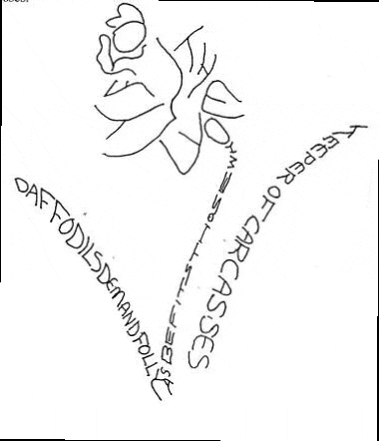
DR: My three self-published chapbooks (Walks, 1983; Hermenoodles, 1988; Self-Portraits in Words and Images, 1997) have at least one illustration (by me) on each page, with each poem, while Self-Portraits are calligrammes, where the lettering of the poems are also the lines of the drawings. Left is an example. Another is from Poems for the Writing, by Fox and Levin, illustrated by Don Riggs.

The cover of my book of poems, Bilateral Asymmetry (2014), illustrates how monsters sometimes fit in; I like dragons but don't feel comfortable writing about them; ordinary things become monsters in my poems, as in "Dialogue of the Hands": The right hand, in a fit / of characteristic pride, / yelled at the left hand, / "You foot!" / --the most devastating curse it knew. / The feet stood by, / silent as oxen. (from Walks 1983).

Scholarship is impossible to weed out from my poetry, because I write about what I know, and therefore refer to things I've read and seen in my research. For example:

2. Made of Words

Mon cher Edgar, poems are made of words,
said Mallarmé to Degas, when Degas’d said
he’d such great ideas for poems, but
they never worked out.
                                      Just as a painting
is made up of brushstrokes, he could well have
pointed out, not some puffy-eyed woman
sitting dispirited behind absinthe
next to a red-nosed, scruffy, bearded man

decades the worse for Bohemian wear,
the memories of his student days dabs
of color on the fragmented fog of his
canvas.
             Life flows by on the sidewalk
as her gaze glazes over. He shrewdly
speculates on how he can score some opium.

That is from Made of Words which was published in Bucharest in 2015, with facing-page Romanian translation.

You’ve been reviewing for TFF-R for a couple of years now. What moment stands out for you, of the items you’ve reviewed?

DR: The moment that first springs to mind is my review of Anna Patrick's Meditations in Wonderland (2015), because it came for review just after John Langdon and I had come back from Cambridge, where I had read my paper on his version of Alice. That immersion in the original material at the conference and in my paper on the Langdon version put me in a perfect situation to see what Anna Patrick was doing in her really quite incredible—and very different—version of Alice.

What's the most interesting thing you have ever found in the garbage?

DR: Whoa. What a question. I think a letter that a woman whom I had yearned for had written me after a visit: the letter itself was extremely understated, but the underlying emotion was incredibly powerful. (It was in a box of materials I had intended to throw out, but had only made it as far as the attic.)

What are you working on now? Anything forthcoming to look forward to?

DR: I'm preparing myself to interview Samuel Delany in mid-December, so when I have the chance I'm reading as much of his work and works about him as possible.

I'm reading a novel by Alex Kudera, Auggie's Revenge (2015), to write a review for a publication in Romania (I don't know the name of the journal).

I'm getting ready to write a paper on Peter Jackson's series of videoblogs that he made to prepare the way for the release of his first Hobbit movie (An Unexpected Journey). I am looking at the series of videoblogs, released in ten units over the 20 months preceding the release of the first film, as a campaign to create a viewership/community to anticipate the release of the film, using Henry Jenkins's theory of intermedia outlined in his book Convergence Culture, and I will present this paper at the International Conference on the Fantastic in the Arts in Orlando, FL in March 2017.

I have been posting a daily poem on my Facebook page for well over a year now, and I'm getting ready to publish a number of them in a collection of Facebook Poems in the near future. Whether I will illustrate them depends upon how much time I have.

Many thanks for joining us, Don!