 What was the inspiration for setting up Jungle Jim and what is the ethos/agenda of the magazine?
I think both of us (Hannes and Jenna) were at a stage when we were working on things that were dependent on outside factors – people, money, circumstance etc. It was becoming frustrating and we dreamt of having a creative project which we could run on our own terms – something we felt was important, but also not too serious (Little did we know…). One day it just reached a crisis point – we were sharing an office at the time – and we decided to start a magazine. Hannes has a background in independent publishing, but I had absolutely none – so we were guided by very little other than what we thought we could achieve, and for which we felt there was a need. Looking around, there were very few print magazines offering the magical combination of storytelling and images I remembered from childhood. We wanted the adult version – something different, shocking, ‘out there’ – and where I could sometimes get away with publishing my own writing! At the same time, I was becoming more and more interested in pulp writing, the ethos of that time – where writing was accessible, imaginative, visual, dramatic, narrative-driven and relatively ego-less (for better or worse). Of course, it’s easy to idealise that time, but we felt there was also a lot to learn – especially in a country where reading is not the entertainment of choice. We became fascinated with the idea of western pop-genre ‘clashing’ with Africa, of the new truths and exciting ideas this could reveal – and potentially the sacred cows we might upset. So we launched the magazine with this ethos: “Jungle Jim is a bi-monthly illustrated print publication, aiming to showcase narrative- and concept-driven African stories. Taking from the pulp tradition, we publish short and serialised fiction that entertains and engrosses in all dramatic genres, accessible to all, but with a high quality of writing. We seek to publish stories that explore the collision between the visceral daring of pulp and the reality of living in Africa.” And our motto is: “African tales of the uncanny and the unexpected.”
Monday, 17 September 2012
Interview: Jungle Jim magazine


Monday, 10 September 2012
New Issue 2012.24
“We don't see things as they are, we see them as we are.”
--Anaïs Nin
Issue 2012.24
![[ Issue 2012.24; Cover art © 2012 Cécile Matthey ]](http://futurefire.net/images/f24cover.jpg "[ Issue 2012.24; Cover art © 2012 Cécile Matthey ]")
- ‘Je me souviens’, Su J. Sokol (illustrated by Soussherpa)
- ‘Secrets of the Sea’, Jennifer Marie Brissett (illustrated by Creative Commons photographs)
- ‘The Harpy’, Laura Heron (illustrated by Rebecca Whitaker)
- ‘Safecracker, Safe’, J.C. Hsyu (illustrated by Christina Cartwright)
- ‘Arrow’, Barry King (illustrated by Cécile Matthey)
- ‘Courtship in the Country of Machine-Gods’, Benjanun Sriduangkaew (illustrated by Tais Teng)
Sunday, 9 September 2012
We See a Different Frontier CFS: extended deadline
As announced three months ago, we are seeking submissions for a colonialism-themed anthology of new stories told from the perspective of those with experience of colonization or postcolonial cultures, titled We See a Different Frontier, to be guest edited by Fabio Fernandes and published by The Future Fire. (See the original Call for Submissions for all rules and pay scale.)
The call for submissions was due to close one week from today. We have received many excellent submissions in this time, but we would like to give more authors who have not yet had a chance to write a story on this theme, particularly authors with underrepresented perspectives (including those whose first language may not be English) the opportunity to do so. Rather than offer this extension of the submissions deadline only to a few authors who have already asked for it, we are keeping the reading period for this anthology open for a few weeks longer, until October 31st 2012.
All stories that are currently held for further consideration will remain in our shortlist until this new closing date, at which point we will make our final decision about the contents of the anthology.
The call for submissions was due to close one week from today. We have received many excellent submissions in this time, but we would like to give more authors who have not yet had a chance to write a story on this theme, particularly authors with underrepresented perspectives (including those whose first language may not be English) the opportunity to do so. Rather than offer this extension of the submissions deadline only to a few authors who have already asked for it, we are keeping the reading period for this anthology open for a few weeks longer, until October 31st 2012.
All stories that are currently held for further consideration will remain in our shortlist until this new closing date, at which point we will make our final decision about the contents of the anthology.
Monday, 16 July 2012
SCIFIISTA RUMBLINGS IN DE-COLONIALIZING AZTLÁN

by
Ernest Hogan
So
it's not just me. Things are happening here in Azltán, the Aztec
homeland, the part of the United States of America that was once
Mexico. The future has arrived, and it's firing imaginations.
It
started with a post by Rudy Ch. Garcia, Spic vs spec – 1. Chicanos/latinos & sci-fi lit, in La Bloga about his
story “Last Call for Ice Cream” in the webzine Flurb. A
critic said, “It has so much slang that it become tiresome very
quickly.” After a few brain clicks, Rudy asked, “Do
Chicanos/latinos read sci-fi?” and “How many are writing sci-fi?
Should more latinos be writing it?
This
got responses from science fiction writing Latinos that triggered
Spic vs spec – 2. providing some
background, and answering questions from the readers.
So
I had to devote my next Chicanonautica column (every first and second
Thurday in La Bloga), to Sci-Fi Evolution and Revolution in the Global Barrio in
which I gave examples of science fictional art and even polticial
discussion, gave some advice to aspiring scifiistas, and even plugged
The Future Fire and
We See a Different
Frontier.

In
Spic vs spec – 3. Rudy went on to ask about where
science fiction readers are (both Anglo and Latino), the need for
entry-level books in the genre, and that “future jobs will be
filled by someone who will likely have an interest in sci-fi lit.”
The
series ended with Spic vs spec – 4.
Rudy got a response from a publisher that was interested in, and
had published multicultural science fiction and fantasy for, the young adult audience and gave a nod to David Macinnis Gill's Black
Hole Sun, a YA about a Latino
mercenary on Mars.
I
went on with another Chicanonautica, Chewing Scifiista Holes in the Tortilla Curtain with links to blogs dealing with
science fiction, fantasy, and horror in Spanish, plus a few others to
help rescue sci-fi from the monocultural ghetto.
And
not to be outdone, Rudy announced the approaching publication of his
novel, The Closet of Discarded Dreams, a post-cyberpunk tour-de-force that boldly demonstrates how
Chicano is a science fiction state of being.
Things
have being stirred up. I hope some writers who hadn't considered
science fiction as a possibility are creating visions of the future
the likes of which no one has ever seen.
And
I encourage those of you who haven't checked out La Bloga to do
so. Some very interesting things are happening there.

Ernest
Hogan is the author of the pioneering Chicano science fiction novel
Cortez on Jupiter.
His infamous short story “The Frankenstein Penis” has recently
become available in the anthology Love That Never Dies.
His blog is Mondo Ernesto.
Thursday, 12 July 2012
Outlaw Bodies ToC
We’re delighted to be able to announce the table of contents of the forthcoming Outlaw Bodies anthology, published by The Future Fire and guest co-edited by Lori Selke.
Outlaw Bodies will be available in print and e-book (PDF, Epub, Kindle) from early November 2012. (e-ARCs available from September: contact me if you’re interested in reviewing a copy.)
- Emily Capettini, ‘Elmer Bank’
- Anna Caro, ‘Millie’
- Fabio Fernandes, ‘The Remaker’
- Vylar Kaftan, ‘She Called me Baby’
- Lori Selke, ‘Frankenstein Unraveled’
- Stacy Sinclair, ‘Winds: NW 20 km/hr’
- M. Svairini, ‘Mouth’
- Jo Thomas, ‘Good Form’
- Tracie Welser, ‘Her Bones, Those of the Dead’
Outlaw Bodies will be available in print and e-book (PDF, Epub, Kindle) from early November 2012. (e-ARCs available from September: contact me if you’re interested in reviewing a copy.)
Thursday, 5 July 2012
TFFcon July 13th, London
The Future Fire and Fabio Fernandes are delighted to invite all of our friends, and anyone interested in speculative fiction with a social conscience, to join us for a mini-TFFcon in the upstairs function room of the Coach and Horses, near Oxford Circus, London (directions below), on Friday July 13th at 18:00 (6pm).
The evening will involve readings, samples and giveaways, convivial chat, eating and drinking. If you'd like to read some of your work, please prepare about 10 minutes-worth and we'll fit you in. If you have any review copies, flyers, or other freebies you'd like to bring along, that would be great too. Any other suggestions most welcome. Email me, leave a comment below, contact us via Twitter,or just bring your idea along on the day.
I hope to see many old friends and new faces next Friday. Directions below.
Coach and Horses, 1 Great Marlborough Street, London W1F 7HG: walking directions from Oxford Street Underground (4 mins)
View Larger Map
The evening will involve readings, samples and giveaways, convivial chat, eating and drinking. If you'd like to read some of your work, please prepare about 10 minutes-worth and we'll fit you in. If you have any review copies, flyers, or other freebies you'd like to bring along, that would be great too. Any other suggestions most welcome. Email me, leave a comment below, contact us via Twitter,or just bring your idea along on the day.
I hope to see many old friends and new faces next Friday. Directions below.
Coach and Horses, 1 Great Marlborough Street, London W1F 7HG: walking directions from Oxford Street Underground (4 mins)
View Larger Map
Saturday, 30 June 2012
New Issue 2012.23
The collective principle asserts that... no society can legitimately call itself civilised if a sick person is denied medical aid because of lack of means.
-- Aneurin Bevan
Issue 2012.23
![[ Issue 2012.23; Cover art © 2012 Eric Asaris ]](http://futurefire.net/images/f23cover.jpg "[ Issue 2012.23; Cover art © 2012 Eric Asaris ]")
- Jamie Killen, ‘Elm’ (illustrations by Lisa Grabenstetter)
- Joe Pitkin, ‘American Golgotha’ (illustrations by Martin Hanford)
- Anne E. Johnson, ‘Lacuna’ (illustrations by Rebecca Whitaker)
- Cory McMillen, ‘Survive!’ (illustrations by Eric Asaris)
- Rebecca J. Schwab, ‘Thick on the Wet Cement’ (illustrations by Cécile Matthey)
Thursday, 14 June 2012
Interview: Bart Leib of Crossed Genres
 If you hang around the kind of circles we do, you almost certainly know about Crossed Genres, originally a monthly speculative fiction magazine, now a quality small press publisher of anthologies and novels. Over the past few weeks, CG have been running a very successful Kickstarter fundraiser, first to keep the press going, then to resurrect the magazine, and finally—if they make their next stretch goal—to make the magazine a pro paying venue. Given the fine work CG have showcased over the years, allowing them to pay their authors a professional rate would in my view be an excellent, and natural, idea. I urge everyone to support them with a few dollars (or squid or euro or schillings).
We've asked Bart Leib, co-editor of Crossed Genres Publications, a few questions about their work.
The Future Fire: You put up a Kickstarter appeal to save Crossed Genres Publications, and received the minimum funding in what seemed like minutes. (Congratulations!) Do you have any specific plans for books that you couldn't have released otherwise? What is the first new thing you're going to do? Are you looking for proposals, submissions?
Bart Leib: Thanks for the congrats! We're still kind of reeling, and realizing how busy our schedules have suddenly gotten! ;)
We've never felt that we were restricted from publishing any book on a particular topic. One of the great things about being a small press is that we can publish what we want, and publish more daring ideas that the big publishers can't because they're worried about how much money they'll lose. Being smaller means we can be more flexible, and produce titles unlike anything else available.

We've never been open to proposals for anthology ideas before, but that's mainly because we're limited on the number of titles we can release. However, I've always wanted to be able to bring aboard a guest editor to spearhead a project they pitch that we'd like to publish but don't have time to handle ourselves. The ability to do that is also limited by funding, so depending on how well the Kickstarter does overall, we may do that in the future.
And we're always open to novel submissions! We'll be publishing our third novel, Sabrina Vourvoulias' INK, in October! We'd love to find another excellent novel for publication in late 2013.
TFF: Your stretch goal was to resurrect the fiction magazine incarnation of Crossed Genres, and now you're aiming to make that a pro-paying venue if you receive just a few thousand dollars more. Tell us briefly about the CG magazine format. What made this 'zine stand out from the crowd, in the past?
BL: Each month, we choose a new genre or theme. And submissions for that issue must combine that genre or theme with some element of science fiction and/or fantasy. Hence the name, 'Crossed Genres'! The structure encourages writers to challenge themselves and as a result we've gotten some truly amazing and unique stories.
The zine is published online each month, and collected into quarterlies for print and ebook editions. (This may change to biannuals depending on what the Kickstarter enables us to do.)
We will of course be continuing the practice when the zine re-launches in January. In fact, we've already decided what the theme will be for our first new issue: BOUNDARIES, and all its various interpretations.
TFF: CG has always been a diversity-friendly magazine and you have been involved in advocacy organizations such as the Outer Alliance. In what ways has the magazine actively promoted inclusiveness and social issues in the past? Do you have any new or different plans to do so in the future?
BL: We've had issues of the zine dedicated to under-represented groups like LGBTQ and characters of color. This has carried over into our other titles, as we've published books dealing with women and body issues (Fat Girl in a Strange Land), slavery/racism (Broken Slate), immigration (INK, coming in October) and more. We've always actively encouraged stories which address these topics and include these characters, in addition to what any given submission call is for.
This will always be a part of how CG works, and we're going to step up our efforts in the future. We want writers to know that they don't have to wait for a specific call for characters of color, or LGBTQ, or strong women – they can send us stories with those characters any time! We want those characters represented throughout our publications!
TFF: What else is on the horizon for Crossed Genres, creatively speaking?
BL: In July, we're publishing a collection of short stories by Daniel José Older titled Salsa Nocturna. (In their review, Publishers Weekly called Daniel a "rising star of the genre"!) Then in October we're publishing the above mentioned INK. In Jan/Feb 2013 we're releasing Menial: Skilled Labor in Science Fiction (submissions open through June). And we currently have an open submission call for novellas of strong older women, titled Winter Well, which we're hoping to have ready for WisCon 37 in May 2013! Winter Well will be the first time we publish novellas, and we're very excited about it!
The Kickstarter is also going to provide something new. One of the pledge rewards gives backers input on the subject of an upcoming anthology we'll publish. After the Kickstarter is over we'll talk with those backers and come to some consensus (it's unlikely that everyone will be 100% on board with the final choice, but we'll do our best to satisfy everyone). We've never had this sort of collaborative input before – in fact no one's ever had any say on the topics we've chosen except my co-publisher Kay and I. Who knows, it could bring about an idea that had never occurred to us before!
TFF: Do you have anything else you'd like to tell our readers about CG or any of your other work?
 BL: CG has always been a labor of love. We never expected to make money from it – and still don't! When Kay lost her job, the easiest thing to do would have been to shut CG down… no one would even have blamed us, considering the situation. But that option was simply never on the table. We immediately started plotting the best way to save it instead.
We decided to pursue the additional Kickstarter goal of paying pro rates because we felt it would give us the best chance of creating some long-term sustainability for CG. That's damn important, because we want to keep doing this for a very long time.
Someday, we hope to have the flexibility to publish other things, like comics, children's books, and more. All that would be well down the road… so we hope people who enjoy and appreciate what we're doing now will help us get there!
Support Crossed Genres Magazine's Kickstarter campaign, get lots of fiction and other goodies, and be part of more future greatness.
Tuesday, 12 June 2012
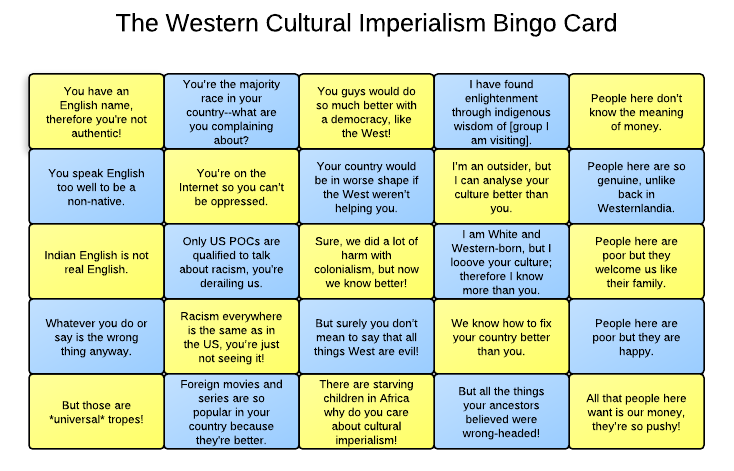
Signal Boost: Presenting the Cultural Imperialism Bingo Card
If you think colonialism is dead... think again. Globalisation has indeed made the world smaller--furthering the dominance of the West over the developing world, shrinking and devaluing local cultures, and uniformising everything to Western values and Western ways of life. This is a pernicious, omnipresent state of things that leads to the same unfounded things being said, over and over, to people from developing countries and/or on developing countries.
It's time for this to stop. Time for the hoary, horrid misrepresentation clichés to be pointed out and examined; and for genuine, non-dismissive conversations to start.
Accordingly, here's a handy bingo card for Western Cultural Imperialism--and we wish we could say we've made it all up, but unfortunately every single comment on this card was seen on the Internet.
 Card designed by Aliette de Bodard, Joyce Chng, Kate Elliott, Rochita Loenen-Ruiz, @requireshate, Charles Tan, @automathic and @mizHalle. Launch orchestrated with the help of Zen Cho and Ekaterina Sedia in addition to above authors (and an army of volunteer signal boosters whom we wish to thank very much!)
Any signal boosting on this much appreciated!
It's time for this to stop. Time for the hoary, horrid misrepresentation clichés to be pointed out and examined; and for genuine, non-dismissive conversations to start.
Accordingly, here's a handy bingo card for Western Cultural Imperialism--and we wish we could say we've made it all up, but unfortunately every single comment on this card was seen on the Internet.
Any signal boosting on this much appreciated!
Monday, 11 June 2012
Guest post: I Hear a Different Frontier by Nisi Shawl
Fellow geniuses, I have things to tell you that you probably already know. But you may know them in different ways than I do.
 For instance, my friend Jaymee Goh knows about postcolonial science fiction and fantasy the way a woman much younger than me would, and in the way someone who was born and has lived most of her life outside the US would, and in the way of someone who has traveled much further into the figurative world of academia than I. So when she was interviewed in early June on the topic of writing postcolonial SF, and a questioner asked, “Do you think belonging to a Non-Western (sic) culture is essential to write a really good, convincing story about it? Being an outsider to the culture you want to write about is an enriching or empoverishing (sic) experience (or it doesn’t matter in the end)?” her reply was much longer and more considered than mine, and also more revealing. I would have said something like, “I refuse to answer your stupid.” Or, in a more cooperative mood I would have talked about my own experience writing about a culture from its outside, which requires work, which I guess might be equated with “empoverishment.”
Not Jaymee, though. She bestowed on the questioner several paragraphs of weighty thoughtfulness while flipping the power dynamic inherent in interview and interrogation right around. She noted that describing non-Western cultures from the perspective of their conquerors, or the perspective of their conquerors’ heirs, is quite a longstanding tradition. My favorite line from her response: "I really have to question why any one writer would ask such a question, and am hard-pressed to come up with any other answer besides 'seeking validation.'" Which validation she then proceeded to deny them.
A couple of weeks before that interchange, I appeared on the “Cultural Not-Appropriation” panel at WisCon 36 with Diantha Sprouse, Sofia Samatar, and Daniel José Older, our moderator. Diantha I’d known for several years, but Sofia and Daniel were new to me.
Daniel is a something of coreligionist—his practice of Lucumi and mine of Ifa are closely related—so that’s a perspective on empire we share, along with US birth and residency. But Daniel’s also younger than me, plus he’s male, and he speaks Spanish. We both differ from colonizers’ cultural paradigms, but in different ways. Our experiences of postcolonialism, and postcolonial speculative fiction, are different. Like yours and mine.
Which is where I would have come from if I’d been seriously answering the question Jaymee got asked. Where I did come from when talking on the WisCon panel about How to Do It Right: from the place of being simultaneously innocent and implicated, and paying attention to what that means.
 What we all know, from our many perspectives, is that colonialism bites the flaming donkey weenie. It messes shit up. It messes up most of what could be used to sort shit out and unmess it. It extracts costs from the colonized, costs that are carried across generations. Some of these costs masquerade as benefits. Some are presented as choices.
I do my best not to contribute to the legacy of colonialism in my fiction, but when it comes to certain entanglements I understand that I must use the utmost caution and concision.
I made what I’d call a successful foray into explicitly postcolonial science fiction with “Deep End,” which first appeared in the anthology So Long Been Dreaming: Postcolonial Science Fiction and Fantasy (Arsenal Pulp Press, 2004). Taking Australia as a model, I wrote about a prison ship flying to an extrasolar planet with a freight of disembodied activists; these activists were scheduled to be downloaded into clones of their oppressors. “Deep End” was reprinted in my Tiptree Award-winning collection Filter House in 2008. This summer I’m working on a sequel.
My current novel-in-progress, Everfair, is another deliberate confrontation of colonialism: steampunk set in the Belgian Congo. It arose from my dislike of steampunk’s tendency to privilege imperialism, and especially Britain’s Victorian Empire. It also focuses on the site of one of the worst modern human rights atrocities, an infamous episode intimately connected with the rape of natural resources that lies behind the Industrial Revolution.
To ensure representation of the multiplicities of non-dominant difference, I’m writing Everfair from many viewpoints: white and mixed-race Europeans, African-Americans, and indigenous Africans. Research is sometimes exhilarating, and sometimes heartbreakingly piecemeal, particularly in the case of the indigenes, whose histories were severely disrupted—to say the least—by their decimation. Often the only voice left to tell a tale is that of the colonizer. When using those versions of events, I do what I can to up-end unwritten assumptions. I learn what I can from the examples of nearby, possibly related, people. I dream and make things up.
I know I’m treading on the bones of those who went before me. It’s unsteady ground, even if I’m related to the giants beneath my feet. I walk respectfully, carefully, listening with my outer and inner ears. Repeating what I hear, what you already know, but saying it in my way.
 For instance, my friend Jaymee Goh knows about postcolonial science fiction and fantasy the way a woman much younger than me would, and in the way someone who was born and has lived most of her life outside the US would, and in the way of someone who has traveled much further into the figurative world of academia than I. So when she was interviewed in early June on the topic of writing postcolonial SF, and a questioner asked, “Do you think belonging to a Non-Western (sic) culture is essential to write a really good, convincing story about it? Being an outsider to the culture you want to write about is an enriching or empoverishing (sic) experience (or it doesn’t matter in the end)?” her reply was much longer and more considered than mine, and also more revealing. I would have said something like, “I refuse to answer your stupid.” Or, in a more cooperative mood I would have talked about my own experience writing about a culture from its outside, which requires work, which I guess might be equated with “empoverishment.”
Not Jaymee, though. She bestowed on the questioner several paragraphs of weighty thoughtfulness while flipping the power dynamic inherent in interview and interrogation right around. She noted that describing non-Western cultures from the perspective of their conquerors, or the perspective of their conquerors’ heirs, is quite a longstanding tradition. My favorite line from her response: "I really have to question why any one writer would ask such a question, and am hard-pressed to come up with any other answer besides 'seeking validation.'" Which validation she then proceeded to deny them.
A couple of weeks before that interchange, I appeared on the “Cultural Not-Appropriation” panel at WisCon 36 with Diantha Sprouse, Sofia Samatar, and Daniel José Older, our moderator. Diantha I’d known for several years, but Sofia and Daniel were new to me.
Daniel is a something of coreligionist—his practice of Lucumi and mine of Ifa are closely related—so that’s a perspective on empire we share, along with US birth and residency. But Daniel’s also younger than me, plus he’s male, and he speaks Spanish. We both differ from colonizers’ cultural paradigms, but in different ways. Our experiences of postcolonialism, and postcolonial speculative fiction, are different. Like yours and mine.
Which is where I would have come from if I’d been seriously answering the question Jaymee got asked. Where I did come from when talking on the WisCon panel about How to Do It Right: from the place of being simultaneously innocent and implicated, and paying attention to what that means.
 What we all know, from our many perspectives, is that colonialism bites the flaming donkey weenie. It messes shit up. It messes up most of what could be used to sort shit out and unmess it. It extracts costs from the colonized, costs that are carried across generations. Some of these costs masquerade as benefits. Some are presented as choices.
I do my best not to contribute to the legacy of colonialism in my fiction, but when it comes to certain entanglements I understand that I must use the utmost caution and concision.
I made what I’d call a successful foray into explicitly postcolonial science fiction with “Deep End,” which first appeared in the anthology So Long Been Dreaming: Postcolonial Science Fiction and Fantasy (Arsenal Pulp Press, 2004). Taking Australia as a model, I wrote about a prison ship flying to an extrasolar planet with a freight of disembodied activists; these activists were scheduled to be downloaded into clones of their oppressors. “Deep End” was reprinted in my Tiptree Award-winning collection Filter House in 2008. This summer I’m working on a sequel.
My current novel-in-progress, Everfair, is another deliberate confrontation of colonialism: steampunk set in the Belgian Congo. It arose from my dislike of steampunk’s tendency to privilege imperialism, and especially Britain’s Victorian Empire. It also focuses on the site of one of the worst modern human rights atrocities, an infamous episode intimately connected with the rape of natural resources that lies behind the Industrial Revolution.
To ensure representation of the multiplicities of non-dominant difference, I’m writing Everfair from many viewpoints: white and mixed-race Europeans, African-Americans, and indigenous Africans. Research is sometimes exhilarating, and sometimes heartbreakingly piecemeal, particularly in the case of the indigenes, whose histories were severely disrupted—to say the least—by their decimation. Often the only voice left to tell a tale is that of the colonizer. When using those versions of events, I do what I can to up-end unwritten assumptions. I learn what I can from the examples of nearby, possibly related, people. I dream and make things up.
I know I’m treading on the bones of those who went before me. It’s unsteady ground, even if I’m related to the giants beneath my feet. I walk respectfully, carefully, listening with my outer and inner ears. Repeating what I hear, what you already know, but saying it in my way.
Nisi Shawl was WisCon 35’s Guest of Honor and the editor of WisCon Chronicles 5: Writing and Racial Identity. She is coauthor of Writing the Other: A Practical Approach, a founder the Carl Brandon Society, and a member of Clarion West’s Board of Directors. She edits reviews for the Cascadia Subduction Zone, a literary quarterly. She’s fairly active on Twitter and Facebook, and she promises to update her homepage (www.nisishawl.com) soon.
Sunday, 10 June 2012
We See a Different Frontier: Call for submissions
We are seeking submissions for a colonialism-themed anthology of new stories told from the perspective of the colonized, titled We See a Different Frontier, to be guest edited by Fábio Fernandes and published by The Future Fire.
It is impossible to consider the history, politics or culture of the modern world without taking into account our colonial past. Most violent conflicts and financial inequalities in some sense result from the social-political-economic matrix imposed by European powers since the seventeenth century—even powerful countries such as the BRICS (Brazil, Russia, India, China, South Africa) have to be viewed through the filter of our history to fully appreciate their current circumstances. The same is true of art and literature, including science fiction; as Rochita Loenen-Ruiz eloquently explained, “it is impossible to discuss non-Western SF without considering the effects of colonialism.” Cultural imperialism erases many native traditions and literatures, exoticizes colonized and other non-European countries and peoples, and drowns native voices in the clamour of Western stories set in their world. Utopian themes like “The Final Frontier”, “Discovering New Worlds” and “Settling the Stars” appeal to a colonial romanticism, especially recalling the American West. But what is romantic and exciting to the privileged, white, anglophone reader is a reminder of exploitation, slavery, rape, genocide and other crimes of colonialism to the rest of the world.
We See a Different Frontier will publish new speculative fiction stories in which the viewpoint is that of the colonized, not the invader. We want to see stories that remind us that neither readers nor writers are a homogeneous club of white, male, Christian, hetero, cis, monoglot anglophone, able-bodied Westerners. We want the cultures, languages and literatures of colonized peoples and recombocultural individuals to be heard, not to show the White Man learning the error of his ways, or Anglos defending the world from colonizing extraterrestrials. We want stories that neither exoticize nor culturally appropriate the non-western settings and characters in them.
We See a Different Frontier will pay US$0.05 per word, with a minimum payment of $50, plus the possibility of royalties if sales are good enough. We are looking for stories between 3,000 and 6,000 words in length; we are willing to be flexible about this wordcount, but the further a story falls outside this range, the harder a sell it will be. Please do not submit stories that are also under consideration elsewhere. Query before sending more than one story to us. We are unlikely to be interested in reprints unless they were published only in a market that is not well-known to an anglo-american SF audience, but in any case please query before sending a reprint, explaining when and where the story has appeared before.
Please send submissions as an attachment (.doc[x], .rtf or .odt) to differentfrontier@gmail.com. The deadline for submissions is midnight UTC, October 31, 2012.
About the publisher: The Future Fire is an e-published magazine showcasing new writing in Social-Political Speculative Fiction, with a special interest in FeministSF, Queer SF, Eco SF, Postcolonial SF and Cyberpunk. See http://futurefire.net/ for more details.
About the editor: Fábio Fernandes is a SFF writer and translator living in São Paulo, Brazil. His short fiction in Portuguese has won two Argos Awards in Brazil. In English, he has several stories published in online venues in the US, the UK, New Zealand, Portugal, Romenia, and Brazil. He also contributed to Steampunk Reloaded, Southern Weirdo: Reconstruction, and The Apex Book of World SF Vol. 2. His articles and reviews have appeared in The Fix, Fantasy Book Critic, Tor.com, and SF Signal. He is also the non-fiction editor for International Speculative Fiction.
THIS CALL IS NOW CLOSED
It is impossible to consider the history, politics or culture of the modern world without taking into account our colonial past. Most violent conflicts and financial inequalities in some sense result from the social-political-economic matrix imposed by European powers since the seventeenth century—even powerful countries such as the BRICS (Brazil, Russia, India, China, South Africa) have to be viewed through the filter of our history to fully appreciate their current circumstances. The same is true of art and literature, including science fiction; as Rochita Loenen-Ruiz eloquently explained, “it is impossible to discuss non-Western SF without considering the effects of colonialism.” Cultural imperialism erases many native traditions and literatures, exoticizes colonized and other non-European countries and peoples, and drowns native voices in the clamour of Western stories set in their world. Utopian themes like “The Final Frontier”, “Discovering New Worlds” and “Settling the Stars” appeal to a colonial romanticism, especially recalling the American West. But what is romantic and exciting to the privileged, white, anglophone reader is a reminder of exploitation, slavery, rape, genocide and other crimes of colonialism to the rest of the world.
We See a Different Frontier will publish new speculative fiction stories in which the viewpoint is that of the colonized, not the invader. We want to see stories that remind us that neither readers nor writers are a homogeneous club of white, male, Christian, hetero, cis, monoglot anglophone, able-bodied Westerners. We want the cultures, languages and literatures of colonized peoples and recombocultural individuals to be heard, not to show the White Man learning the error of his ways, or Anglos defending the world from colonizing extraterrestrials. We want stories that neither exoticize nor culturally appropriate the non-western settings and characters in them.
We See a Different Frontier will pay US$0.05 per word, with a minimum payment of $50, plus the possibility of royalties if sales are good enough. We are looking for stories between 3,000 and 6,000 words in length; we are willing to be flexible about this wordcount, but the further a story falls outside this range, the harder a sell it will be. Please do not submit stories that are also under consideration elsewhere. Query before sending more than one story to us. We are unlikely to be interested in reprints unless they were published only in a market that is not well-known to an anglo-american SF audience, but in any case please query before sending a reprint, explaining when and where the story has appeared before.
Please send submissions as an attachment (.doc[x], .rtf or .odt) to differentfrontier@gmail.com. The deadline for submissions is midnight UTC, October 31, 2012.
About the publisher: The Future Fire is an e-published magazine showcasing new writing in Social-Political Speculative Fiction, with a special interest in FeministSF, Queer SF, Eco SF, Postcolonial SF and Cyberpunk. See http://futurefire.net/ for more details.
About the editor: Fábio Fernandes is a SFF writer and translator living in São Paulo, Brazil. His short fiction in Portuguese has won two Argos Awards in Brazil. In English, he has several stories published in online venues in the US, the UK, New Zealand, Portugal, Romenia, and Brazil. He also contributed to Steampunk Reloaded, Southern Weirdo: Reconstruction, and The Apex Book of World SF Vol. 2. His articles and reviews have appeared in The Fix, Fantasy Book Critic, Tor.com, and SF Signal. He is also the non-fiction editor for International Speculative Fiction.
Thursday, 31 May 2012
One last book giveaway

To celebrate the last few days of the appeal, and thanks to several generous donors, we're running another book giveaway. Everyone who donates to the We See a Different Frontier fundraiser in the next four days will go into a hat to win one of the following titles:
- Steve Berman & Joselle Vanderhooft, Heiresses of Russ (hardcover)
- Kari Sperring, Living with Ghosts (signed)
- Inanna Arthen, The Longer the Fall (signed and personalized)
We'll do the draw on Monday. If you don't want to be entered (but why wouldn't you!), just let me know when you donate.
Thanks again to the many people who have supported the project so far, in all capacities. You all rock.
Subscribe to:
Posts (Atom)