Guest post by Jordan Hirsch
[CW: mental health issues]
Picture it: a Family-Feud-style board. Steve Harvey at the mic. A studio audience silent and waiting. The question: what comes to mind when thinking about Star Trek?
Survey says: space, utopia, starships, Vulcans.
Mental health? [X]
Disability representation? [X]
Bodily autonomy [X]
While these are good answers and cases could be made for each of them when looking at specific episodes, none of the above have historically been major themes in the long-running franchise.
But let’s rewind from the 23rd century back to 2018.
The past six years have been some of the hardest of my life. I won’t go into too much detail, but between religious trauma, broken relationships, and losing what I thought was my dream job on top of the ongoing pandemic, the necessary civil uprising here in Minnesota after George Floyd was murdered, and the general despair of our political climate, my mental health plummeted. This manifested in depression and anxiety disorder, which my nervous system translated to vertigo-like symptoms, digestion issues, some agoraphobia, and probably other things I’ll realize down the road weren’t normal for me.
I don’t share this laundry list of experiences for pity, but for context and solidarity with anyone who might be dealing with something similar.
It took more than two years to discover the above symptoms were due to my anxiety disorder, after finally seeking medication during a ten-day, unrelenting panic attack. I was prescribed an SSRI, and let me tell you, I wish I’d started it so much sooner. At the time, though, I experienced what I now know so many others have when starting medication for their mental well-being.
Was I a failure? Weak? Would I be taking these pills for the rest of my life?
Would I even be myself while on these meds?
Should I survey 100 people to see what they said, top 6 answers on the board? Thankfully, answers for me lay elsewhere.
Star Trek: Discovery, which just wrapped its fifth and final season a few months ago, reignited the franchise when it came on our screens in 2017. In many ways, it truly went where no Star Trek had gone before. From the first on-screen canon gay couple to re-designed Klingons to darker and grittier storylines, Discovery paved its own frontier.
Other Trek series have dipped their toes into themes of mental health before, in episodes such as “It’s Only a Paper Moon” of Deep Space Nine, “Extreme Risk” of Voyager, and season 3 of Enterprise. However, these arcs were contained, leaving little to no lasting effects that would come up for characters later in the series. Discovery, however, tackled these issues with multiple characters over multiple seasons, and one in particular has made a lasting impression on me as I’ve navigated my own health.
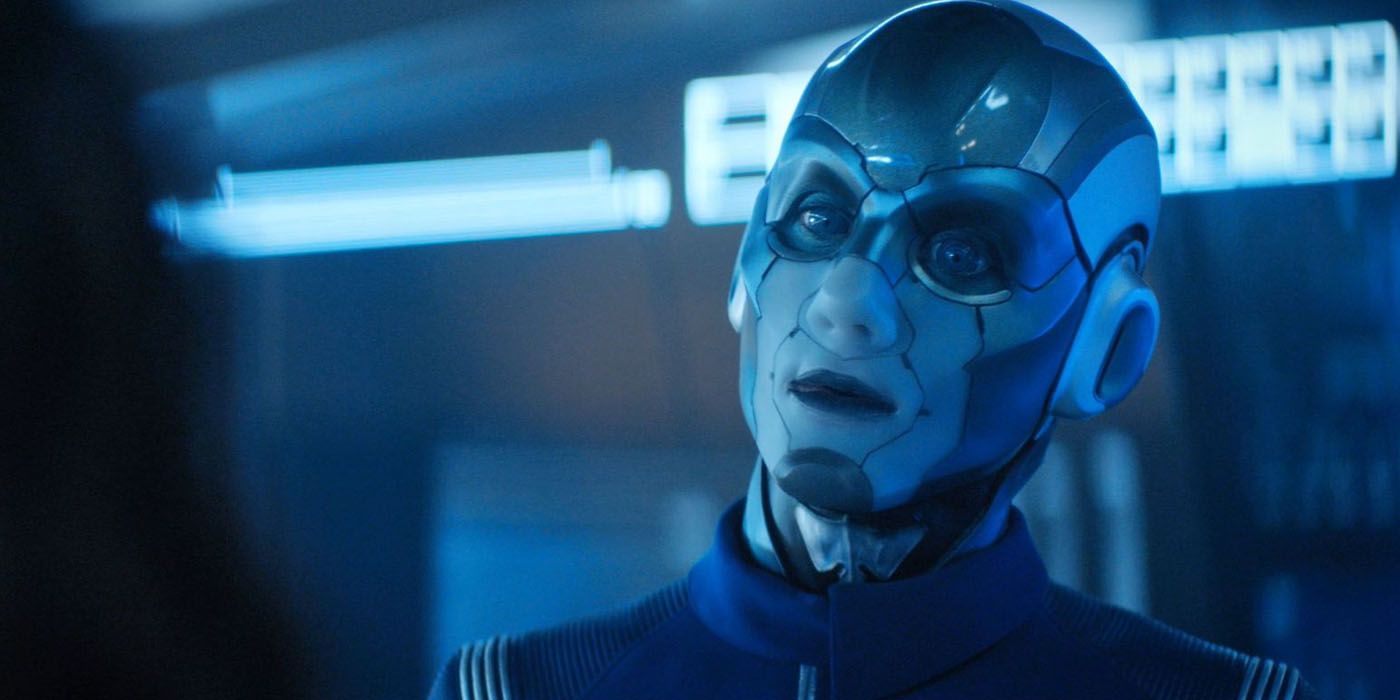
Airiam is a quiet and steady member on Discovery’s bridge. Unfortunately, for most of the first season and half, we don’t get to know much about her. She’s dutiful, she’s smart, she’s dependable. She has friends on the ship, and she’s even third in command. She also has a tragic backstory.
When returning from eloping, Airiam was in a tragic shuttle accident that damaged most of her body and killed her husband. To stay alive, she had to be cybernetically augmented, with most of her body needing to be artificial. Now, Airiam’s brain can’t store memories properly, and when her artificial storage reaches capacity, she has to choose which memories to delete and which ones to keep.
None of this stopped her, however. She still pursued her Starfleet career, she still spars and trains with shipmates, she still rocks at board game night.
Airiam lives on her own terms, and (spoilers) heroically, she dies on her own terms as well, sacrificing herself after becoming infected by a malicious AI.
We see a lot of on-screen deaths in Discovery, but we rarely see any post-death ceremonies. However, we do get to see Airiam’s funeral, and during that time, her crewmates share what she meant to them, speaking of her impact, her resilience, her loyalty, and her outlook on life.
However, it was what Airiam’s friend and Discovery’s pilot Keyla Detmer said that puts my own sentiments into words: “[Airiam] showed me that my augmentation didn’t make me an imitation of myself. It made both of us new, that there could be a future.” You see, Keyla had been injured in the Klingon War, losing an eye and having her own augmentation.
Her words cut right to my core as I questioned if starting medication would alter my identity.
The analogy isn’t perfect; they never are. But what is perfect is the way this character gave me permission to need my own augmentation, the way she assured me I’d still be me, even while on medication.
My SSRIs aren’t permanent like Airiam’s augmentations. I can change my dose, stop taking them, choose something else with my doctor’s advice and supervision. But even if they do need to be a tool in my toolbox for the rest of my life, that doesn’t mean that I’m less myself. That doesn’t mean I’ve failed or I’ve forsaken all or part of who I am. On the contrary, I’m more myself than I’ve been in a very long time.
Would I have made it here without Airiam?
The optimist in me likes to think so. But I owe the Star Trek: Discovery writers and creators and the two actresses that played Airiam (Sara Mitich and Hannah Cheesman) so much for making this journey easier for me. For helping me embrace what proper medication could do for my brain, my body, my life. For showing me that an augmented me is still entirely me. For giving me permission to, once again, live life on my own terms.

Jordan Hirsch’s poetry chapbook, Both Worlds, is available from Bottlecap Press (https://bottlecap.press/products/both).
Jordan Hirsch writes speculative fiction and poetry while occupying the ancestral and current homelands of the Dakota people, Mni Sota Makoce. She is a recent graduate of Concordia University’s MFA in Creative Writing program and is a member of the Science Fiction and Fantasy Poetry Association. You can find more of Jordan’s work on her website (jordanrhirsch.wordpress.com).


