The Future Fire are celebrating with a bumper volume for this, our
fiftieth issue—three times the word-length of our usual issues—full of novelettes and long poems. I am interviewing our General Editor, Djibril al-Ayad in recognition of this release.
Bruce Stenning: Djibril, how has the content of
The Future Fire changed over the course of the last fifty issues, and what would you like to see more of in submissions in the future?
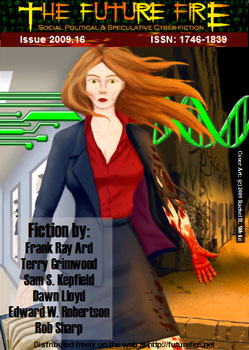 |
| TFF #16 cover © 2009 Rachel H. White |
Djibril al-Ayad: The main thing that changed in the key growth period between the first few issues and, let’s say, issue #10 or #15 when I think we could start to call ourselves a serious fiction venue, was the volume of submissions that come with greater exposure and reputation (or perhaps principally community). This volume allowed us to be highly selective in what we published, not only on quality (which we were already), but on theme, genre, social-political content, inclusiveness and representation. This in turn enabled us to build a reputation for—as we now specify it—social-political and progressive speculative fiction, feminist-, queer-, eco- and multicultural SF, which leads to our seeing more of that in the slush-pile and being able to publish more of it. I would love to see more fiction in some of the rarer intersections of these social-justice areas, and especially #ownvoices writing. Even better, we should be collaborating with editors from these and other marginalizations, so that we don’t become the self-appointed gatekeepers for these minority voices.
On a different note, I would also love to see more stories that use form, medium and genre in creative and mischievous ways: book reviews that turn out to be fabricated, fiction masquerading as non-fiction, ekphrasis, surreal or irreal stories, and other postmodern playfulness. We’ll say more about this later, in fact.
BS: I have always been a fan of stories—in any medium—that play with reality or are deceptive with our perception or pre-conception. Do you have any favourite examples of such stories?
DA: The most obvious way to play with expectations like this is by use of the unreliable narrator, either in the manner of
Rashomon, where the narrative style (first person narration, flashback, etc.) leads the reader to expect truth, but turns out to be from a very relativist perspective or downright dishonest; or I suppose as in
Memento, where the narrator is not only unreliable, but turns out to be actively rewriting reality by lying (to himself). Borges’s œuvre is full of fake book reviews, profiles of non-existent historical villains or mythographic accounts of newly invented folkloric monsters (apparently early in his career he would pass some of these off as non-fiction).
Can you think of any more recent examples, Bruce?
 |
TFF #35 cover © 2015 Laura-Anca
Adascalitei |
BS: I think most examples that I can think of at the moment come from film. I need to watch
Lucia y el sexo again; I seem to remember that messing with my head greatly, though it is fairly dark. Films that play with reality that I do recommend include:
Eternal Sunshine of the Spotless Mind,
Stranger than Fiction, and
Donnie Darko (though I’ve been warned off the director’s cut). Most of Charlie Kaufman’s work I enjoy, and is often a recipe for much head-scratching. Outside film, I can’t help thinking of the way characters in Robert Rankin’s comedy novels interject and play with reality. The literary equivalent of breaking the fourth wall is always fun, but—damn my memory—I’m finding it difficult to remember good examples beyond Rankin, and Tom Robbins’
Even Cowgirls Get The Blues. So I shall now misdirect and bring us jarringly back to the real world (
or is it?)
BS: The world seems to be caught in an increasingly alarming slipknot, with climate change, global inequality, nuclear threat, misinformation, disinformation, and mal-information, the emboldening of the far right, and precarious global market. Do you see Speculative Fiction playing a role in bringing awareness of these issues to people, or would you say that only people who are aware of these issues are likely to seek out or encounter Speculative Fiction?
DA: I don’t know that I’d say the group of people who read SF overlaps particularly with the group who are aware of what a mess things are and believe that we can do anything about it—or should. I’m not sure speculative fiction as a substitute for news or campaigning is particularly efficient either—but I do believe that it is important to recognise the political impact of SF, as all literature and indeed all art. We may not be able to convince anyone of anything, but there’s a lot to be said for helping those who do care to know they’re not alone; those who fear there’s nothing to be done to see even the possibility of resistance; to hold back the darkness for just a few moments with some hopeful imagination. Ursula Le Guin once pointed out the value in preaching to the choir (that it keeps the choir from giving up singing), and I think that’s a really nice metaphor. So I might argue that at this point in time there’s not a lot of point in inventing new dystopias, because you’ll have a tough time surpassing the worst of reality, but fiction with a glimmer of hope, just that fellowship of rebels, that community of survivors, that possibility of love—we all need a bit of that. (Although of course, sometimes the best place to show that little glimmer of hope, narratively, is in a dystopian setting, too…)
 |
| TFF #26 cover © 2013 Eric Asaris |
BS: So would you like to see gently optimistic stories more closely grounded in the real-world, or is it important that speculative stories provide some distance from the world we are familiar with?
DA: Oh, I totally think there’s room for both, and everything in between. I’m usually not a fan of hardcore dystopia, but a particularly beautifully written one could surely win me over. And I enjoy the deeply optimistic utopian or solarpunk or decolonised stories very much as well—Laurie J. Marks’s
Elemental Logic series of stories are a great example of how a world that is magical, beautiful, queer, progressive and utopian in so many ways, can still contain gripping conflict, drama, evil, and suffering. There are also stories set in alien worlds with nothing we would recognise, although they are of course still to some extent stories about ourselves, our concerns, our cultural and political needs.
BS: And for stories that do draw heavily on the real-world, how important do you feel it is that the author is an expert in—or at least versed in—the fields that real-world stories are grounded in?
DA: For fiction, including speculative fiction, it’s important not to legislate away imagination and creativity. So if you want to write a story in a distant galaxy with slightly different laws of physics, but you’re not a theoretical physicist who could write such laws to be credible or at least consistently unbelievable—go the fuck ahead anyway! That said, if you write a “hard social science fiction” story in which your lack of qualification in the social sciences causes you to misunderstand or misrepresent human culture and society to the detriment of the story, then expect to be criticised for it. (Should you consult an expert or do some serious reading in sociology before you publish it? That’s entirely up to you, but the point is just because you’re emphatically allowed to write anything you like, doesn’t mean you should.) The same holds even more true for writing about cultures, languages, religions, heritage traditions that are not you own. Yes we should all write the diversity that we find in the world, but if you fuck up someone else’s culture, not only should you expect to be criticised for it, but you should be aware that if you are white, abled, cishet or Anglo-American etc., you are probably taking up space in the genre thanks to layers of privilege, that someone who could write the setting better could otherwise use. If you’re doing that (and I’m not going to tell you you can’t) then at the very least it behoves you to do the best, most informed, most respectful job of it you can.
BS: If you had to pick the place on Earth where you thought utopia would be most likely to spring from in the next century, where would it be?
 |
TFF #45 cover © 2018 Saleha
Chowdhury |
DA: I can’t see it anywhere, honestly. There have been a few societies popped up over the years that could have been, if not utopian, at least interesting political advances, if only they were left alone to give it a try. But of course they won’t be left alone. I’m thinking of radically egalitarian and secular breakaway states, socio-economic experiments, altermondialist approaches and the like, that we’ve seen crushed by coups d’état, trade sanctions, or literal tanks and bombs. But isn’t that what happened to the original “Utopia”?
BS: There does seem to be a strong “inner space” precondition on social reform, in that socially destabilising impulses appear to come largely from self-interest and short-term thinking. There are counter-examples of peoples behaving in sustainable and equity-oriented manners. So do you see this as a “tipping point” scenario where we just need to add enough weight to the scales in order to see a positive feedback effect?
DA: I feel like it would probably take much more than that, but I do agree that every small act of selflessness and social progress is absolutely essential on the road to making the world a sustainable, liveable, and just place.
BS: To change the topic—role-playing games, while collaboratively creative, often fall into the trap of tropes and stereotypes, it being useful to have some common lexicon of ideas to draw consensus or mechanics from. Are there notable exceptions? What should RPGs be taking from SF to alleviate this?
DA: I don’t think this problem is particular to role-playing games, so much as it is to games with rule systems and settings written by people who don’t really have the imagination to go past settings established by Tolkien (or Lovecraft, or Roddenberry, or Gibson). The most egregious culprit in the RPG world may be Dungeons and Dragons, of course, which is a notoriously eugenicist world-system, with racial and gendered traits baked into the rules. At the same time, by virtue of being the largest and one of the oldest systems, with so much scope for inventing new worlds, D&D may be one of the easiest systems in which to subvert these fucked up rules and run a setting in which radical and progressive beliefs about (lack of) genetic and chromosomal determination apply instead. (It’s also particularly fun to play Cthulhu-based games that you
know Lovecraft would have hated because of his xenophobia and related bigotries.) And as for learning from Speculative Fiction or any genre of more traditional literature, I’m afraid SF is just as guilty of pumping out reams of retrogressive and conservative crap as the gaming world is. There are many people breaking those rules and subverting those norms, but they have to go out of their way and do so on purpose. I know I haven’t really answered your question about narrative creativity, but I’m much more interested in the politics of a setting than the details of how you choose to tell a story. (Another time, we might talk about the crossover between the two—where interactive fiction becomes a storytelling medium, and is basically impossible to distinguish clearly from gaming.)
BS: Who would you most like to meet, living or dead, for a drink tonight?
DA: I think I would have loved to go for a pint with Vonda N. MacIntyre, who I have chatted with a few times on Twitter, but never had the privilege of meeting in person. I would enjoy chatting with her about social-political and progressive science fiction, on which she had possibly the best perspective I have come across. Maybe after a couple pints I would also have talked to her some more about my favourite character in her
Starfarer novels, the sci-fi novelist J.D. Sauvage, and how her particular brand of really alien aliens would transplant to our own literary setting (that is to say in a world in which we’ve not met any aliens and are nowhere near interstellar capability), and what an anthology edited by J.D. might look like today…
BS: If you were told that there was an impending disaster and to preserve yourself you were to be “injected” into a Vonda N. MacIntyre story of your choice, as your current persona, which would you choose, and why?
DA: While the setting of
Dreamsnake is an amazing post apocalyptic world with a mix of horror and wonderfully progressive culture, I honestly don’t think I’d survive five minutes there, so the (no less dystopian in some ways) world of
Starfarers would have to be my choice—because at the moment I wouldn’t hesitate very long before boarding a self-sustaining intergalactic vessel and going out there to meet some aliens who, while not perfect, might help to put some of our problems into perspective.
BS: What would be the next themed issue or anthology topic that you would want to pick for TFF?
 |
| TFF #50 cover © 2019 Pear Nuallak |
DA: You’ve got the idea of J.D. Sauvage’s mind-blowing really alien sci-fi anthology in my head now! I’m really now sure how we’d phrase the call for submissions (because surely everyone hopes their sci-fi is really mind-blowing), but I think it would include the idea that not only science, language and philosophy would be very different from humanity’s, but also culture, religion, sex and sexuality (if they exist), morals and mores, and the whole gamut of social-political expectations. That would be pretty cool. But this isn’t a real next anthology plan, just a dream…
In the real world, our
next themed issue is going to be on the topic of fiction masquerading as non-fiction (or vice versa), both of which we’ve experimented with in the past. Book reviews of titles that turn out to have been invented by the reviewer as a different way to tell the story… profiles of historical science fiction luminaries who never lived (but should have!)… travel reports for fabricated cities or lands. We’ve always wanted to hear you making up stories, but this time we want you to
lie to us!
BS: Yes, I’m also excited by the possibilities that this theme might inspire! Thank you very much for your thoughts.
As mentioned, our Jubilee issue can be found online
here.
 Some stories carry great wisdom in their simplicity, and it can take a lifetime to realize the strength of their gentleness. I've returned to My Neighbor Totoro at many phases of life, each time with a deeper sense of comfort and astonishment. It's not just that the story illustrates that one need not have antagonists to develop emotional weight: that realization comes with early viewings. Later, though, one watches the film and notices everything not included in this postwar Japan snapshot of a childhood impacted by a sick mother and soothed by animist wonder. One considers what the director lived through, and the antagonism he saw shape and shatter lives, before choosing to lean into the inner life of deeply feeling human beings. One remembers, too, the Cold War world into which this film was released in 1988, and the fact that Studio Ghibli launched another film the very same day, about a boy and his little sister dying in war-torn Japan. The world is often a difficult place in which to retain a sense of wonder, and hope. But still, even in difficult times, we manage to create oases of uplift in our art. My Neighbor Totoro reminds us that we contain multitudes--and that the gentle and kind in them are very much worth protecting.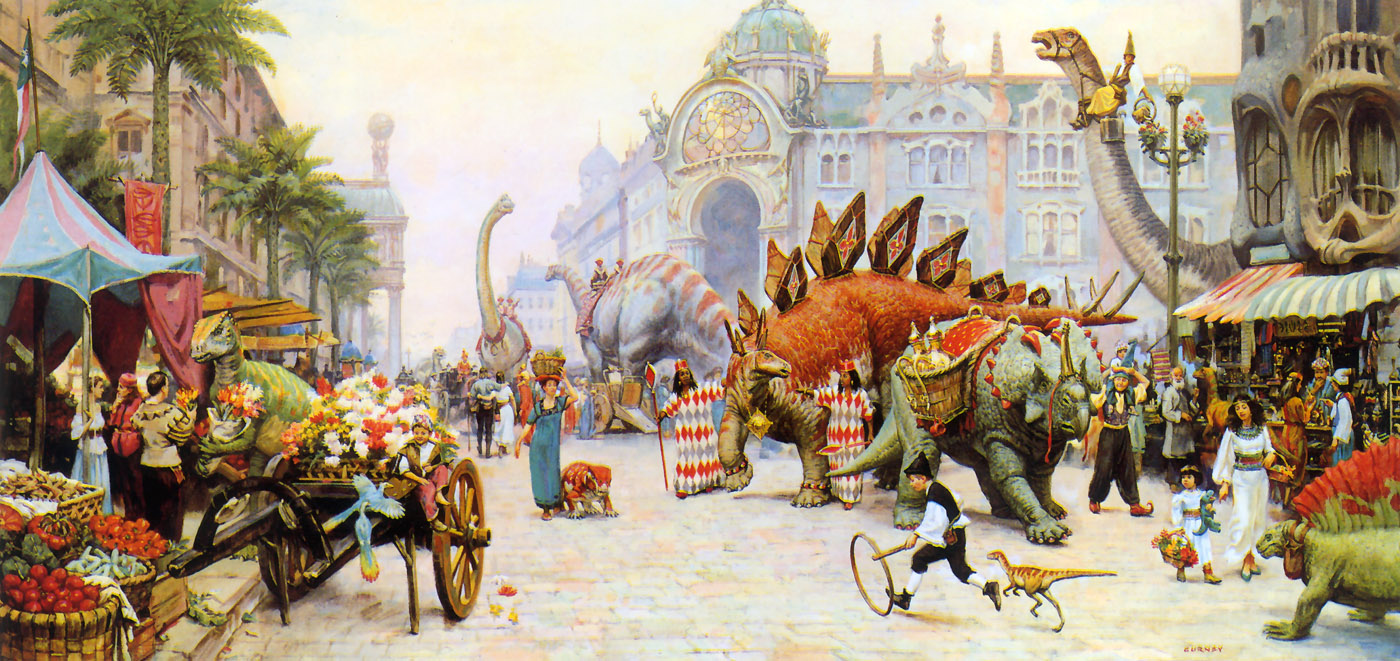
 Toby MacNutt
 I’ve long felt that a utopian setting need not be perfect in every way, lacking in conflict and adventure—any more than a dystopia is a completely unlivable hellscape with no redeeming features—it only need show by example one or a few ways in which our own world could be better with a bit less cruelty, greed, bigotry or self-destruction. Just so is Vonda N. McIntyre’s Starfarers tetralogy: famously invented as a hoax response to a boring panel about SF TV shows, then written by popular demand, this glorious space opera show features not a military starship but a literal university campus in space (faculty and staff rather than crew, a principal rather than a captain, decisions made by senate rather than a command structure); multiple queer, polyamorous, accepting relationships; multi-generational or inter-species friendships; posthumanism and eco-engineering; a space artist making fake archaeology; wonderfully alien aliens; and a science fiction writer as alien first-contact specialist. And while the world isn’t perfect (the principal is even more of a politicking bureaucrat than any vice chancellor I’ve worked under), conflict and peril abound, not all of the positive characters—even protagonists—are entirely likeable, they’re wonderful books, full of comforting adventures, and I could happily read a dozen more volumes. And really: why has no one made the TV show yet!

 Djibril al-Ayad: Not gonna lie, my fabulous co-editor is the brains behind this operation (I’m at best the muscle; at worst a sleazy, corrupt freeloader running contraband through his barely-breaking-even dive bar…). When she walked into my office with an offer I couldn't refuse—backed up by a secret investor—I could see the smart move from the start. Takes a better man than me (or at least a soberer one) to say no to a dame like that. And hey: I didn't live to regret it, did I?
![[ Issue 2020.53; Cover art © 2020 Gwen C. Katz ]](http://futurefire.net/images/f53cover.jpg "[ Issue 2020.53; Cover art © 2020 Gwen C. Katz ]")