Thursday, 3 November 2022

Micro-interview with Katharine A. Viola

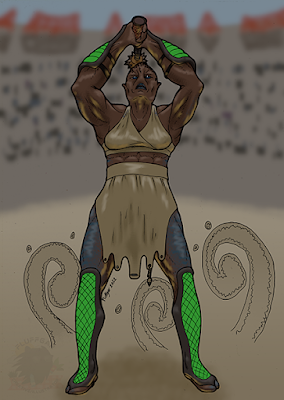
We’re delighted to have Katharine A. Viola, illustrator of “Seams of Iron” in the Future Fire #63, over to answer a few questions.

Illustration © 2022 Katharine A. Viola

TFF: How did you go about illustrating “Seams of Iron”?

Katharine A. Viola: There are many beautifully written descriptions in this story, but what really stood out to me was the magic involving the plants, such as nettle, being spun into a thread. Immediately I had ideas about how I wanted to create this image. Additionally, at the end, the snapping of the feather, was really special and I felt it was necessary to include.

TFF: Who or what is your favourite monster?

KV: I love a monster whose back story wasn't always evil; a creature so sad and desperate they felt they had to resort to evil, even though life always presented a choice. Kind of like Darth Vader… so sad, and often relatable.

TFF: Is there a difference for you between creating artwork to order, and composing purely from your own imagination?

KV: Absolutely! I can't stress that enough. While I love to create for other people; something different happens when you create for yourself; a piece of you goes into the work and it will forever be an extension of who you are.


Reminder: You can comment on any of the stories or illustrations in this issue at http://press.futurefire.net/2022/10/new-issue-202263.html

Monday, 31 October 2022

Micro-interview with Jennifer Hudak

We welcome Jennifer Hudak, author of “Spindle House” in The Future Fire #63, for this tiny interview.


Illustration © 2022 Eric Asaris
TFF: What does “Spindle House” mean to you?

Jennifer Hudak: As women age, we often lose societal power, but that doesn't mean our power is gone; it’s just hidden. In “Spindle House,” I explore what power might look like as we age, and how we might wield that power as a community.

TFF: Who is your favourite kick-ass woman from history?

JH: I have a real soft spot for Susan B. Anthony, who lived in my town. She devoted her life to the Women’s Suffrage movement and, alongside Frederick Douglass, became an abolition activist. While she died before women got the right to vote, it’s a local tradition for women to make a pilgrimage to her grave on voting day, and put their “I voted” sticker on her headstone.

TFF: What are you working on next?

JH: I’m currently revising my first novel. It’s a portal fantasy in which a 45-year old woman, her 13-year old daughter, and her 70-year old mother all travel to a portal universe together.


Extract:
Only the crones can hear Spindle House’s call. They alone recognize the whispering of its windows and the keening of its attic, and the ones who follow the call all the way to the front door are allowed admittance. Once ushered inside, the crones do not impose their will on the House, don’t tear down the sagging porch or reupholster the sitting room chairs. They know enough to leave the cobwebs intact, and the House loves them for it. For the crones are no mere inhabitants, and the House is no object to be owned. They are, all of them, peers. They are confidants. They are a coven.

Reminder: You can comment on any of the stories or illustrations in this issue at http://press.futurefire.net/2022/10/new-issue-202263.html

Thursday, 27 October 2022

How to Break a Curse

How To Break A Curse

Guest post by Tenacity Plys

If you’ve ever tweeted about feeling like a changeling, you’re probably neurodivergent. That was one of the signs for me: that ugly duckling feeling of being so fundamentally different from the other kids in your grade you could be a separate species. Basically, if the popular kids treated you like you weren’t human in middle school, you might have been considered inhuman in the Middle Ages as well—you would have been a changeling.

While changelings were babies disowned by their parents as too strange to be human, that narrative is complicated by the fact that neurodivergence is genetic. While some members of a family might be noticeably different enough to be diagnosed, some people fly under the radar their whole lives. Thinking back on family stories I’ve heard over the years, I realized I’d never know how many people in my family were like me. They didn’t even know it themselves!

With that in mind, when I sat down to write about neurodivergence and the changeling myth, I didn’t just want to write about one changeling. I wanted to write about generations of them. The book that resulted is called Family Curse, but neurodivergence isn’t the curse—curses work better as a metaphor for generational trauma. The neurodivergence of the characters isn’t a metaphor for anything, actually; I just think it’s cool.

Like every story, Family Curse is about what people in the present will do with what they inherit from the past. The autobiographical level of my work is usually an exegesis of some aspect of my personal past that can illuminate my way forward (even if it takes me years to see what my subconscious was trying to tell me when I wrote it, lol). In a larger sense, the past can mean our inheritance from the last generation, our society’s institutions, or something else, depending on who’s telling the story and who’s listening. Curses trouble the passage from past to future.

In curse narratives, the past makes war on the present, dragging characters back in time to repeat cycles of violence. The Oresteia visualizes a curse as a flock of Furies stalking the palace at Mycenae; these bird-women represent lust for revenge, which is the fatal flaw of Atreus, then Agamemnon, then Clytemnestra, then Orestes and Electra. It’s like the House of Atreus has a vendetta against itself, and tellingly, no revenge killing can resolve it. Orestes finally breaks it by… *checks notes* …inventing Athenian democracy? As an ending it sounds weird, but this abrupt left turn is a lesson: turning to justice rather than revenge is what quiets the Furies and their endless clamoring for more blood. In other words, that’s how a curse can be broken.

Since the Atreus curse always appears in the form of one family member killing another because they believe it will give them justice for past wrongs, I would argue that’s literally all their curse is—no bird-women needed. A classics professor in The Secret History speculates that what the ancients called fate is actually another word for what we call psychology; characters in Greek drama have free will despite the fact that their “fatal” flaws make their actions look deterministic. In this way, one act of violence centuries ago can echo down the generations, even when memory of the actual event is lost.

When we don’t even remember the origin of a family curse, how do we make sense of ourselves, let alone find a path to healing? If a missing piece of my familial puzzle came to me at 28, how many more are left to find? I wrote my book as a replacement for the fragments of history I can never get back—not just for my biological family, but the people like me through the centuries whose stories will never be told. If I’m lucky, this (and therapy) will get the Furies to leave me alone.


You can pick up Tenacity Plys’s novella Family Curse - Field Notebooks 1880–2020 as a print chapbook or e-book from Bottlecap Press at https://bottlecap.press/collections/on-sale-now/products/curse.

Monday, 24 October 2022

Micro-interview with Joyce Chng

We invited over Joyce Chng, author of “Treacle Blood” in The Future Fire #63, to answer a few questions.


Illustration © 2022, L.E. Badillo
TFF: What does “Treacle Blood” mean to you?

Joyce Chng: I wrote "Treacle Blood" in year one (or two?) of the pandemic, I think—and writing it brought out all the emotions I'd felt about viruses, performativity, and baring one's soul to an audience who may or may not care. As writers and artists, why do we keep baring our souls (and our metaphorical veins) to audiences who only take and have never given back. In the story, the protagonist/MC keeps on performing even though it saps her physical and mental strength, simply because there is a need. She needs to perform.

TFF: If you had to invite the protagonist of your current work-in-progress to dinner, what would you cook for them?

JC: My current work-in-progress (amongst many) is a YA cosy murder mystery set in the same world of Fire Heart, a YA novel about coming-of-age, swords and swordmaking. The protagonist in this WIP is a young woman apprentice priestess. So, the meal will be simple: home-made rye bread and morani stew (which roughly translates to chicken stew in our world).

TFF: What is your favourite library?

JC: I might sound biased here, but the Singapore National Library (main branch) is my favourite. It's a huge modern building housing more than four levels of books as well as space for performance arts. It has its own cafe as well.


Extract:

“You don’t have to cut open your veins,” the old woman warned me, “just to let them feed on you.”

Reminder: You can comment on any of the stories or illustrations in this issue at http://press.futurefire.net/2022/10/new-issue-202263.html

Thursday, 20 October 2022

Micro-interview with Josep Lledó

Josep Lledó, illustrator of “Bridge” in The Future Fire #63 came by to answer a few short questions:


illustration © 2022 Josep Lledó

TFF: How did you go about illustrating “Bridge”?

Josep Lledó: I have seen many trolls under bridges and I want to give my vision of that subject so I decided that this would be my drawing. I tried to make a different troll since the bridges are usually all the same

TFF: What is the spookiest corner of the city you live in?

JL: My whole city is a terrifying place, it's built on a wet and unhealthy swamp.

TFF: If you could teleport to any place in the world, where would you go right now?

JL: To the bathroom.


Reminder: You can comment on any of the stories or illustrations in this issue at http://press.futurefire.net/2022/10/new-issue-202263.html.

Monday, 17 October 2022

Micro-inteview with Marisca Pichette

Micro-interview with Marisca Pichette, author of the poem “Charybdis” in The Future Fire #63.


Illustration ©2022 Fluffgar
TFF: What does “Charybdis” mean to you?

Marisca Pichette: To me, "charybdis" is a poem about looking back at your past and seeing both growth and loss. It is tinged with nostalgia as much as gratitude, recalling the magic of childhood and using it to enhance the present.


TFF: What is the oldest memory you have?

MP: My oldest memory is of a dream. I woke from sleep and walked down the dark hallway, finding my mother in the kitchen getting ready for work. Seeing her dress, I knew at once I'd worn it-—owned it—in a life before. This is one of two instances when I've felt keenly the memory of a past existence, before I grew old enough for my current life to displace the others.

TFF: If you could "enter" a famous painting or illustration, which one would you choose?

MP: I've always loved the paintings of Lawrence Alma-Tadema. As a child I dreamed of stepping into them, sitting on Grecian benches and looking out across Mediterranean water. My parents' bedroom had a tapestry of "Under the Roof of Blue Ionian Weather." This work sticks with me the most.

TFF: What are you working on next?

MP: What am I not working on? I have new stories and poems coming out all the time, which I announce on my Twitter and through my monthly newsletter, which you can subscribe to through my website. My biggest project right now is a collection of 50 speculative poems, Rivers in Your Skin, Sirens in Your Hair, which is coming out in April 2023 from Android Press. Visit the Android Press bookstore to preorder a copy!


      see her:
dancing at the bottom
—whirlpool kisses—
streams of bubbles
i forgot to taste as i swam
      gasping
in circles.

Reminder: You can comment on any of the stories or illustrations in this issue at http://press.futurefire.net/2022/10/new-issue-202263.html

Wednesday, 5 October 2022

New Issue: 2022.63

“Progressive art can assist people to learn not only about the objective forces at work in the society in which they live, but also about the intensely social character of their interior lives. Ultimately, it can propel people toward social emancipation.”

—Angela Davis

[ Issue 2022.63; Cover art © 2022 L.E. Badillo ]Issue 2022.63

Flash fiction

Short stories

Poetry

Download e-book version: PDF | EPUB | Mobi

Editorial by Djibril al-Ayad

Friday, 12 August 2022

Micro-interview with Sarah Day

We ran a micro-interview with Sarah Day, author of “The Heart of the Party” in The Future Fire #62.


TFF: What does “The Heart of the Party” mean to you?

Illustration © 2022 Miguel Santos

Sarah Day: “The Heart of the Party” is an exploration of the consensuality of inclusion, basically—that we opt in to communities as much as we may perceive ourselves to be validated or included by a community's inclusion of us. Clear self-expression is a key value that contributes to how I practice my various identities, whether that means which ones I choose to express in a given moment, or the ones that are applied to me by social mores or stereotypes. Consciously choosing your community is way more empowering than accepting the defaults assigned to you, and I think that comes through pretty clearly in the text.

TFF: If a device enabled to share thought and emotions with other people, would you connect to it?

SD: No. I feel enough of people's emotions already without additional wetware. I also work in tech—it's impossible for me to imagine new technology without imagining its commercial or society-wide applications. The idea of normalizing shared emotions among the general populace sounds like a bit of a gender and racial nightmare. Even with all my privilege, I still experience the expectations around silent emotional labor applied to most women, and I definitely wouldn't want to give people more of a reason to expect that I would be doing more of that because I could perceive their feelings and thoughts. And like most power structures, the farther you get from being a straight able-bodied cis white man, the worse I imagine this would go: feeling the barista's racism as you queue up for your morning coffee, hearing a passerby's ableist thought as they navigate around your wheelchair. That's a hard no from me.

TFF: What are you working on next?

SD: I just sold my debut novella, Greyhowler, to Mark Teppo of Underland Press!


Extract:

Staring at the Patrollers across the street, I worried at my crippled implant the way I would work my tongue in an empty tooth socket, trying for the millionth time to activate it. No joy. The frizz of feedback in my hand told me they were still communicating, but the hardware was too damaged for me to hear them. I could guess their conversation, though; they were trying to understand why I’d flash an implant scar at them in broad daylight. Use of networking technology by civilians was illegal, and I was clearly a civilian.

Reminder: You can comment on any of the stories or illustrations in this issue at http://press.futurefire.net/2022/07/new-issue-202262.html

Monday, 8 August 2022

Micro-interview with Jordan Hirsch

Micro-interview with Jordan Hirsch, author of the poem “We Don't Always Have to Toss Her in the Deep End” in The Future Fire #62.


Illustration © 2022 Cécile Matthey

TFF: What does “We Don't Always Have to Toss Her in the Deep End” mean to you?

Jordan Hirsch: Society in the US relies heavily on the unpaid labor of women and femme-presenting people—particularly BIPOC. We are run ragged and are not adequately supported but are then praised (but not compensated) for our resilience, reliability, and large capacities. How much more would we thrive if we weren't so bogged and beaten down?

TFF: What lost-at-sea thing would you like to find while snorkeling?

JH: A message in a bottle from someone whose story and history I could learn more about.

TFF: What are you working on next?

JH: My main focus right now is revising my adult fantasy novel, though I also have a horror novella that won't stop pestering me to be written. Hopefully you'll get to read both someday soon!


Extract:

What if when she drowns
she grows gills
sprouting out of her hands
because keeping them busy
has always been
what’s allowed her
to breathe?

Reminder: You can comment on any of the stories or illustrations in this issue at http://press.futurefire.net/2022/07/new-issue-202262.html

Friday, 5 August 2022

Micro-interview with Nicole Lungerhausen

We had a chat with Nicole Lungerhausen, author of “Song of Your Life” in The Future Fire #62, who was kind enough to answer a few questions.


Illustration © 2022 Fluffgar

TFF: What does “Song of Your Life” mean to you?

Nicole Lungerhausen: I admire people who are unafraid to speak up and let their voices be heard, especially when it comes to speaking truth to power. There are more ways to speak up and be seen and heard right now than at any other time in history, yet in America so many of us are lonely, isolated and disconnected. As important as it is to speak up, listening—to others and to ourselves—is a revolutionary act of generosity and defiance that more of us need to practice right now.

TFF: Who is your favourite mythological heroine?

NL: I love rusalkas. They are my favorite of the vengeful female tropes in mythology, although, as with most things, whether they are heroines or villains is all in the eye of the beholder. In some Slavic traditions, rusalkas are protectors of pregnant women and children, while in others they are shape-shifting sirens luring young men to their death. Should I meet a rusalka someday, I'm not sure if I would ask her for help or run and hide and I love that!

TFF: What are you working on next?

NL: I'm working on a sci-fi short story that involves time travel, epigenetics, and mental health. And it's a comedy… just kidding! I'm aiming for a hopeful story, though, which I think is an even more difficult needle to thread than writing a comedic story.


Extract:
You make two attempts to sing the song of your life as the keepers herd you and the other recruits from the holding cell to the arena. Unfortunately, neither attempt results in your death.

Reminder: You can comment on any of the stories or illustrations in this issue at http://press.futurefire.net/2022/07/new-issue-202262.html

Wednesday, 3 August 2022

Mini-interview with Nicole J. LeBoeuf

We have a mini-interview with Nicole J. LeBoeuf, author of the poem “Reasonable Accommodations” in The Future Fire #62.


Illustration © 2022 Cécile Matthey
TFF: What does “Reasonable Accommodations” mean to you?

Nicole J. LeBoeuf: “What would a were-deer have to do to hold down a corporate job?” began as a light-hearted poetry prompt, but workplace accommodations are in no way a light-hearted subject. It's infuriating that so many of us have to contort ourselves to some arbitrary standard of professionalism, a standard that excludes disabilities and pregnancy and breast-feeding and non-white bodies and trans bodies and queer bodies and gender-nonconforming bodies—there are so many “wrong” ways to have a body! And those who deviate from that strict norm can only expect accommodations from their employer after jumping through an enormous set of hoops to adapt ourselves to a workplace that is hostile to their very existence. And then you're supposed to be so grateful for what scraps of consideration get tossed your way, and if your needs are still unmet, well, that's not your employer's responsibility, is it? So many people have it worse than you, and it's not like we're asking you to do anything your co-workers aren't, so suck it up, stop rocking the boat, stop complaining, stop acting like your situation is unique. That the "disability" being half-heartedly accommodated in the poem is unique speaks to how isolating the experience can be, how we're discouraged from making common cause with each other.

What is the most “punk” thing you've ever done or made?

NJL: Oh, that's easy. In 2012 I joined a roller derby league, and, ten years plus a pandemic later, I'm still at it. Flying around the rink on quad skates and slamming my body into my opponents is about as punk as anything in my life gets. For a female-presenting person in a misogynist world, it's revolutionary to be an athlete, to insist on valuing my body for what I can do with it rather than what it looks like. To wear a tank top and shorts without feeling obligated to shave, for goodness's sake! It's revolutionary to be part of a gender-inclusive sport, to share the track with other women, cis and trans, with non-binary individuals, with people of all identities and backgrounds and body types who just want to get together and play this absurd and bad-ass sport we've all come to love.

What are you working on next?

NJL: Mainly I've been scrambling to get my Patreon project, "Friday Fictionettes," caught up to its intended schedule. Otherwise, I'm working on--well, a lot of things, each of them at a different progress point and all of them giving me trouble. I bounce back and forth between them, which I'm told you're not supposed to do, but it's the only way I function. I've got to have somewhere to go when I get stuck. If the mermaid story is refusing to budge, I can jump to the superhero-who-sees-ghosts story, or the oak dryad poem, or the sentient architecture story cycle, see whether one of those other worlds has come together a little more while it was on the back-burner. I'm a big believer in back-burner time for recalcitrant stories.


Extract:

Long before it rises in the evening,
the moon’s already full, has been for hours.


Reminder: You can comment on any of the stories or illustrations in this issue at http://press.futurefire.net/2022/07/new-issue-202262.html

Monday, 1 August 2022

Micro-interview with Sarah Salcedo

Interview with Sarah Salcedo, illustrator of “We Were Ghostless before Her” in TFF #62.

Illustration © 2022 Sarah Salcedo

TFF: How did you go about illustrating “We Were Ghostless before Her”?

Sarah Salcedo: I've been trying to develop a style when it comes to my The Future Fire pieces lately. I don't know how far it will extend, but the stories you've sent me have all felt resonant with each other. I want my drawings to compliment the work without pulling away or spoiling anything. I love beautiful genre art, but the really descriptive ones for me always take away a little bit of my enjoyment of the story. I don't want to be distracted wondering how the art correlates to the story, but I love suggestive art when it accompanies a story. Where it gives you little in terms of a spoiler, but makes sense after it's been read. Ioanna's piece, to be careful not to spoil it for anyone who still needs to read it, inspired me with this image.

TFF: What is the spookiest corner of the city you live in?

SS: I live out in the woods, and I don't know that I find much spooky these days. Whenever I feel that haunted feeling, it usually feels more sad or curious than anything.

TFF: To which famous wedding (in any period of history) would have you liked to be invited?

SS: Hmmm… I'd love to get to Anne Boleyn before Henry the VIII and tell her that I'll make a distraction while she escapes on some horses I've hidden out back…

TFF: Tell us about an artist whose work you're particularly enjoying at the moment?

SS: I am constantly returning to the work of Anselm Keifer. I was just working on a story inspired by his Brunhilde Sleeps that floors me to this day.

TFF: What else are you working on now?

SS: I am finishing up a short story collection, as well as a fantasy novel, and a rewrite of a literary novel I wrote about an autistic family of women in a small town. I am trying to finish these projects before the fall when I have to dive back into my documentary film projects.


Reminder: You can comment on any of the stories or illustrations in this issue at http://press.futurefire.net/2022/07/new-issue-202262.html